 * * *
Family Photos/Stories of Veterans: Lives During Wartime
History of Veterans Day: Why Do We Honor Our Veterans on the 11th of November?
World War I – known at the time as “The Great War” – officially ended when the Treaty of Versailles was signed on June 28, 1919, in the Palace of Versailles outside the town of Versailles, France. However, fighting ceased seven months earlier when an armistice, or temporary cessation of hostilities, between the Allied nations and Germany went into effect on the eleventh hour of the eleventh day of the eleventh month. For that reason, November 11, 1918, is generally regarded as the end of “the war to end all wars.”
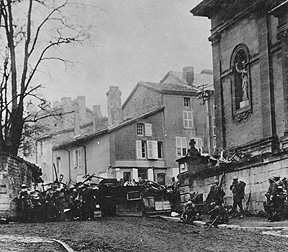
Soldiers of the 353rd Infantry near a church at Stenay, Meuse in France, wait for the end of hostilities. This photo was taken at 10:58 a.m., on November 11, 1918, two minutes before the armistice ending World War I went into effect
The last man killed in the Great War— American Private Henry Gunter:
… Americans took heavy casualties on the last day of the war. This was because their commander, General John Pershing, believed that the Germans had to be severely defeated at a military level to effectively ‘teach them a lesson’. Pershing saw the terms of the Armistice as being soft on the Germans. Therefore, he supported those commanders who wanted to be pro-active in attacking German positions – even though he knew that an Armistice had been signed. In particular, the Americans suffered heavy casualties attempting to cross the River Meuse on the night of the 10th/11th with the US Marines taking over 1,100 casualties alone. However, if they had waited until 11.00, they could have crossed the river unhindered and with no casualties. The 89th US Division was ordered to attack and take the town of Stenay on the morning of November 11th. Stenay was the last town captured on the Western Front but at a cost of 300 casualties.
The CWGC records that the last British soldier killed in World War One was Private George Edwin Ellison of the 5thRoyal Irish Lancers. He was killed at Mons (where he had also fought in 1914) at 09.30, just 90 minutes before the ceasefire.
The last French soldier to die was Augustin Trebuchon from the 415th Infantry Regiment. He was a runner and was in the process of taking a message to his colleagues at the front informing them of the ceasefire. He was hit by a single shot and killed at 10.50. In total, 75 French soldiers were killed on November 11th but their graves state November 10th. Two theories have been forwarded for this discrepancy. The first is that by stating that they died on November 10th before the war had ended, there could be no question about their family’s entitlement to a war pension. The other theory, is that the French government wanted to avoid any form of embarrassment or political scandal should it ever become known that so many died on the last day of the war.
The last Canadian to die was Private George Lawrence Price of the Canadian Infantry (2nd Canadian Division) who was killed at Mons at 10.58. Officially, Price was the last Commonwealth soldier to be killed in World War One.
The last American soldier killed was Private Henry Gunter who was killed at 10.59. Officially, Gunter was the last man to die in World War One. His unit had been ordered to advance and take a German machine gun post. It is said that even the Germans – who knew that they were literally minutes away from a ceasefire – tried to stop the Americans attacking. But when it became obvious that this had failed, they fired on their attackers and Gunter was killed. His divisional record stated:
“Almost as he fell, the gunfire died away and an appalling silence prevailed.”
In November 1919, President Wilson proclaimed November 11 as the first commemoration of Armistice Day with the following words: “To us in America, the reflections of Armistice Day will be filled with solemn pride in the heroism of those who died in the country’s service and with gratitude for the victory, both because of the thing from which it has freed us and because of the opportunity it has given America to show her sympathy with peace and justice in the councils of the nations…”
The original concept for the celebration was for a day observed with parades and public meetings and a brief suspension of business beginning at 11:00 a.m.
The United States Congress officially recognized the end of World War I when it passed a concurrent resolution on June 4, 1926, with these words:
Whereas the 11th of November 1918, marked the cessation of the most destructive, sanguinary, and far reaching war in human annals and the resumption by the people of the United States of peaceful relations with other nations, which we hope may never again be severed, and
Whereas it is fitting that the recurring anniversary of this date should be commemorated with thanksgiving and prayer and exercises designed to perpetuate peace through good will and mutual understanding between nations; and
Whereas the legislatures of twenty-seven of our States have already declared November 11 to be a legal holiday: Therefore be it Resolved by the Senate (the House of Representatives concurring), that the President of the United States is requested to issue a proclamation calling upon the officials to display the flag of the United States on all Government buildings on November 11 and inviting the people of the United States to observe the day in schools and churches, or other suitable places, with appropriate ceremonies of friendly relations with all other peoples.
An Act (52 Stat. 351; 5 U. S. Code, Sec. 87a) approved May 13, 1938, made the 11th of November in each year a legal holiday—a day to be dedicated to the cause of world peace and to be thereafter celebrated and known as “Armistice Day.” Armistice Day was primarily a day set aside to honor veterans of World War I, but in 1954, after World War II had required the greatest mobilization of soldiers, sailors, Marines and airmen in the Nation’s history; after American forces had fought aggression in Korea, the 83rd Congress, at the urging of the veterans service organizations, amended the Act of 1938 by striking out the word “Armistice” and inserting in its place the word “Veterans.” With the approval of this legislation (Public Law 380) on June 1, 1954, November 11th became a day to honor American veterans of all wars.