
Chess Club Teacher Mr. Dustin gave a demonstration last month (with the help of some Larry Evans Chess Club alumni) and OTA students were captivated. 78 Students signed the Chess Club interest list!

Why Study Chess? Patience, Planning, Problem-Solving, Puzzling, Perseverance… Chess teaches self-control & humility, grace under pressure, & it makes children smarter.*
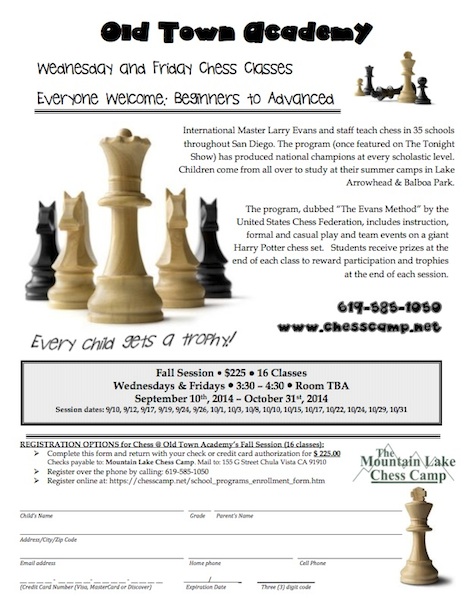
Larry Evans Chess Camp is taught by master instructors, using very effective tools and motivation techniques. OTA students loved it during our first year but schedule changes brought it down to once a week last year. Once a week isn’t enough to learn anything! So, we’re bringing it back to two days a week.
- Students may sign up throughout the quarter–contact the Chess Camp for pro-rated discount. Sign-up Online Now! (Choose Old Town from the dropdown menu: Chess Club will be offered Wednesday and Friday after school.)
- Get Inspired, watch the film Brooklyn Castle about America’s best chess team!
*
STUDIES (see more studies at Quad City Chess Club)
- In a 1973-74 Zaire study conducted by Dr. Albert Frank, employing 92 students, age 16-18, the chess-playing experimental group showed a significant advancement in spatial, numerical and administrative-directional abilities, along with verbal aptitudes, compared to the control group. The improvements held true regardless of the final chess skill level attained. [1], [2], [7]
- In a 1974-1976 Belgium study, a chess-playing experimental group of fifth graders experienced a statistically significant gain in cognitive development over a control group, using Piaget’s tests for cognitive development. Perhaps more noteworthy, they also did significantly better in their regular school testing, as well as in standardized testing administered by an outside agency which did not know the identity of the two groups. Quoting Dr. Adriaan de Groot: …“In addition, the Belgium study appears to demonstrate that the treatment of the elementary, clear-cut and playful subject matter can have a positive effect on motivation and school achievement generally…” [1], [3], [7]
- In a 1977-1979 study at the Chinese University in Hong Kong by Dr. Yee Wang Fung, chess players showed a 15% improvement in math and science test scores. [4]
- A four-year study (1979-1983) in Pennsylvania found that the chess-playing experimental group consistently outperformed the control groups engaged in other thinking development programs, using measurements from the Watson-Glaser Critical Thinking Appraisal and the Torrance Tests of Creative Thinking. [1], [4], [5], [6],[7], [23]
- The 1979-1983 Venezuela “Learning to Think Project,” which trained 100,000 teachers to teach thinking skills and involved a sample of 4,266 second grade students, reached a general conclusion that chess, methodologically taught, is an incentive system sufficient to accelerate the increase of IQ in elementary age children of both sexes at all socio-economic levels. [1], [7], [8], [9], [10]
- During his governor’s teacher grant from the New Jersey State Department of Education, William Levy found that