California Standards Test Scores Arrive This Week • OTA “School Quality Snapshot”

Dear OTA Families:
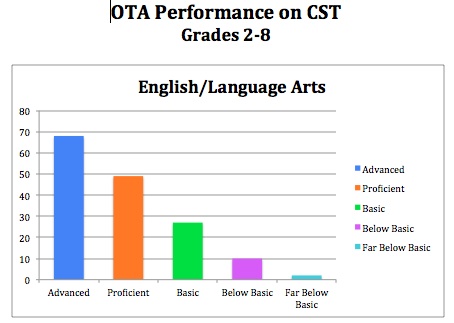
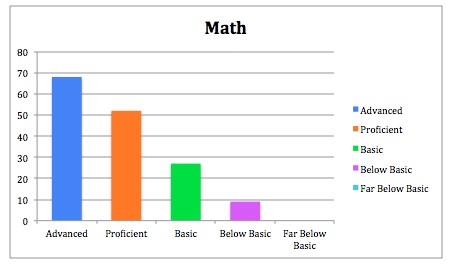
The California Standards Test (CST) results are out and your child’s scores should be arriving by mail this week. Since OTA does not have two years of test results we do not have growth data from the State tests; but we do have the breakdown on how many of last year’s students scored Advanced, Proficient, Basic, Below Basic, or Far Below Basic in Math & English/Language Arts.
=====
I’ve included two graphs below summarizing our scores in Math & English/Language Arts. In a separate post we’ll share the Results of our 2011-2012 Student Survey, which we take as seriously as the CST scores (Download a Parent Guide to the CST).
  • CA Standards Test Results in English/Language Arts (85% of OTA students scored Advance or Proficient in English/Language Arts: 121/142 )
  • CA Standards Test Results in Math (84% of OTA students scored Advanced or Proficient in Math: 119/142)
“School Quality Snapshot”: You can download the California Dept of Education’s  report card on our first year of operation here: OTA Accountability Report Card. Our first year API (Academic Performance Index) Score is 884.

These school-wide scores for our first year of operation are very good and the question arises, can OTA take any credit for these results? Yes, OTA teachers deserve credit for the high percentages of students who scored advanced or proficient in Math and English/Language Arts.

  • We tested our students in the latest possible testing window; so students had almost an entire year within our classrooms and labs before they sat down to take the exam.
  • If we had serious flaws in our academic programs or classroom instruction the test results would have revealed them.
  • We started the year with 191 students and ended the year with 217. Most of our students spent the majority of the school year at OTA.
But the real measure of a good academic quality assurance system is whether it can answer these two questions: Continue reading →

Big Study Links Good Teachers to Lasting Gain – NYTimes

“Everybody believes that teacher quality is very, very important,” says Eric A. Hanushek, a senior fellow at the Hoover Institution at Stanford and longtime researcher of education policy. “What this paper and other work has shown is that it’s probably more important than people think. That the variations or differences between really good and really bad teachers have lifelong impacts on children.”

The average effect of one teacher on a single student is modest. All else equal, a student with one excellent teacher for one year between fourth and eighth grade would gain $4,600 in lifetime income, compared to a student of similar demographics who has an average teacher. The student with the excellent teacher would also be 0.5 percent more likely to attend college.

Perhaps just as important, given the difficulty of finding, training and retaining outstanding teachers, is that the difference in long-term outcome between students who have average teachers and those with poor-performing ones is as significant as the difference between those who have excellent teachers and those with average ones, the study found.
In the aggregate, these differences are potentially enormous. Replacing a poor teacher with an average one would raise a single classroom’s lifetime earnings by about $266,000, the economists estimate. Multiply that by a career’s worth of classrooms…

Big Study Links Good Teachers to Lasting Gain – NYTimes.com.

=======

The Power of the Playground

The OTA Playground is Ready!

“Ask a young child, ‘How was school today?’ and you’re likely to hear about recess. My son is 7 years old, and like many children his age, recess is the emotional core of his school day. Whether he comes home light- or heavy-hearted depends on what happened during play time. This is common. Researchers say that one of the best predictors of whether kids feel happy in school is whether they feel comfortable and competent during recess.

Continue reading →

“How to Stop the Drop in Verbal Scores,” by E.D. Hirsch, Jr. -NY Times

The latest bad news from our nation’s schools is that the verbal scores of our top students have once again declined… Nearly nothing in our otherwise laudable and energetic education reform efforts takes direct aim at the Great Verbal Decline that took place among 17-year-olds from (roughly) 1970 to 1980.

[The way to avoid perpetuating this decline] is to make sure that every student is offered coherent knowledge about the world around them from the first days of school. This is no mere theoretical notion:

Continue reading →

Escondido charter school ranked best in state

Heritage K-8 Charter School in Escondido has been named the state’s top charter by the University of Southern California.

The annual “USC School Performance Dashboard” released Wednesday by the Center on Education Governance at the USC Rossier School of Education for the first time offers a list of California’s top 10 charters. The ranking is based on data from more than 800 of the state’s publicly financed and independently operated charters in the 2009-10 school year.

The schools were chosen based on academic ratings — including state test scores — and financial indicators, including the amount of revenue dedicated to student programs. The report was designed to strengthen accountability among California charter schools.

The study’s top 10 charters are:

Continue reading →

Fulfilling the Charter School Promise

Something unprecedented is happening with charter schools in San Diego and across California. This year, San Diego County saw a 14 percent increase in the number of charter schools operating, jumping from 81 to 92. Throughout California, 115 new charters opened – the largest number to ever open in a single year in any state in the nation. This brings California to 912 charter schools serving 365,000 students. Even though the state’s funding crisis is disproportionately affecting charter schools, the pipeline for expansion is more robust than it has ever been.

What is causing this growth?
Plain and simple, it is coming in response to demand from parents. Parents are seeing the successes that charter schools are generating. In addition to offering highly innovative programs that cater to individual student needs, charter schools are becoming known for generating high levels of learning.
via Fulfilling the charter school promise – SignOnSanDiego.com.

A Better Way to Teach Math – No Step too Small to Ignore

Teachers tell me that when they begin using Jump they are surprised to discover that what they were teaching as one step may contain as many as seven micro steps. Breaking things down this finely allows a teacher to identify the specific point at which a student may need help. “No step is too small to ignore,” Mighton says. “Math is like a ladder. If you miss a step, sometimes you can’t go on. And then you start losing your confidence and then the hierarchies develop. It’s all interconnected.”

Mighton saw that if he approached teaching this way, he could virtually guarantee that every student would experience success.

Continue reading →

Test-Taking Cements Knowledge Better Than Studying, Researchers Say

Taking a test is not just a passive mechanism for assessing how much people know, according to new research. It actually helps people learn, and it works better than a number of other studying techniques.

via Test-Taking Cements Knowledge Better Than Studying –NYTimes.com.

Testing kids is an effective way to help lock in skills and we do it all the time in our Core Learning Lab (with programs like IXL Math); but students also need to learn to make their own tests (an open-notes reading exam where they can use their own Concept Maps is a great way to teach that skill). After they leave school nobody is going to hand them a test as they try to master new knowledge or skills.

The research, published online Thursday in the journal Science, found that students who read a passage, then took a test asking them to recall what they had read, retained about 50 percent more of the information a week later than students who used two other methods [like concept mapping.] Continue reading →