
“Our Ruby taught us all a lot. She became someone who helped change our country. She was part of history just like generals and presidents are part of history. They’re leaders, and so was Ruby. She led us nearer to knowing each other, the white folks and black folks.” -Ruby’s Mother, Lucille Bridges
Ruby Nell Bridges was born on September 8, 1954, in Tylertown, Mississippi in a small cabin. Ruby grew up on a farm, with her parents and grandparents. In 1958, Ruby was 4 years young, when her parents decided to move to New Orleans for a better life. Her father, Abon Bridges, got a job as a gas station attendant. Her mother, Lucille Bridges, took night jobs cleaning floors and bathrooms. Soon, Ruby had two younger brothers Jonah and Malcolm, and a younger sister, Michelle. Even though Ruby’s parents were struggling a bit, Ruby’s education was still important.
Ruby lived about five blocks from an all “white” school, however she attended kindergarten miles away in an all black school. Ruby one of many African-American students in New Orleans. Ruby and her classmates were chosen to take a test. The test determined whether or not they would attend a “white” school. The test was rigged, so it would be difficult for the student to pass. They thought if all the African-American children failed the test, New Orleans schools would be able to stay segregated for a bit longer. However, Ruby was one of six other African-Americans who past the hand-written test.
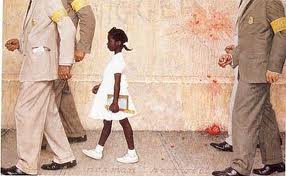
Mr. Bridges was afraid for Ruby and his family, knowing that Ruby’s acceptance into an all white school would lead to trouble. However, Mrs. Bridges was happy about the opportunity that Ruby had. She believed that Ruby would get a better education. She was finally able to convince Mr. Bridges that it was a good idea. “Fearing there would be some civil disturbance, the federal district court judge requested the U.S government send federals marshals to New Orleans to protect the children,” (Biography.com). In 1960, federal marshals drove Ruby and her Mother to school and explained what was going to happened when they arrived to school. They told her that she will be walked by four large men; two in front of her, 2 in back of her. Clearly, people didn’t accept the idea of her walking into their school, and the fact she was being escorted by for large white men. There was crowds all over the place, throwing objects at her. Police men were all over the place. Know that a little black girl was going to be attending William Frantz Elementary School, parents kept their kids from going to that school. In addition, some teachers didn’t attend that school either, which meant classes weren’t in session, and innocent Ruby spent her time in the principal’s office. For the first few days, it seemed as if Ruby wasn’t going to be attending class.
However, a new teacher from Boston agreed to tech Ruby. Barbara Henry, was the only white teacher to accept Ruby. Ruby was Mrs. Henry’s only student for a full year. Parents weren’t at all happy about the situation, they threatened to send their kids to different schools and had pulled them out. “Ruby Bridges’ first few weeks at Frantz School were not easy ones. Several times she was confronted with blatant racism in full view of her federal escorts. On her second day of school, women threatened to poison her. After this, the federal marshals allowed her to only eat food from her home. On another day, she was “greeted” by a women displaying a black doll in a wooden coffin,” (Biography.com). Ruby was all alone in the classroom, ate by herself, didn’t have a best friend to share secrets with, and when needed to go to the bathroom she had to be escorted by the federal marshals. However, despite of all the death threats, her mother encouraged her to stay strong, keep going to school, and to focus on what’s important. Her mother influenced to pray to God everyday before going to school. Not only did this affect Ruby, but it also had an effect on her family. However, some of the people in their community showed support.
Later on, families began to sent their children back to school. The threats, protest, chanting, slowly began to go away as the year went on. But still after everything, Ruby started to express her feelings. She was stressing, having nightmares, stopped eating, etc. She wouldn’t eat the lunches her mother packed for her, because she wanted to fit in with the other kids. Sooner then later, she started to eat lunch with her teacher. Because of her behavior, Ruby started to see a psychologist for children, Dr. Robert Coles. Her parents, teacher, and therapist were all concerned with how a little girl can handle so much pressure. Later, he wrote a book on how children handle change and a children’s book based off of Ruby’s experience.
Towards the end of the year, things began to settle down. The kids didn’t really seem to care about Ruby’s color, and Ruby seemed to forget what happened within the first year she attended William Frantz Elementary. Her second year was completely different; she had best friends, walked to school without being yelled at, walked without any federal marshals, walked home without any problems, but most of all she felt safe.
Eventually, Ruby graduated from Francis T. Nicholls High School in New Orleans. “She then, studied travel and tourism at the Kansas City business school and worked for American Express as a world travel agent,” (Biography.com). In 1984, she married Malcolm Hall, and had four kids. In 1993, Ruby’s brother, Malcolm, was killed and she took care of his four kids. They attended William Frantz School, and so she began to volunteer at the school several times a week, and soon became a parent-community liaison.
In 1995, Ruby and reunited with her elementary teacher, Barbara Henry on the Oprah Winfrey show. “With Bridges’ experience as liaison at the school, and reconnection with influential people in her past, she began to see a need for bringing parents back into the schools to take a more active role in their children’s education. In 1999, Bridges formed the Ruby Bridge’s Foundation, headquarter in New Orleans. The foundation promotes the values of tolerance, respect, and appreciations of all differences,” (Biography.com). The foundation’s motto was, “Racism is a grown-up disease and we must stop using our children to spread it”, and in 2007 the Children’s Museum of Indianapolis revealed a new exhibit documenting Ruby’s life.
Now, Ruby Bridges is 59; she’s still living and is influencing people in many ways. She has taught us to never give up, and to believe in what right!