Acting French – How Grammar opens the door to foreign languages -The Atlantic

One afternoon, I was walking from lunch feeling battered by the language. I started talking with a young master in training. I told her I was having a tough time. She gave me some encouraging words in French from a famous author. I told her I didn’t understand. She repeated them. I still didn’t understand. She repeated them again. I shook my head, smiled, and walked away mildly frustrated because I understood every word she was saying but could not understand how it fit. It was as though someone had said, “He her walks swim plus that yesterday the fight.” (This is how French often sounds to me.)

The next day, I sat at lunch with her and another young woman. I asked her to spell the quote out for me. I wrote the phrase down. I did not understand. The other young lady explained the function of the pronouns in the sentence. Suddenly I understood—and not just the meaning of the phrase. I understood something about the function of language, why being able to diagram sentences was important, why understanding partitives and collective nouns was important.

In my long voyage through this sea of language, that was my first sighting of land. I now knew how much I didn’t know. The feeling of discovery and understanding that came from this was incredible. It was the first moment when I thought I might survive the sea.

via Acting French – The Atlantic.

Posted in Uncategorized

Handwriting: What’s Gained when Children Learn to Write Cursive

  • Handwriting: What’s Gained when Children Learn to Write Cursive

    • Benefits of Learning Cursive: Improve Phonetic/Decoding Skills (aka Writing to Read), Increase Creativity and Writing/Fluidity; Increase Self-Control; Allow for Reflection and Memory Encoding.
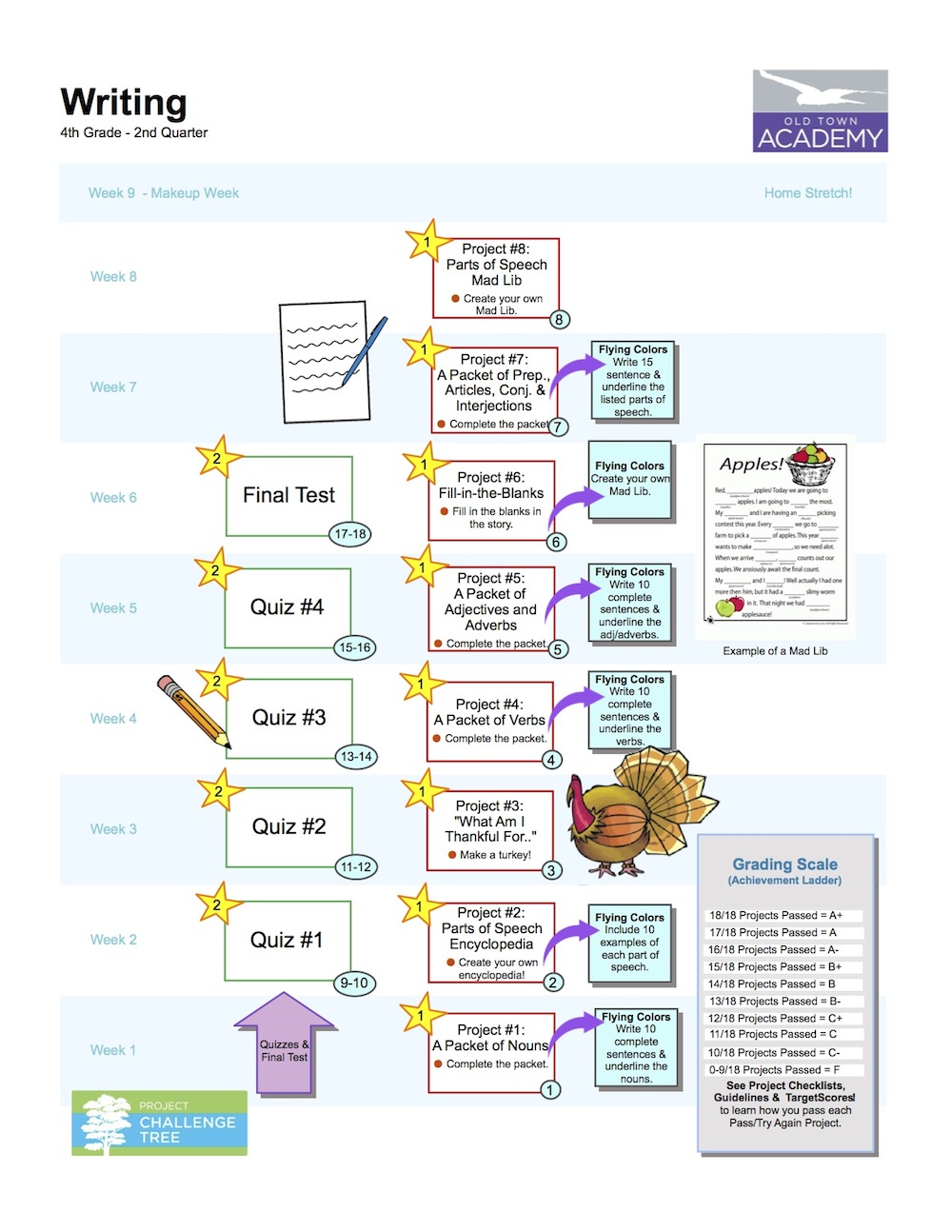
    • Every 2nd Grade Student Must Learn Cursive (and continue staying cursive through 4th grade)–Not a Privilege, not an advanced class: a Reading, Writing, Creativity Enhancer. Pass-Try Again Projects that all students attempt.
    • All OTA Students (in K-8 ) should write first drafts of all papers by Hand (think before you write!). Typing should be Extra Credit only or a Separate Independent Project: “Now that you have passed your final draft (of your handwritten paper), for extra credit or to earn a second project point, to either copy it over in cursive with a fountain or calligraphy pen or type it up on your blog (yourself–please do not ask your parents to type your paper). Then publish it to your blog.”
    • Touch-Typing still important—learned independently:  use Typing Instructor to create Independent Projects in Language Arts— Goal is to type 35 wpm by 8th grade graduation.

By MARIA KONNIKOVA JUNE 2, 2014

Does handwriting matter?

Not very much, according to many educators. The Common Core standards, which have been adopted in most states, call for teaching legible writing, but only in kindergarten and first grade. After that, the emphasis quickly shifts to proficiency on the keyboard.

But … New evidence suggests that the links between handwriting and broader educational development run deep.

Children not only learn to read more quickly when they first learn to write by hand, but they also remain better able to generate ideas and retain information. In other words, it’s not just what we write that matters — but how.

“When we write, a unique neural circuit is automatically activated,” said Stanislas Dehaene, a psychologist at the Collège de France in Paris. “There is a core recognition of the gesture in the written word, a sort of recognition by mental simulation in your brain.

Handwriting is being dropped in public schools — that could be bad for young minds. “And it seems that this circuit is contributing in unique ways we didn’t realize,” he continued. “Learning is made easier.”

A 2012 study led by Karin James, a psychologist at Indiana University, lent support to that view. Children who had not yet learned to read and write were presented with a letter or a shape on an index card and asked to reproduce it in one of three ways: trace the image on a page with a dotted outline, draw it on a blank white sheet, or type it on a computer. They were then placed in a brain scanner and shown the image again.

The researchers found that the initial duplication process mattered a great deal. When children had drawn a letter freehand, they exhibited increased activity in three areas of the brain that are activated in adults when they read and write: the left fusiform gyrus, the inferior frontal gyrus and the posterior parietal cortex.

By contrast, children who typed or traced the letter or shape showed no such effect. The activation was significantly weaker.

Dr. James attributes the differences to the messiness inherent in free-form handwriting: Not only must we first plan and execute the action in a way that is not required when we have a traceable outline, but we are also likely to produce a result that is highly variable.

That variability may itself be a learning tool. “When a kid produces a messy letter,” Dr. James said, “that might help him learn it.”

Our brain must understand that each possible iteration of, say, an “a” is the same, no matter how we see it written. Being able to decipher the messiness of each “a” may be more helpful in establishing that eventual representation than seeing the same result repeatedly.

The effect goes well beyond letter recognition. In a study that followed children in grades two through five, Virginia Berninger, a psychologist at the University of Washington, demonstrated that printing, cursive writing, and typing on a keyboard are all associated with distinct and separate brain patterns — and each results in a distinct end product. When the children composed text by hand, they not only consistently produced more words more quickly than they did on a keyboard, but expressed more ideas. And brain imaging in the oldest subjects suggested that the connection between writing and idea generation went even further. When these children were asked to come up with ideas for a composition, the ones with better handwriting exhibited greater neural activation in areas associated with working memory — and increased overall activation in the reading and writing networks.

It now appears that there may even be a difference between printing and cursive writing — Continue reading →

Posted in Uncategorized

Good Writing = Thinking and Re-Thinking: Importance of Templates and “Random Access” tools

The key problem with young writers is they get stuck with their (unorganized, random, repetitive) first draft and can’t find a way to see it, element by element, and rearrange or cut each element as needed.

Why do they get stuck? A linear template that makes each section look the same; a template without enough space to separate sections, edit, erase, make notes, etc…..

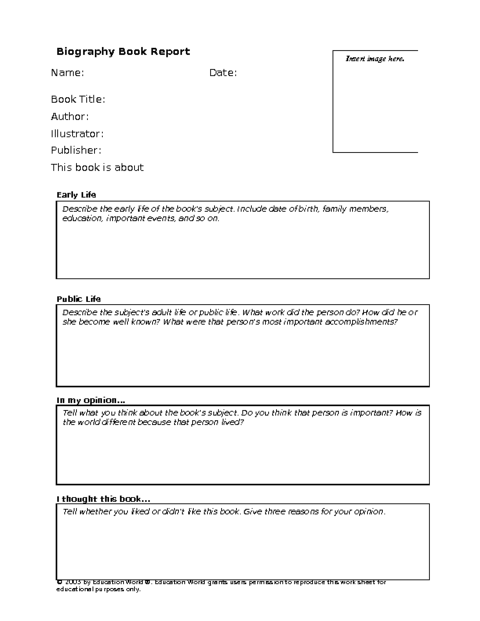
Bad Writing Template 2-bookreport_biography-thumb

computers that make it easy to type before thinking (once it’s typed, it’s hard to edit it); writing in pen (too hard to erase).

Antidotes to that:

  • Lincoln and his cardboard cutouts (one with each thought)–shuffling them around to construct the perfect Gettysburg Address.
  • Pencil is Mightier than the pen–erasability!
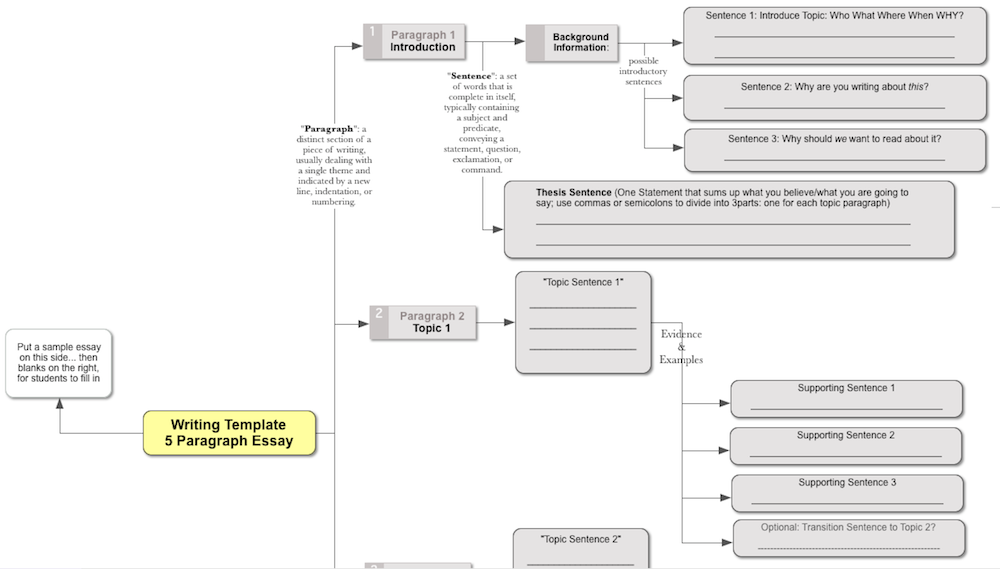
  • Templates that separate out each element/section: Topic Sentences separate from Sentences with Evidence or Examples… Divide and conquer the paper bit by bit, reexamine it often: does this TOPIC sentence fit the first Topic? Does the SUPPORTING sentence belong in this TOPIC/section? etc.

Model Writing Template

Posted in Uncategorized

The Wrong Way to Teach Grammar – Michelle Navarre Cleary – The Atlantic

As we experiment with IXL Grammar, good time to read this study. Grammar, taught poorly, can kill the love of language and a student’s ability to write.

I think Grammar can be a great gift when it’s seen as

  • a tool kids can use to x-ray the English language and to learn about human languages in general,
  • including preparing kids to learn any foreign language
  • a set of tools for talking about and polishing first drafts of writing projects (after the THINKING part is done)
  • linked to writing in the realm of RHETORIC (Parallel construction, linking phrases (on the one hand…; therefore, etc. not comma vs contraction vs semi-colon) as a series of models to emulate
  • Diagramming sentences is cool–if done right (with colors, etc.) and made optional–everyone learns the basics, those who want to go on can do so in… an iPad game?
  • Finally, the two lessons below seems to be: (1) De-Link formal grammar lessons from Writing so you don’t interfere with what writing really is: thinking and organizing your thoughts (2) Don’t make grammar the heart of your English class–instead: Poetry, Drama, Story, Writing, Speeches, etc.


No more diagramming sentences: Students learn more from simply writing and reading.

MICHELLE NAVARRE CLEARY FEB 25 2014, 10:06 AM ET

A century of research shows that traditional grammar lessons—those hours spent diagramming sentences and memorizing parts of speech—don’t help and may even hinder students’ efforts to become better writers. Yes, they need to learn grammar, but the old-fashioned way does not work.

This finding—confirmed in 1984, 2007, and 2012 through reviews of over 250 studies—is consistent among students of all ages, from elementary school through college. For example, one well-regarded study followed three groups of students from 9th to 11th grade where one group had traditional rule-bound lessons, a second received an alternative approach to grammar instruction, and a third received no grammar lessons at all, just more literature and creative writing. The result: No significant differences among the three groups—except that both grammar groups emerged with a strong antipathy to English. Continue reading →

Posted in Uncategorized

The 10 Skills Employers Most Want In 20-Something Employees – Forbes

Despite all the emphasis in the news about the need for computer software and programming skills, the most important qualities employers seek are basic teamwork, problem-solving and the ability to plan and prioritize.

Here are the 10 skills employers say they seek, in order of importance:

  • 1. Ability to work in a team
  • 2. Ability to make decisions and solve problems
  • 3. Ability to plan, organize and prioritize work
  • 4. Ability to communicate verbally with people inside and outside an organization
  • 5. Ability to obtain and process information
  • 6. Ability to analyze quantitative data
  • 7. Technical knowledge related to the job
  • 8. Proficiency with computer software programs
  • 9. Ability to create and/or edit written reports
  • 10. Ability to sell and influence others

The good news for grads: No matter what you have studied in school, whether anthropology or French or computer science, you will have had to learn the top five skills on the list. The trick is to demonstrate that you have those skills through your cover letter, résumé and interview. Think about class projects where you have been a team member or leader and jobs where you have had to plan and prioritize. Describe those skills specifically in your résumé and cover letter.

via The 10 Skills Employers Most Want In 20-Something Employees – Forbes.

Posted in Uncategorized

Remembering Donald H. Graves – National Writing Project

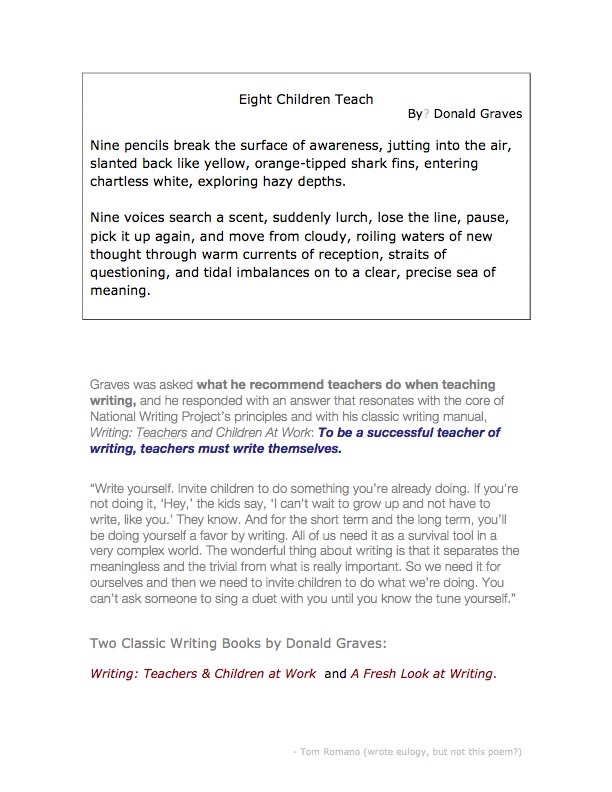
In an interview with Scholastic’s Instructor Magazine , Graves was asked what he recommend teachers do when teaching writing, and he responded with an answer that resonates with the core of NWP’s principles: to be a successful teacher of writing, teachers must write themselves.

“Write yourself. Invite children to do something you’re already doing. If you’re not doing it, ‘Hey,’ the kids say, ‘I can’t wait to grow up and not have to write, like you.’ They know. And for the short term and the long term, you’ll be doing yourself a favor by writing. All of us need it as a survival tool in a very complex world. The wonderful thing about writing is that it separates the meaningless and the trivial from what is really important. So we need it for ourselves and then we need to invite children to do what we’re doing. You can’t ask someone to sing a duet with you until you know the tune yourself.”

via Remembering Donald H. Graves – National Writing Project.

Greaves on Getting a Writing Class Started

***
Greaves on Putting a Voice in Writing

====

“Don’s work helped teachers teach children to write. One of his fundamental beliefs was the importance of writing “in a country whose founding fathers prized the expression of ideas in a free society” (Graves, 2002, p. 11). He lamented that most schools placed more emphasis on children receiving information than sending it. It’s crucial, he believed, that children participate in public conversations, that they voice their concerns and per- captions …”  From Don Greaves Remembered


Posted in Uncategorized