When the eclipse reaches its peak, 83 percent of the sun will be shrouded. This is the January 4, 1992 annular eclipse at sunset in San Diego. During this eclipse, the whole moon passed directly in front of the setting sun when viewed here. — John Gibbins
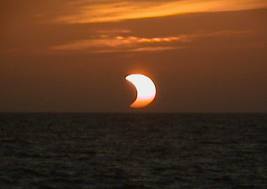
There will be a stunning partial solar eclipse on Sunday, May 20th, as seen from San Diego. The moon will begin shrouding the sun at 5:27 p.m. and will peak and cover 83 percent of the sun’s surface at 6:40 p.m. The eclipse will take place while the sun is sinking toward the horizon, out over the ocean. It’ll be easy to see, if skies are clear.
Do not — repeat, do not — look at the eclipse with your naked eye or with materials that don’t protect your vision from UV and infrared radiation. You risk permanent and serious damage to your vision if you don’t use the proper safety equipment to view a solar eclipse, and the damage can occur within seconds.
“I can’t emphasize the need for safety enough.”Dr. Sanford G. Feldman, an ophthalmologist at Scripps Memorial Hospital in La Jolla, says a person can suffer solar retinopathy, or damage to the retina, especially the area of the eye known as the macula.
Such damage can “take away a person’s ability to see details that are straight ahead of them,” Feldman said. “You can’t recognize faces and it makes it hard to read street signs or see details on a TV screen. It can lead to legal blindness.”
Feldman emphasized that — contrary to popular belief — you cannot safely look at a solar eclipse by peering through exposed X-ray film or photographic film. Sunglasses also do not provide adequate protection, nor does the gray filter that is attached to a camera lens.
Read more at Union Tribune