Current events Q1 #1

uzi-kids-0893333b.jpg.885x490_q90_box-0,67,3665,2098_crop_detail

The article I read was “Fatal accident at a range has country talking about kids and guns.” The date of the article was September 1, 2014. A 9 year old girl at a shooting range with her parents. It took place August 27, 2014. This terrible accident took place in White Hills, Arizona. People are debating whether young children should be allowed to use dangerous weapons of any kind. The 9 year old girl was getting lessons from 39 year old Charles Vacca. Just after her first use of the Uzi submachine gun she looses control and hits Vacca in the head. Right now you must be 18 years or older to own a gun of any sort but it does not say you can’t use a gun.

“I don’t think you should keep kids away from firearms,” said Tom. I agree with in the sense that kids shouldn’t be totally banished from weans but they shouldn’t be handling the dangerous ones. The author was unbiased.

Theodore Roosevelt

“Believe you can and you’re halfway there.” a quote by Teddy Roosevelt. Theodore Roosevelt was our twenty-sixth president of the United States of America. He served as Assistant Secretary of the Navy and explored the Amazonian rain forests. He was also known for the teddy bear being named after him.

Theodore Rosevelt was born in Manhattan, New York on October 27, 1858. He was the second of four children in his family. During his childhood he was raised in New York. Teddy was mostly home schooled by tutors. But when he grew older he went to Harvard University and was a boxer there. After Harvard he went to Columbia Law school. His dad’s side of the family were union supporters and his mom’s side of the family were federate supporters. Theodore Roosevelt looked up to the sixteenth president of the United States of America, Abraham Lincoln.

Theodore Roosevelt wrote a book named,”The Naval War of 1812.” In 1906. He also won the medal of honor, he won it for mediating the Russo-Japanese war. In 1901 He got elected president of the United States of America, and he was also the youngest president too. Roosevelt was the reason the Panama Canal is finished. Some say Theodore Roosevelt is one the best presidents ever. National parks and national park systems were created by Teddy.

Theodore Roosevelt died in Oyster Bay, New York on January 9, 1919. He died in his sleep, he suffered from a heart attack. Theodore Roosevelt’s work effects the history of the teddy bear to this day. Today we remember Teddy Roosevelt as the creator of the National parks and finishing the Panama Canal. One of the reasons why he is important is, Roosevelt vowed to not favor any group of Americans, but to be fair to all.

Compare and contrast essay: Angel Island and Ellis Island

Angel Island and Ellis Island introduced so many different immigrants from around the world to America. But if you think about it, there are some smaller differences and some bigger differences. In this essay, I am going to explain the similarities between the two islands. Some of the similarities between Angel Island and Ellis Island are: It was the first stop to America, they’re located on water, and both had a very long process to get through.

Both Islands passed through thousands of immigrants. Ellis Island passed through twelve million immigrants and Angel island passed through one hundred sixty five thousand Immigrants. Ellis Island’s maximum capacity was one thousand people. It is unknown how many Immigrants Angel Island could hold.

Both Angel Island and Ellis Island are located on water, and both are islands. Ellis Island is located in the upper New York bay, and Angel Island is in the San Francisco bay. Both islands have over a square mile.

Ellis Island and Angel Island both had a long process to pass through. Elis Island would take a few hours at the shortest and a few days at the longest to get passed through. At Angel Island it would take somewhere from a week to a month to get passed through. At Ellis Island you would also have to answer twenty-nine questions. At Angel Island the facility was mainly a detention center and seventy percent of the immigrants were Chinese. The security would check you if you had any diseases. If you did, they would mark your clothes which would represent which disease you had, and then you would be treated.photo-d

Angel Island was once known as the “Ellis Island of the west coast.” Even though both islands are on the opposite side of the country, they brought in so many different immigrants from across the world. Both islands helped thousands of immigrants, but now both of them are museums. There is a good chance that one of your ancestors passed through Angel Island or Ellis Island.

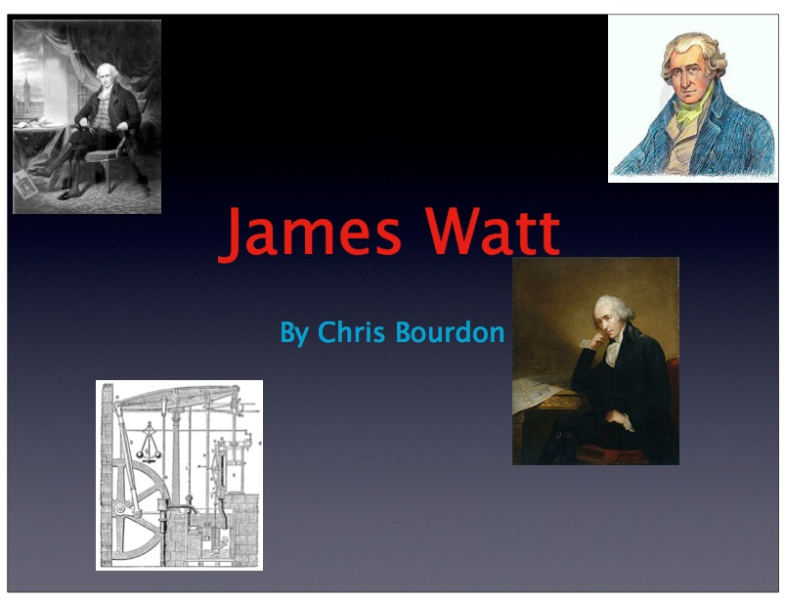
James Watt

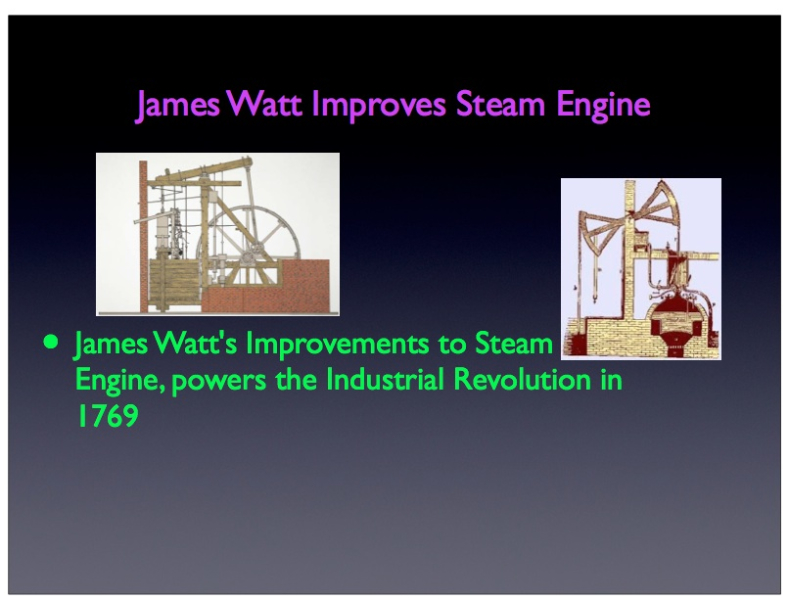
James Watt was a great Scottish engineer of the 18th century. He is one of the most well-known names of the Industrial Revolution.  He is credited with some of the most important ideas that lead to inventions of the modern age. He built the first steam engine that could be used for industrial purposes and helped develop engines that run on steam to be used for many different things.

James Watt was born on January 19, 1736 in Greenock, Scotland. He grew up in a fishing village. James was a thin, weak child who suffered from migraines and toothaches. He did not go to school regularly. He enjoyed mathematics in grammar school, and also learned carpentry from his father. His mother came from a distinguished well educated family. His father was a carpenter by training, and built anything from furniture to ships, but primarily worked in shipbuilding. Watt learned about the navigational aids on ships: quadrants, compasses, and telescopes. By his mid teens he knew he wanted to become an instrument maker. Watt’s father had just lost a substantial investment due to a shipwreck, and he could see the benefits of another occupation, so was supportive of Watt’s ambitions. Unfortunately, there were no opportunities for instrument training in Greenock.

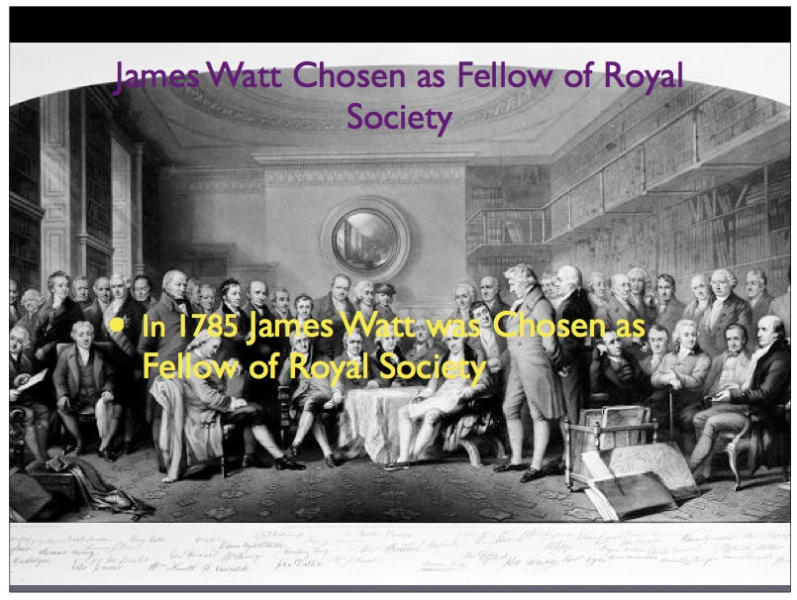
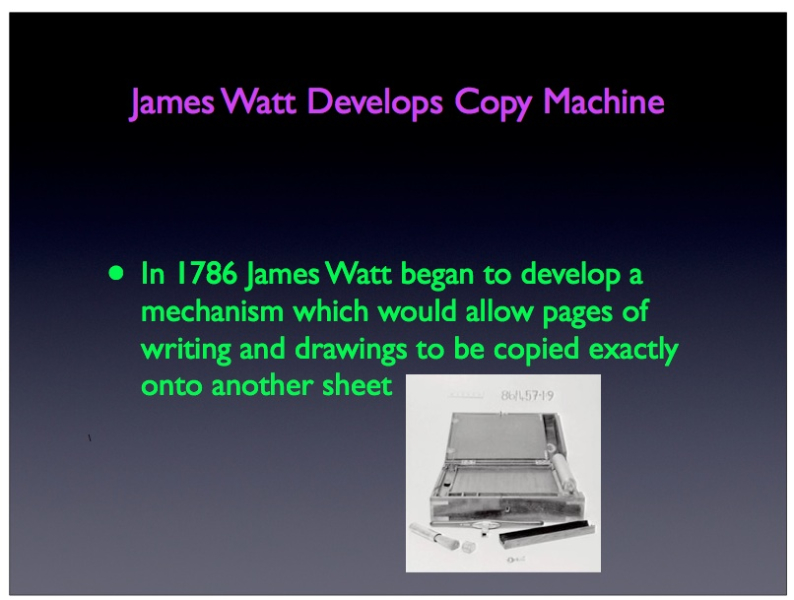
James Watt had many accomplishments in his life. In addition to the Newcomen Steam Engine, he invented the process of duplicating written papers into what is now the copy machine. In 1786, Watt began experiments with chemicals and paved the way for others to invent bleach. Along with mechanical projects, Watt also attempted to work with chemicals. He discovered that chlorine could be produced by mixing manganese dioxide with salt. In 1785 James Watt was chosen as fellow of the royal society.

Demands for his engine came quickly from paper mills, flour mills, cotton mills, iron mills, distilleries, and canals and waterworks.  By 1790, Watt was a wealthy man.

James Watt’s work was important because he improved the steam engine by making it smaller, safer and faster. He is also important because we use his inventions today in everyday life, like bleach and the steam engine.

His long-time retirement was saddened by the death of a son, Gregory, by his second marriage, and the deaths of many of his close friends. James Watt died on August 25, 1819 in Birmingham, England. We should remember James Watt because he played  a big roll in the industrial revolution.

Industrial revolution

The Industrial Revolution was the transition to new manufacturing process. Historians debate on  weather it was a good or bad thing. Manufacturing was created after steam power was created.

The Industrial revolution began in about 1760 and ended between 1820 and 1840. When they manufactured they used hand tools and simple machines. There was no labor laws. People also invented morse code.

People invented telegraphs, coal, steam powered trains, and the steam engine. Alexander Gram Bell invented the telephone in 1876. Cotten Gin by Eli  Whitney. Samuel Morse invented the telegraph.

During the Industrial Revolution, kids were forced into labor. 20% of the people from this time were middle or upper class. Most people with farmland had their land taken away. The kids worked 14 hours a day with a 1 hour break. Company owners hired children because they could crawl into small spaces, and could be beaten if they disobeyed, and could be easily replaced.


During the Industrial Revolution , the role of government was to keep the peace or fight wars, maintain civil order and enforce law. By the progressive era, government in addition accepted some responsibility for the economy and caring for the needy. The concept of economic policy had been born. Anti-Trust laws and civil rights laws now existed.


As you can see there were many pros and cons in the industrial revolution. Some of the positives were improving manufacturing process, cheaper items, and more inventions. However there were many negatives such as, children were overworked and under paid. The families were falling apart and some farms were taken away. More people were dying and poor working conditions in factories.