
The more time children spend in structured, parent-guided activities, the worse their ability to work productively towards self-directed goals.
JESSICA LAHEY -JUN 20 2014
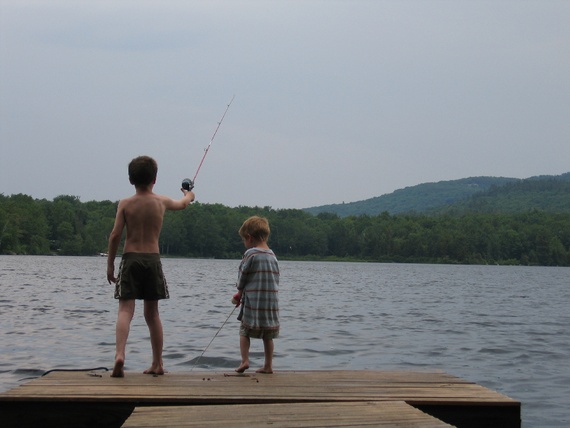
The author’s sons enjoying summertime in their younger years.
Most schools across the nation have marked the end of another academic year, and it’s time for summer. Time for kids to bolt for the schoolhouse doors for two long months of play, to explore their neighborhoods and discover the mysteries, treasures, and dramas they have to offer. This childhood idyll will hold true for some children, but for many kids, the coming of summer signals little more than a seasonal shift from one set of scheduled, adult-supervised lessons and activities to another.
Unscheduled, unsupervised, playtime is one of the most valuable educational opportunities we give our children. It is fertile ground; the place where children strengthen social bonds, build emotional maturity, develop cognitive skills, and shore up their physical health. The value of free play, daydreaming, risk-taking, and independent discovery have been much in the news this year, and a new study by psychologists at the University of Colorado reveals just how important these activities are in the development of children’s executive functioning.
Executive function is a broad term for cognitive skills such as organization, long-term planning, self-regulation, task initiation, and the ability to switch between activities. It is a vital part of school preparedness and has long been accepted as a powerful predictor of academic performance and other positive life outcomes such as health and wealth. The focus of this study is “self-directed executive function,” or the ability to generate personal goals and determine how to achieve them on a practical level. The power of self-direction is an underrated and invaluable skill that allows students to act productively in order to achieve their own goals.
Children who engage in more free play have more highly developed self-directed executive function.
The authors studied the schedules and play habits of 70 six-year-old children, measuring how much time each of them spent in “less structured,” spontaneous activities such as imaginative play and self-selected reading and “structured” activities organized and supervised by adults, such as lessons, sports practice, community service and homework. They found that children who engage in more free play have more highly developed self-directed executive function. The opposite was also true: The more time kids spent in structured activities, the worse their sense of self-directed control. It’s worth noting that when classifying activities as “less structured” or “structured,” the authors deemed all child-initiated activities as “less-structured,” while all adult-led activities were “structured.”
All of this is in keeping with the findings of Boston College psychology professor Peter Gray, who studies the benefits of play in human development. In his book Free to Learn: Why Unleashing the Instinct to Play Will Make Our Children Happier, More Self-Reliant, and Better Students for Life, he elaborates on how play supports the development of executive function, and particularly self-directed control:
Free play is nature’s means of teaching children that they are not helpless. In play, away from adults, children really do have control and can practice asserting it.
via Why Free Play Is the Best Summer School – Jessica Lahey – The Atlantic.