A Mental Trick from the World’s Best Team « The Talent Code

… they devised a tool to fix that, built on a simple two-part frame that describes the mental state you want to avoid, and the one you want to be in. They call it Red Head/Blue Head.

Red Head is the negative state, when you are heated, overwhelmed, and tense (H.O.T., in the parlance). Your emotional engine is smoking, your perceptions are slow, the game feels too fast, and your decision making is rushed.

Blue Head, on the other hand, is the precise opposite: the cool, controlled, pattern-seeing state, when you retain your awareness and your decision-making power, when you stay flexible and deliver top performance.

The key is doing three things:

  • 1) seek to stay in Blue Head as your default setting
  • 2) sense cues when you are entering Red-Head mode
  • 3) use a physical or mental trigger to get yourself back into Blue Head.

On the All-Blacks, each player is encouraged to devise personal triggers to make the transition. One player stamps his feet into the grass, to ground himself. Another uses mental imagery, picturing himself from the highest seat in the stadium, to help put the moment in perspective. Whatever  tool you use doesn’t matter — what matters is realizing you’re in the wrong emotional zone, and finding ways to cool yourself off and get back in a high-performing head space.

I think this is an idea that applies to a lot more than just sports. The notion that you can build yourself an emotional thermostat that senses when it’s overheating, and cools itself down when needed, is powerfully useful.

via A Mental Trick from the World’s Best Team « The Talent Code.
Posted in Uncategorized

The Bonner Basketball Challenge “Stop Doing Drills; Start Using Challenges (The Talent Code

The word “drill” is a signal that:

  • There is one correct way to do something, and only one way
  • This group values machine-like repetition above all else

Now, there are moments when that kind of signal is perfectly appropriate. But the ethos of “drilling” has been applied to a far wider range of activities, like soccer players learning to control the ball, or math students solving algebraic equations, or musicians working on improvisational skills — situations where you are seeking to create creativity, energy, and innovation.

So what word is better? I think the answer is “challenge.”

I know, it seems like a tiny change. And yet, there are differences between the two terms that are worth appreciating.

The word “challenge” is a signal that:

  • This is social, fun, and gamelike. It’s connective. (After all, it’s not called the “Ice-Bucket Drill,”is it?)
  • Difficulty is expected; mindfulness is required; innovation is embraced
  • This group values challenging obstacles, competing, and creating

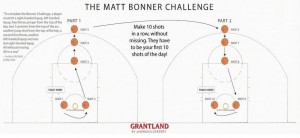
One of my favorite examples is the Bonner Challenge, invented by Matt Bonner, reserve forward for the NBA champion San Antonio Spurs. Continue reading →

Posted in Uncategorized

Practice & Preparation! Two “Talent Code” Stories (Football & Football)


This reveals the deeper truth behind his great catch: it was no accident:

Watch how Beckham  keeps one hand at his side, as if  pinned by a defender; how he controls the nose of the ball with his index finger; how his eyes follow the ball into his palm. We normally think of this kind of catch as a feat of athleticism. This shows that it’s really a feat of preparation. This is a very particular kind of preparation, systematically pre-creating the most difficult situations. You might call it High-Leverage Practice, because it shows how focusing relentlessly on pre-creating pressure conditions can set a performer apart from their peers.

  • via The Talent Code: “Greatness Isn’t Born. It’s Grown. Here’s How.”
Posted in Uncategorized

Basketball: “Players play, but tough players win.” (SmartPractice CHECKLIST)

From “Defining Toughness in College Hoops” by Jay Bilas, ESPNJay bilas_Defining Toughness in College Hoops

“Toughness has nothing to do with size, physical strength or athleticism. Some players may be born tough, but I believe that toughness is a skill, and it is a skill that can be developed and improved. Michigan State coach Tom Izzo always says, “Players play, but tough players win.” He is right.

Make getting better every day your goal: Tough players come to work every day to get better, and keep their horizons short. They meet victory and defeat the same way: They get up the next day and go to work to be better than they were the day before. Tough players hate losing but are not shaken or deterred by a loss. Tough players enjoy winning but are never satisfied. For tough players, a championship or a trophy is not a goal; it is a destination. The goal is to get better every day.

When I was playing, the players I respected most were not the best or most talented players. The players I respected most were the toughest players. I don’t remember anything about the players who talked a good game or blocked a shot and acted like a fool. I remember the players who were tough to play against.

Anybody can talk. Not anybody can be tough.

Here are some of the ways true toughness is exhibited in basketball:

Set a good screen: The toughest players to guard are the players who set good screens. When you set a good screen, you are improving the chances for a teammate to get open, and you are greatly improving your chances of getting open. A good screen can force the defense to make a mistake. A lazy or bad screen is a waste of everyone’s time and energy.

To be a tough player, you need to be a “screener/scorer,” a player who screens hard and immediately looks for an opportunity on offense. On the 1984 U.S. Olympic Team, Bob Knight made Michael Jordan set a screen before he could get a shot. If it is good enough for Jordan, arguably the toughest player ever, it is good enough for you.

Set up your cut: The toughest players make hard cuts, and set up their cuts. Basketball is about deception.

Take your defender one way, and then plant the foot opposite of the direction you want to go and cut hard. A hard cut may get you a basket, but it may also get a teammate a basket. If you do not make a hard cut, you will not get anyone open. Setting up your cut, making the proper read of the defense, and making a hard cut require alertness, good conditioning and good concentration. Davidson’s Stephen Curry is hardly a physical muscle-man, but he is a tough player because he is in constant motion, he changes speeds, he sets up his cuts, and he cuts hard. Curry is hard to guard, and he is a tough player.

Work on your pass: A tough player doesn’t have his passes deflected. A tough player gets down, pivots, pass-fakes, and works to get the proper angle to pass away from the defense and deliver the ball.

To see more…

Continue reading →

Posted in Uncategorized

Brazilian Jiu-Jitsu | Self-Defense: My Teacher the Retired NYPD Officer

Codella is an expert at Brazilian jiu-jitsu, a contemporary martial art that he used during a 20-year career with the New York Police Department. Graying but still broad-shouldered and fit, he now runs Codella Brazilian Jiu-Jitsu Academy on Staten Island.

“Like most people who got involved in Brazilian jiu-jitsu, I saw the early UFC fights,” Codella told me. In those fights, which infamously took place in a cage, he watched a slight young Brazilian named Royce Gracie contort himself in all sorts of weird positions to win an essentially no-holds-barred competition. Amazingly, the men he beat dwarfed him in size and strength. Codella, himself only 5’7″, figured he could incorporate the same holds that this Brazilian used in a cage to subdue much larger men on the street.

Continue reading →

Posted in Uncategorized

Why Free Play Is the Best Summer School – Jessica Lahey – The Atlantic

The more time children spend in structured, parent-guided activities, the worse their ability to work productively towards self-directed goals.

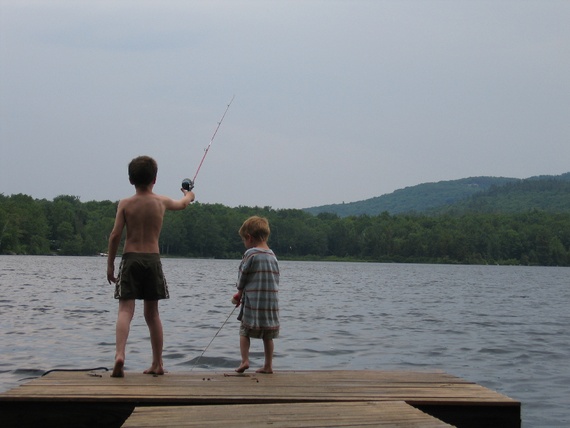
Free Play over Summer-Boys Fishing

The author’s sons enjoying summertime in their younger years.

Most schools across the nation have marked the end of another academic year, and it’s time for summer. Time for kids to bolt for the schoolhouse doors for two long months of play, to explore their neighborhoods and discover the mysteries, treasures, and dramas they have to offer. This childhood idyll will hold true for some children, but for many kids, the coming of summer signals little more than a seasonal shift from one set of scheduled, adult-supervised lessons and activities to another.

Unscheduled, unsupervised, playtime is one of the most valuable educational opportunities we give our children. Continue reading →

Posted in Uncategorized