At Voice Charter School in Queens, Students Have Outperformed Their Peers Academically
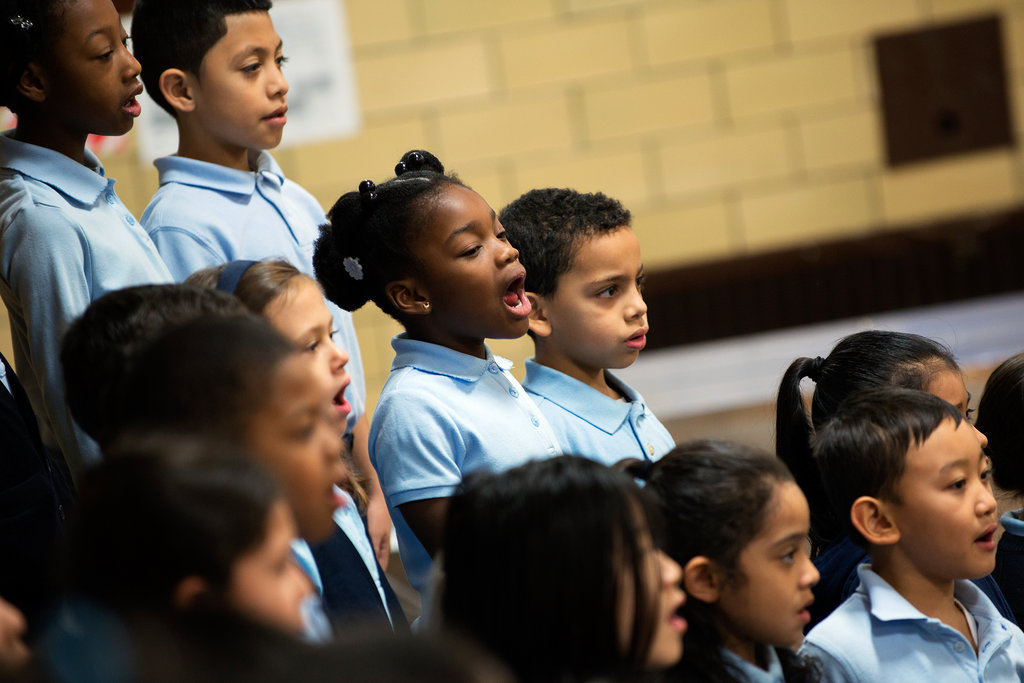
“They learn how to be really good at something,” Mr. Headley said. “We believe that then translates into everything else.”
In an era of dwindling attention to the arts in public schools, Voice is now in its seventh year. Mr. Headley founded the school after learning that music and movement might improve language acquisition, he said, a concept he came across while he was studying at a principal training program called New Leaders. Voice started with kindergarten and has added one new grade each year; it expects to reach its full complement of kindergarten through eighth grade in the fall.
Today, the school has just shy of 600 students spread between two buildings in Long Island City; one of them used to be a Catholic school. Bells from St. Rita’s Roman Catholic Church, right next door, chime throughout the day. Seventy percent of the students qualified for free lunch last year, according to city data. Like other New York charter schools, which are publicly funded but privately run, it admits students through a lottery. No one auditions.
Academically, students at Voice did significantly better than the city average on New York State math exams last year, with 70 percent of its students passing, compared with 39 percent citywide. Their English performance was less impressive, but with 39 percent passing, it still beat the citywide average of 30 percent.
Humming aside, Ms. Athens, a fourth-year teacher who has never taught elsewhere, said the students appeared to learn skills in their music lessons that translated to her classroom.
“They learn to stick with something hard and breaking things down into steps,” she said. “And work together as a group at such a young age.”
All this pops especially brightly against the drab state of the arts in New York City public schools at large, where a report by the comptroller this spring found that spending on arts supplies and equipment fell by 84 percent from 2006 to 2013. The report also found that 20 percent of public schools had no arts teachers at all, and that the dearth in arts education was especially dire in low-income areas. The administration of Mayor Bill de Blasio has since increased arts funding and pledged to hire 120 new arts teachers in middle and high schools, where state law requires arts instruction.
Younger students at Voice usually have music twice a day, and older students once, on average. But so much time spent on music is not without its price. To make room for those courses, the school day is unusually long, from 7:55 a.m. to 4:25 p.m., which can be hard for small children (as a nonunion school, it has more power to set its own hours).
“The hardest part about school, I think, is that there are so many hours in the day, because after a while, everyone seems to get a little more tired, on edge,” said Delaiah Robinson, 11. “I live kind of far away from the school, so I get home pretty late.”