Jump to:
- Geological timeline | Geological time periods | Big Five mass extinction events |
- Mass extinction theories | Ancient Earth habitats
- Geological timeline
History of life on Earth
 Pangea supercontinent from space, as it may have looked 300 million years ago.
The Earth is a little over 4.5 billion years old, its oldest materials being 4.3 billion-year-old zircon crystals. Its earliest times were geologically violent, and it suffered constant bombardment from meteorites. When this ended, the Earth cooled and its surface solidified to a crust – the first solid rocks. There were no continents as yet, just a global ocean peppered with small islands. Erosion, sedimentation and volcanic activity – possibly assisted by more meteor impacts – eventually created small proto-continents which grew until they reached roughly their current size 2.5 billion years ago. The continents have since repeatedly collided and been torn apart, so maps of Earth in the distant past are quite different to today’s.
The history of life on Earth began about 3.8 billion years ago, initially with single-celled prokaryotic cells, such as bacteria. Multicellular life evolved over a billion years later and it’s only in the last 570 million years that the kind of life forms we are familiar with began to evolve, starting with arthropods, followed by fish 530 million years ago (Ma), land plants 475Ma and forests 385Ma. Mammals didn’t evolve until 200Ma and our own species, Homo sapiens, only 200,000 years ago. So humans have been around for a mere 0.004% of the Earth’s history.
Jump to:Geological timeline | Geological time periods |Big Five mass extinction events |
Mass extinction theories | Ancient Earth habitats
Geological timeline
During its dramatic 4.5 billion year history, Earth has gone through a series of major geological and biological changes. The timescale below highlights a number of notable prehistoric events and the geological periods in which they occurred. As things didn’t get interesting from a biological perspective until around 570 million years ago, we’ve included a couple of zoomed in timelines to show the detail of more recent evolutionary history. Show text only timeline


Geological time periods
Geologists have organised the history of the Earth into a timescale on which large chunks of time are called periods and smaller ones called epochs. Each period is separated by a major geological or palaeontological event, such as the mass extinction of the dinosaurs which occurred at the boundary between the Cretaceous period and the Paleocene epoch.
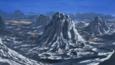 Archean era3.8 billion–2.5 billion years ago
 Cryogenian period850 million–635 million years ago
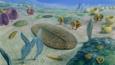 Ediacaran period635 million–545 million years ago
 Cambrian period545 million–495 million years ago
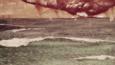 Ordovician period495 million–443 million years ago
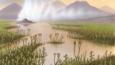 Silurian period443 million–417 million years ago
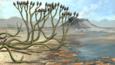 Devonian period417 million–354 million years ago
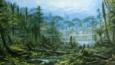 Carboniferous period354 million–290 million years ago
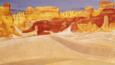 Permian period290 million–248 million years ago
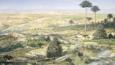 Triassic period248 million–205 million years ago
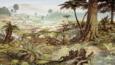 Jurassic period205 million–142 million years ago
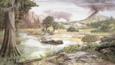 Cretaceous period142 million–65 million years ago
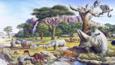 Palaeocene epoch65 million–54.8 million years ago
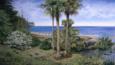 Eocene epoch54.8 million–33.7 million years ago
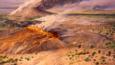 Oligocene epoch33.7 million–23.8 million years ago
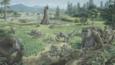 Miocene epoch23.8 million–5.3 million years ago
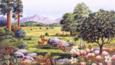 Pliocene epoch5.3 million–2.6 million years ago
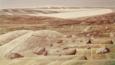 Pleistocene epoch2.6 million–11.7 thousand years ago
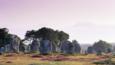 Holocene epoch11.7 thousand years ago–present day
Big Five mass extinction events
Although the Cretaceous-Tertiary (or K-T) extinction event is the most well-known because it wiped out the dinosaurs, a series of other mass extinction events has occurred throughout the history of the Earth, some even more devastating than K-T. Mass extinctions are periods in Earth’s history when abnormally large numbers of species die out simultaneously or within a limited time frame. The most severe occurred at the end of the Permian period when 96% of all species perished. This along with K-T are two of the Big Five mass extinctions, each of which wiped out at least half of all species. Many smaller scale mass extinctions have occurred, indeed the disappearance of many animals and plants at the hands of man in prehistoric, historic and modern times will eventually show up in the fossil record as mass extinctions. Discover more about Earth’s major extinction events below.
 Ordovician-Silurian mass extinction443 million years ago
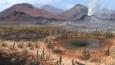 Late Devonian mass extinction359 million years ago
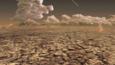 Permian mass extinction248 million years ago
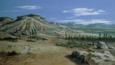 Triassic-Jurassic mass extinction200 million years ago
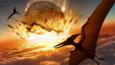 Cretaceous-Tertiary mass extinction65 million years ago
Mass extinction theories
Asteroid impacts, climate change, volcanoes – there have been many theories about the causes of mass extinctions. In some cases, such as the Cretaceous mass extinction event, more than one such factor was involved in the global catastrophe.
Ancient Earth habitats
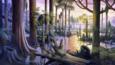
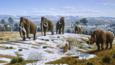
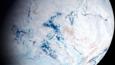
If you were able to travel back far in time, you’d find Earth to be a very different place – at times a giant hot molten ball of rock, at others a frozen planet completely covered in snow and ice. During its long history, Earth has been covered by habitats and experienced climates that no longer exist. Discover more about these and about the dramatic story of ancient Earth.