Dimensional analysis (also known as the factor-label method or unit-factor method or UNIT ANALYSIS) is by far the most useful math trick you’ll ever learn. Maybe you’ve learned some algebra, but will you use it? For many people the answer is, “not after the final exam.”
For a fraction of the effort needed to learn algebra, you too can learn “dimensional analysis.” First off, however, let’s get rid of the big words. What this is all about is just conversion—converting one thing to another. This is something you will have occasion to do in real life. This is seriously useful stuff.
This trick is about applied math, not about numbers in the abstract. We’re talking about measurable stuff, stuff you can count. Anything you measure will have a number with some sort of “unit of measure” (the dimension) attached. A unit could be miles, gallons, miles per second, peas per pod, or pizza slices per person.
Source: Fun with Dimensional Analysis
Two Sample Problems (see web site for more):
- Rate Problems: If you are going 50 miles per hour, how many feet per second are you traveling?
(Sometimes you need to convert both numerator and denominator)… - Mixing Problems: How much bleach would you need to make a quart of 5 percent bleach solution?
Example 3
Sometimes both the top and bottom units need to be converted:
If you are going 50 miles per hour, how many feet per second are you traveling?
If you were to do this one on the blackboard, it might look something like this:
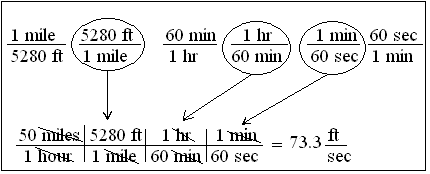
You want your answer to be in feet per second. You are given 50 miles per hour. Notice that both are in distance per time. Normally you can use any value given by the problem as your starting factor. One thing you know, then, is given. The other things you just know or have to look up in a conversion table. Although every conversion factor can be written two ways, you really only need to write each one way. That’s because you know you can always just flip it over and then use it. If you have written 60 min/1 hr, then to solve this problem you would just flip the 60 min/hour factor over. With practice you won’t even need to write down what you know, you’ll just pull it out of your head and write down the last part, do the math, and get the right answer.
Example 4
How much bleach would you need to make a quart of 5 percent bleach solution?
You’re not told what answer unit to use, but ounces would work since there are 32 oz in a quart. If the only thing you had to measure bleach with was in milliliters, then you would pick “mL” as your answer unit.
When you are given something like “5 percent” or “5%” by a problem, you need to translate it into math terms you can use. “5%” means 5 per 100 or 5/100, but 5 what? per 100 what? You need to label the numbers appropriately. In this example you write down “5 oz bleach/100 oz bleach solution” or just “5 oz B/100 oz BS” as a factor you are given. If you were going for milliliters, then you would use “5 mL B/100 mL BS.” The top and bottom units must be the same or equivalent, but otherwise can be any units you may need. If you had 5 gal. bleach/100 gal. bleach solution, then you would still have a 5% bleach solution.
Setting up and solving this problem is now easy:

So you would add 1.6 oz bleach to a quart measuring cup, then add water (30.4 oz) to make 32 ounces of 5% bleach solution.