 *
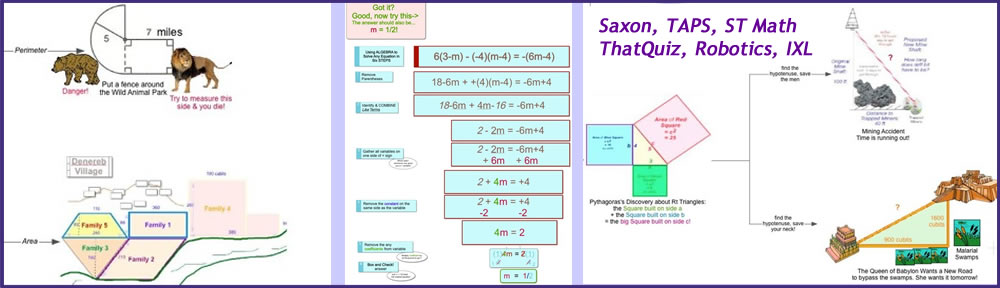
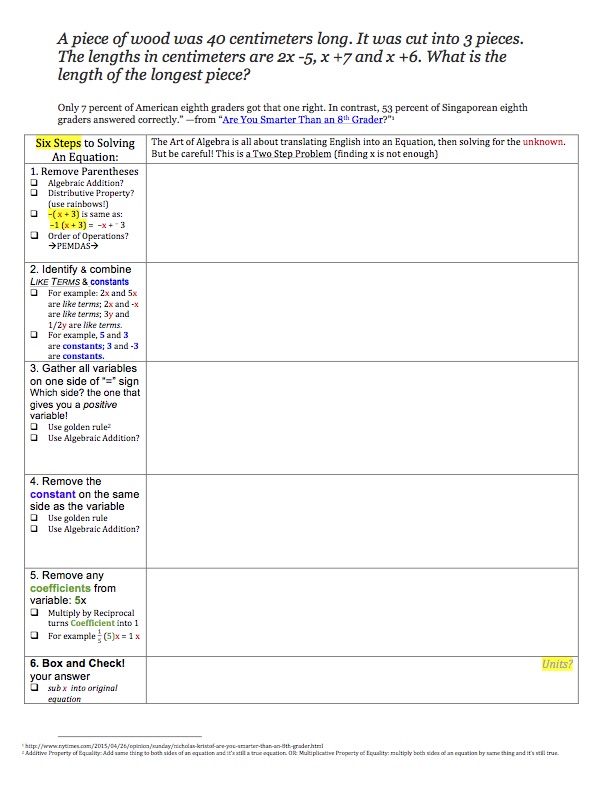 To see Sample Equation Solved in 6 Steps…
Dimensional analysis (also known as the factor-label method or unit-factor method or UNIT ANALYSIS) is by far the most useful math trick you’ll ever learn. Maybe you’ve learned some algebra, but will you use it? For many people the answer is, “not after the final exam.”
For a fraction of the effort needed to learn algebra, you too can learn “dimensional analysis.” First off, however, let’s get rid of the big words. What this is all about is just conversion—converting one thing to another. This is something you will have occasion to do in real life. This is seriously useful stuff.
This trick is about applied math, not about numbers in the abstract. We’re talking about measurable stuff, stuff you can count. Anything you measure will have a number with some sort of “unit of measure” (the dimension) attached. A unit could be miles, gallons, miles per second, peas per pod, or pizza slices per person.
Source: Fun with Dimensional Analysis
Two Sample Problems (see web site for more):
“It’s just fascinating—countries that do very well on PISA in mathematics, countries like Finland, Korea, Japan, and Netherlands, they score terribly on this motivation index,” Loveless aid. “Kids don’t look intrinsically motivated at all.”
What makes kids “like” math is succeeding at math. That is why we like classic Saxon math texts (which make no attempt to motivate students! no photos, no inspiring stories about people who use math when they grow up, no real effort to answer the perennial “When are we going to use this?”). None of this means you shouldn’t ALSO motivate students (while continuing your Saxon Daily 30 Reps”; another case of second rate educational research and analysis, presenting teachers and parents with false dichotomies (motivation or high scores? we choose both!)
But when it comes to the arguments for adoption, I demur. No, the metric system is not “more logical” than the so-called English system. And in many ways, it simply fails the test for logic, at least if by logic you mean usefulness.
I admit that when it comes to particle physics and engineering, the fact that you can do a good deal of your math by simply moving a decimal point has a lot in its favor. For the very large and the very small: for astrophysicists and nano-technologists, the 10-based metric system is the logical choice.
But I resent the patronizing tone so many pedants take toward the older system, as if it made no sense at all — when in fact, it makes a great deal of sense. There is a logic to the English system, and one that makes our lives easier — and more human.
Just start with the thermometer. When Daniel Gabriel Fahrenheit invented the mercury thermometer in 1714, he devised his system of measuring temperature in very human terms. Zero degrees was a cold as he make brine before it froze, and 100 degrees was (he was a little off) body temperature.
And using the Fahrenheit thermometer, when it is 0 degrees F, you know it is cold, and when it hits 100 in the shade, you know you’re hot.
The Celsius, or centigrade system that is used in metric nations, is based on the boiling and freezing points of fresh water. Sounds logical, perhaps, but I’m not water, I’m human. Why should it be considered logical to base your thermometer on water?
First, there is the expense ratio — about 1.12 percent of assets for the average large capitalization blend fund. Then there are transaction costs and distribution costs. Active funds also pay a penalty for keeping a share of their assets in low-yielding cash. Altogether, costs add up to 2.27 percent per year, Mr. Bogle estimates.
By contrast, a passive index fund, like Vanguard’s Total Stock Market Index Fund, costs merely 0.06 percent a year in all.
Of course, Mr. Bogle has a horse in the race. He founded the Vanguard Group. He invented the first index fund for the public. His case is powerful, nonetheless.
Assuming an annual market return of 7 percent, he says, a 30-year-old worker who made $30,000 a year and received a 3 percent annual raise could retire at age 70 with $927,000 in the pot by saving 10 percent of her wages every year in a passive index fund. (Such a nest egg, at the standard withdrawal rate of 4 percent, would generate an inflation-adjusted $37,000 a year more or less indefinitely.) If she put it in a typical actively managed fund, she would end up with only $561,000.
via Americans Aren’t Saving Enough for Retirement, but One Change Could Help – NYTimes.com.
(1) always write out your plan in English (pseudo-code)(2) always write your guess (program) on the dry erase board before you enter it into the robot and try it
Kinderlogo Activities
Kinderlogo is divided into 5 levels, each with new commands to learn and activities that help children practice and explore them. At each level, students begin with the KL file (KL1 for Level 1, KL2 for Level 2, etc.). They learn the new commands and freely explore with the turtle.
After giving students time to experiment with the turtle, the teacher may guide them in trying specific projects, such as drawing a letter of the alphabet, or designing a house. It is important that the children be allowed to express themselves independently within the scope of the project.
Kinderlogo activities are arranged with a folder for each level. Custom icons, with instructions for applying them, are included with the program.
 |
 |
 |
 |
 |
Click on a folder above to learn about the activities for that level.

Saxon Math already has a series of book for kindergarten through third grade, and another series that begins with Math 54 for fourth grade and continues up through Calculus. So why this Intermediate series for grades 3, 4, and 5? For the lower levels, at least part of the answer lies in the differences between the Saxon Math program for K-3 and the rest of the Saxon books from Math 54 up through Calculus. The K-3 program is completely different from the other Saxon books. They were written by a different author, incorporate manipulatives, and have a very teacher-intensive form of lesson presentation.
Math 54 and all the texts beyond that were written by John Saxon, Stephen Hake or both of them together. Saxon Math Intermediate 3, 4, and 5 were written by Stephen Hake and, consequently, are more similar to the upper level books than the K-3 series. Those just starting into Saxon Math at third grade level should probably go with Math Intermediate 3 since it ensures a more comfortable transition into Math 54. Those who have been using the Saxon K-3 series up through second grade can go either way, perhaps deciding based on a preference for manipulatives used in the K-3 courses or a preference for the less teacher-intensive Intermediate 3 course. For older students, you need to choose between Math Intermediate 4 and Math 54, and between Math Intermediate 5 and Math 65.
The Saxon Math Intermediate courses differ some from the Math 54 and up courses in layout, and they require a little more teacher involvement. Parents might need to work through presentation of new concepts with students in each lesson, but some students should be able to work independently through most or all of many lessons.
There are four components to the homeschool kit for each level: the student text, a solutions manual, Power Up Workbook, and Homeschool Testing Book.
Each lesson begins with “Power Up” activities. These are a bit more involved than the “Warm Up” activities that begin each lesson in Math 54 and Math 65. Power Up activities include four categories of problems each time: math fact review, count aloud or “jump start,” mental math, and problem solving. Math Intermediate 3 labels the second category “jump start.” Whatever the label, this second category might include oral counting by increments, drawing hands on a clock, thermometer reading, writing a fact family for three numbers, etc. The count aloud category is dropped from some of the Power Up sections in Math Intermediate 4 and 5 since by fourth and fifth grades students should be able to skip count fairly proficiently and will need only occasional review. The separate Power Up Workbook is used for the written activities for the Power Up section of each lesson with one page to accompany each lesson. The top half of each page is for math fact review problems. Then sections for each of the other three type activities might each contain some content (e.g., clock face in jump start) or simply provide blank space for students to write their responses. I suspect that some students will need assistance in completing some of these activities, especially at the beginning of the school year.
After the Power Up activities, a new concept is introduced along with sample problems that are completely worked out. The series includes some work on conceptual understanding as new skills and concepts are taught. However, concepts are taught with written or pictorial explanations rather than manipulatives (aside from fraction manipulatives used a few times in fourth grade), and conceptual development is not as strong as in Singapore Math or Math-U-See. After the new concept is presented, some lesson practice problems provide students with practice only on the new concept. “Written Practice” problems follow with 15 to 20 problems per lesson for third grade that review previously taught concepts. The number of written practice problems increases to 30 per lesson in fourth and fifth grades.