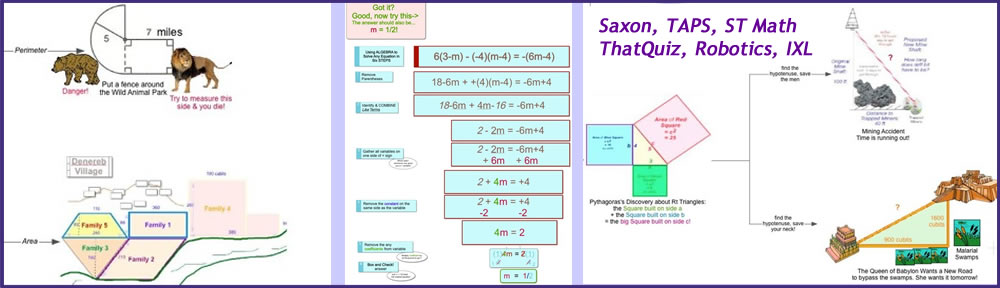
ST Math: Showing 1. How common denominators are created? 2. Why they work? • Do Kids Really Understand

The text in the Interactive Demo on How ST Math Teaches Fractions says: “Notice how using the visual grid to multiply a third and a fourth provides a reason why 12ths can be used as a common denominator.”ST Math-multiplying denominators to get commonBut I wonder:
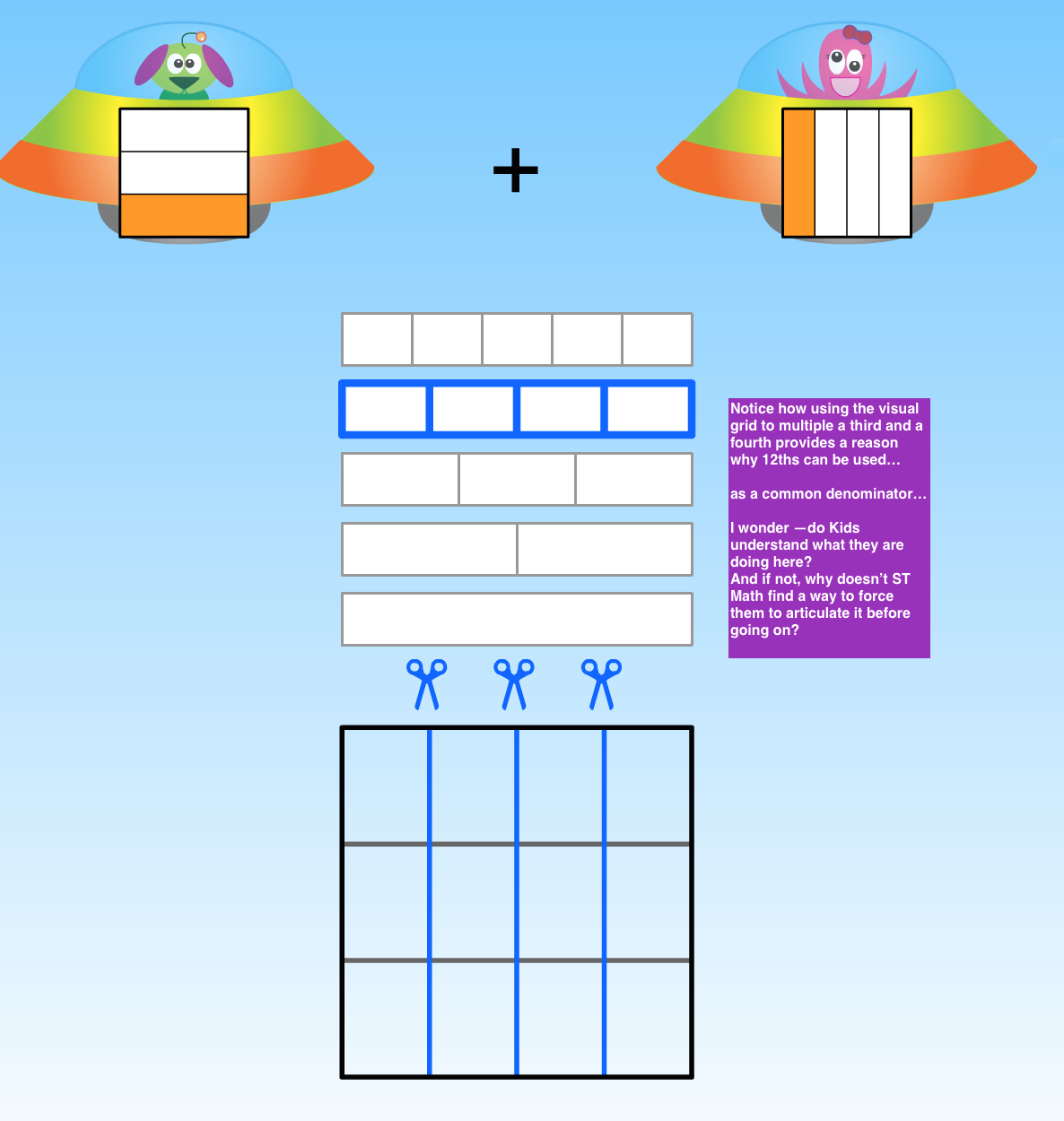
  • Do kids even pay attention to the grid ANIMATION (other than unconsicously)?
  • even realize they’re doing multiplication?
  • Even realize they’re multiplying the denominators?
  • Even realize the answer is the product of the two original denominators, and that it’s 12, or 12ths?

And if not, why not? Why doesn’t ST Math work harder to make them watch, manipulate, pay attention to the animations before they can go on? Work harder to articulate what they are doing as they follow the “PATH TO ABSTRACTION” … from non-verbal intuitions about concrete models of mathematical concepts… to verbal understanding of and fluency in manipulating abstract-symbolic representations of those mathematical concepts?
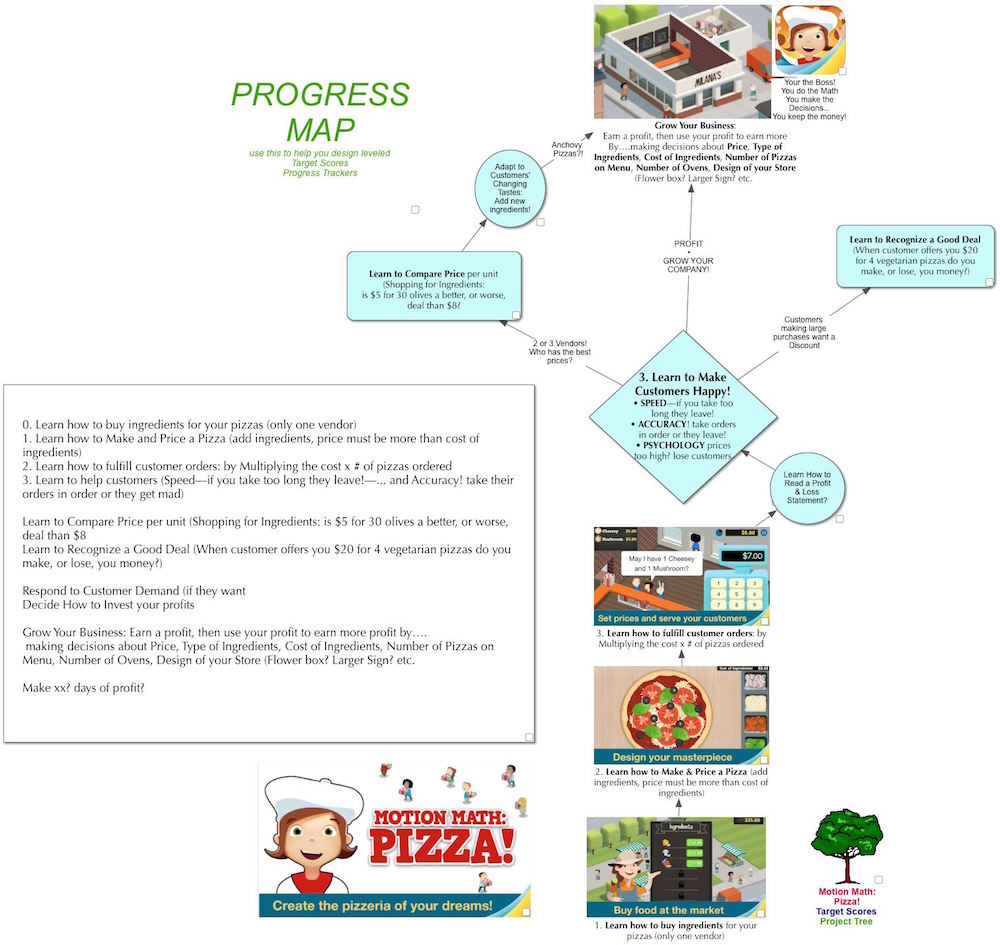
Progress TREE (aka Progress Map) for Motion Math Pizza! Build Your Own Pizzeria

Step 1: Play the Game and list all the Goals

Step 2: Arrange the Goals in to a visual Progress Tree

Pizza MathTarget ScoresTREEStep 3: Play the game again and set specific Targets (TargetScores) that kids must hit to earn credit for the Learning Game in school…

Step 4: Arrange those TargetScores in to LEVELS

Step 5: Motivate Kids: Why this Game? What goals will it help you hit? Method? How does it work so well? Can you beat Ms/Mr X’s score!?


The Mystery of Go, the Ancient Game That Computers Still Can’t Win | WIRED

Invented over 2500 years ago in China, Go is a pastime beloved by emperors and generals, intellectuals and child prodigies. Like chess, it’s a deterministic perfect information game — a game where no information is hidden from either player, and there are no built-in elements of chance, such as dice.1 And like chess, it’s a two-person war game. Play begins with an empty board, where players alternate the placement of black and white stones, attempting to surround territory while avoiding capture by the enemy. That may seem simpler than chess, but it’s not. When Deep Blue was busy beating Kasparov, the best Go programs couldn’t even challenge a decent amateur. And despite huge computing advances in the years since — Kasparov would probably lose to your home computer — the automation of expert-level Go remains one of AI’s greatest unsolved riddles.

via The Mystery of Go, the Ancient Game That Computers Still Can’t Win | WIRED.

Why Coders Are Going Nuts Over SWIFT, Apple’s New Programming Language | WIRED

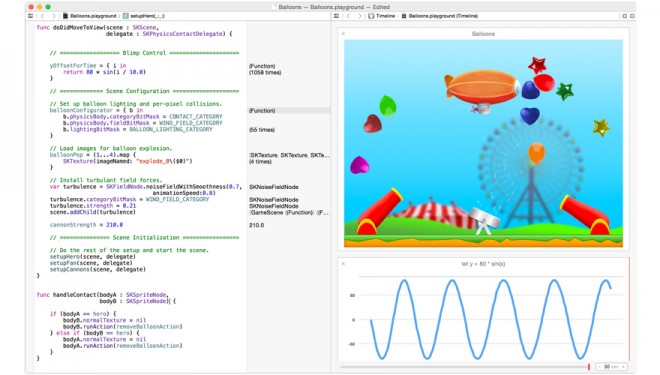
The Interactive Playground

On top of this, Apple has added the “interactive playground,” a way of viewing the results of a piece of code as you type it. Pollak says it reminds him of the work that ex-Apple designer Bret Victor has done with the Javascript language, trying to make it a more visual endeavor. And Larson compares it to the new Wolfram programming language designed by respected scientist and technologist Stephen Wolfram. Andrew Stone, an independent Apple developer living in New Mexico, calls it “absolutely amazing.”

This is the wild card. Depending how well it works, Pollak says, the playground could push mainstream programming in a new direction, providing a more intuitive means of building code. “This isn’t necessarily an Apple invention, but it is something that has been bubbling up over the last few years,” he explains.

via Why Coders Are Going Nuts Over Apple’s New Programming Language | WIRED.

Thank You ResMed! … for Supporting “Music to Mathematics” at OTA

ResMed, a local medical company specializing in sleep apnea and respiratory care solutions, is a generous supporter of San Diego Education non-profits that work with children. At an Awards Luncheon yesterday ResMed presented OTA with a grant to support our Kiwanis Club of San Diego (Serving the World’s Children) Music-Math Learning Acceleration Lab
*** *** ***

What is ST (Spatial Temporal) Math?

Why ST Math?

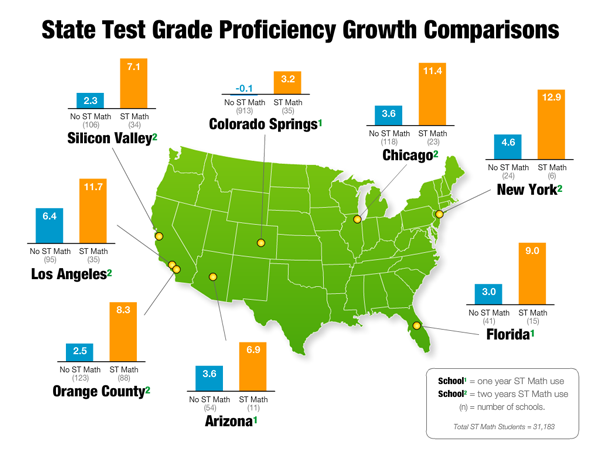
ST Math score nationwide

Why Music at OTA?

2014 Music-It-Makes-You-Smarter-and-Younger

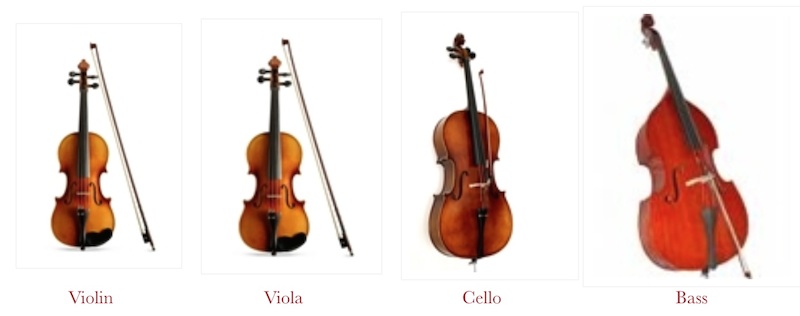
Violin, Viola, Cello, Bass

Is Music the Key to Success?

By JOANNE LIPMAN

Violin, Viola, Cello, Bass

CONDOLEEZZA RICE trained to be a concert pianist. Alan Greenspan, former chairman of the Federal Reserve, was a professional clarinet and saxophone player. The hedge fund billionaire Bruce Kovner is a pianist who took classes at Juilliard.

Multiple studies link music study to academic achievement. But what is it about serious music training that seems to correlate with outsize success in other fields?

The connection isn’t a coincidence. I know because I asked. I put the question to top-flight professionals in industries from tech to finance to media, all of whom had serious (if often little-known) past lives as musicians. Almost all made a connection between their music training and their professional achievements.

The phenomenon extends beyond the math-music association. Strikingly, many high achievers told me music opened up the pathways to creative thinking. And their experiences suggest that music training sharpens other qualities: Collaboration. The ability to listen. A way of thinking that weaves together disparate ideas. The power to focus on the present and the future simultaneously

via Is Music the Key to Success?