
Introduction to “That Quiz” – Online Math Challenges

Intro to ThatQuiz-Games that Make You Strong

The goal of That Quiz math challenges is to help students make basic math skills “Automatic” so they can concentrate on solving word problems in the Saxon Math Text and the TAPS Project Trees (Think Aloud Problem Solving)…. and real math problems from Science, Robotics, Cooking, Carpentry, Money, and more!
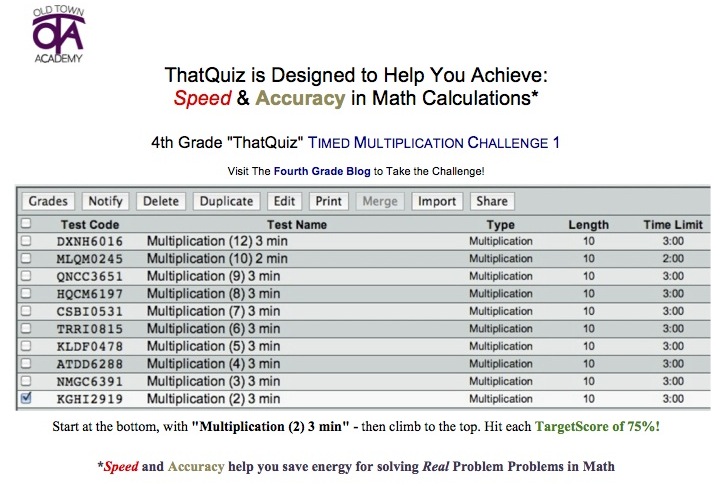
4th Grade That Quiz-Timed Multiplication Challenge

To start using ThatQuiz…

  1. Click: Timed Multiplication Tables Challenge.
  2. Find your name on the roster;
  3. Enter your birthdate (10/1/04), and
  4. Click on your name. 10 Times Tables Quizzes will appear.
  5. Try to finish each Quiz before time runs out!

Other ThatQuiz Math Challenges coming soon…
“The Nobel Prize in Physics is Really a Nobel Prize in Math”

“I have deeply regretted that I did not proceed far enough at least to understand something of the great leading principles of mathematics, for men thus endowed seem to have an extra sense.” — Charles Darwin
Mathematics [should not be] about studying boring and useless equations: It is about accessing a new way of thinking and understanding reality at a deeper level. It endows us with an extra sense and enables humanity to keep pushing the boundaries of the unknown. Excerpted From “The Nobel Prize in Physics is Really a Nobel Prize in Math”

The Myth of ‘I’m Bad at Math’ – Miles Kimball & Noah Smith – The Atlantic

They found that students who agreed that “You can always greatly change how intelligent you are” got higher grades. But as Richard Nisbett recounts in his bookIntelligence and How to Get It, they did something even more remarkable:

Dweck and her colleagues then tried to convince a group of poor minority junior high school students that intelligence is highly malleable and can be developed by hard work…that learning changes the brain by forming new…connections and that students are in charge of this change process. Continue reading →

“Cognition is Recognition” • Fluid nature of mental Categories: The Man Who Would Teach Machines to Think – James Somers – The Atlantic

Automated Public Turing tests to tell Computers and Humans Apart”), those widgets that require you to read distorted text and type the characters into a box before, say, letting you sign up for a Web site.

In Hofstadter’s mind, there is nothing to be surprised about. To know what all A’s have in common would be, he argued in a 1982 essay, to “understand the fluid nature of mental categories.” And that, he says, is the core of human intelligence.

“Cognition is recognition,” he likes to say. He describes “seeing as” as the essential cognitive act: you see some lines as “an A,” you see a hunk of wood as “a table,” you see a meeting as “an emperor-has-no-clothes situation” and a friend’s pouting as “sour grapes” and a young man’s style as “hipsterish” and on and on ceaselessly throughout your day. That’s what it means to understand. But how does understanding work? For three decades, Hofstadter and his students have been trying to find out, trying to build “computer models of the fundamental mechanisms of thought.”

Continue reading →

How to improve at chess. Top 10 reasons for stagnation.

Improve at chess – 10 “secret” obstacles

If you are serious about your chess improvement, you should know the top 10 reasons for stagnation:

1) Too much play

  • Playing chess – practice – is very important for improvement. When you play chess (over the board, at tournaments), you put into practice what you have learned, you use your brain to think chess, you are in the testing environment, you test your accumulated knowledge and skill against another person.
  • However, too much play and too little study holds you back. You can repeat the same mistakes over and over. You will tend to follow your own old patterns and not have time to develop a different, correct thinking process, and to learn proper strategy and new ideas.
  • In this case, you should take a long break from playing and concentrate only on study for several months. You will make a significant improvement.

2) Incomplete knowledge

  • It’s so simple: an incomplete study of theory leaves you with weaknesses and a chain is only as strong as its weakest link.
  • Continue reading →

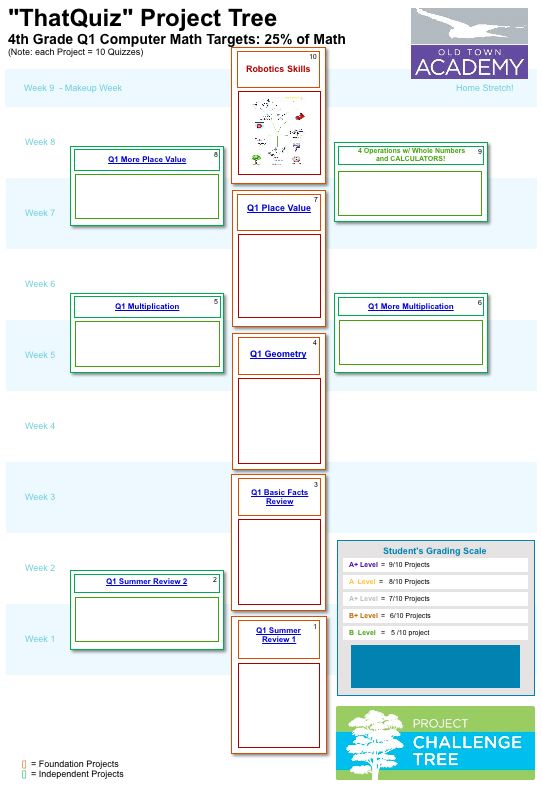
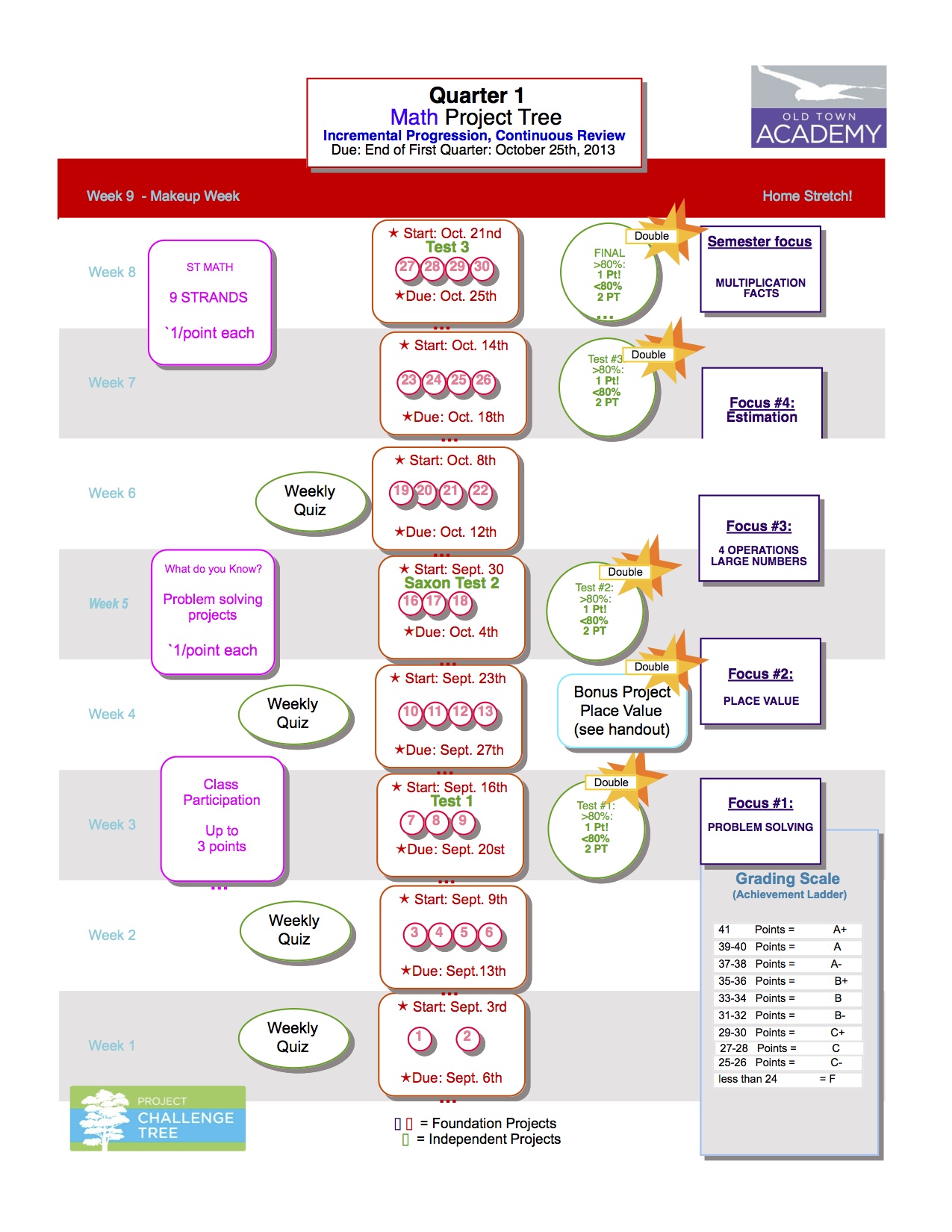
Fourth Grade: 2012-2013 “That Quiz” – Q1 Computer Math Links • MODEL ThatQuiz Project Tree • 2012-2013 Q1

The goal of That Quiz math challenges is to help students make basic math skills “Automatic” (= Speed + Perfection) so they can concentrate on solving real math problems from Science, Robotics, Cooking, Carpentry, Money, and more!

1. Start at the bottom –>
2. Hit your TargetScore for each ThatQuiz (80% Correct in the Given Time) –>
3. Climb as high as you can go in 9 weeks!

PASTE THE LINKS ABOVE into an INTERACTIVE ThatQuiz PROJECT TREE (which you can create in Inspiration… turning it into an html “Project Tree” with live links going to the ThatQuiz links.

=====

Click to print for your refrigerator: Q1 4th ThatQuiz Project Tree

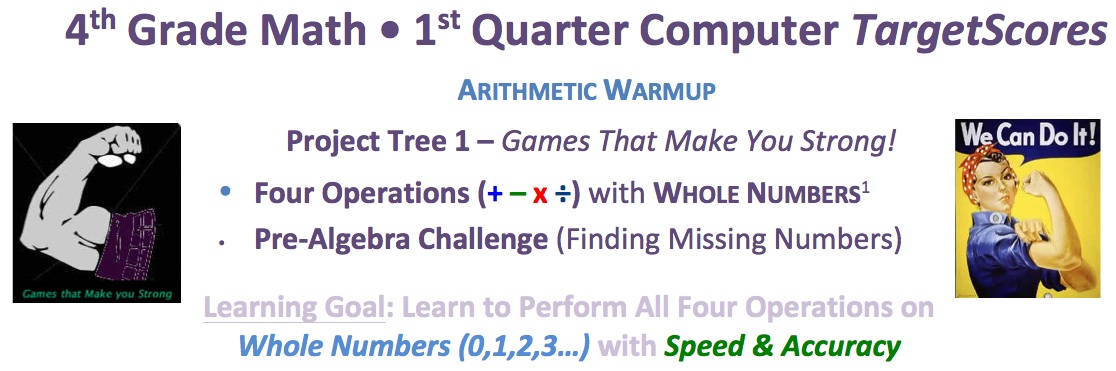
Fourth Grade: 2011-2012 Q1 Math Computer TargetScores

Fourth Graders! Click on the Links Below to Open ThatQuiz Projects;  (Log in with your birthday: month/date/year. For example, October 2, 1999 is written: 10/2/99). Use Your Project Tree to track your Progress and your Computer Math Grade

First Quarter Computer Math Target Scores

4 Operations (+ – x ÷) with Whole Numbers

Pre-Algebra Challenge (Variables)

Second Quarter Computer Math Target Scores

Continue reading →

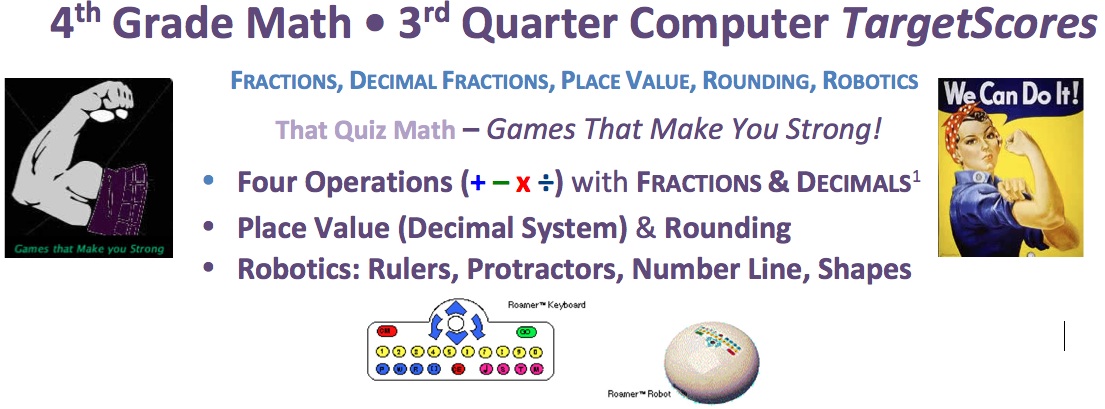
2011-2012: 4th Grade Q3 Math – Computer TargetScores

  ==============================================================

Third Quarter • Computer Math • Target Scores
(Click on the Links Below to Open ThatQuiz Projects) 

Place Value (Decimal System):

*Q2 Review: Didn’t complete this Project in 2nd Quarter? Finish it now for credit!

Continue reading →