Why Do We Do TAPS? Study: You Really Can ‘Work Smarter, Not Harder’ – Nanette Fondas – The Atlantic

We take advantage of this effect (The REFLECTION EFFECT) in the key element in TAPS: the requirement that students think ALOUD. But it only works if students have already been taught how to do the problem. (if they’ve never seen it before you won’t have time for reflection, only teaching –and often confusion since the TAPS space isn’t designed for first time teaching).

Then you the TAPS coach can say: Great you got it right, now explain how you got that answer. Then you coach can ask: Why did you do it that way? Are there other ways you could have used?

Learning is more effective if a lesson or experience is deliberately coupled with time spent thinking about what was just presented, a new study shows. In “Learning by Thinking: How Reflection Aids Performance,” a team of researchers from HEC Paris, Harvard Business School, and the University of North Carolina describe what they call the first empirical test of the effect of reflection on learning. By “reflection,” they mean taking time after a lesson to synthesize, abstract, or articulate the important points.

The Wrong Way to Teach Grammar

In the lab portion of the study, participants completed a math brain teaser under time pressure and wrote about what strategy they used or might use in the future to solve the problem. This group did 18 percent better in a second-round test than their control-group counterparts, who were not given time to reflect. In the field study, groups of newly-hired customer-service agents undergoing job training were compared. Some were given 15 minutes at the end of each training day to reflect on the main things they had learned and write about at least two lessons. Those given time to think and reflect scored 23 percent better on their end-of-training assessment than those who were not. And these improvements weren’t temporary—they lasted over time, researchers found.

via Study: You Really Can ‘Work Smarter, Not Harder’ – Nanette Fondas – The Atlantic.
Rising IQ Scores Don’t Mean Greater Intelligence | New Republic

Woodley and his co-author, Elijah Armstrong, ranked 14 IQ tests according to the extent to which they could be solved by applying and re-applying rules. Some tests, like Raven’s Progressive Matrices, ask test-takers to detect complex patterns—but figuring out and reapplying a few simple rules can result in a substantial boost in scores. Other tests, like vocabulary tests, depend on recalled knowledge; they cannot be solved by using rules. (Determining the rule-dependence of tests is the most subjective part of this paper.) When Armstrong and Woodley compared data on the Flynn effect for each of the 14 different IQ tests, their results were striking: The more rule-dependent a test, the more pronounced the Flynn effect—suggesting that the Flynn effect is not due to increases in general intelligence, but to a better ability to short-circuit the test by detecting and applying certain rules

via Rising IQ Scores Don’t Mean Greater Intelligence | New Republic.

American 15-Year-Olds Lag, Mainly in Math, on International Standardized Tests – NYTimes.com

In the United States, just 9 percent of 15-year-olds scored in the top two levels of proficiency in math, compared with an average of 13 percent among industrialized nations and as high as 55 percent in Shanghai, 40 percent in Singapore, and 17 percent in Germany and Poland.

Jack Buckley, the commissioner of the National Center for Education Statistics, noted that American students from families with incomes in the highest quartile did not perform as well as students with similar backgrounds in other countries.

via American 15-Year-Olds Lag, Mainly in Math, on International Standardized Tests – NYTimes.com.

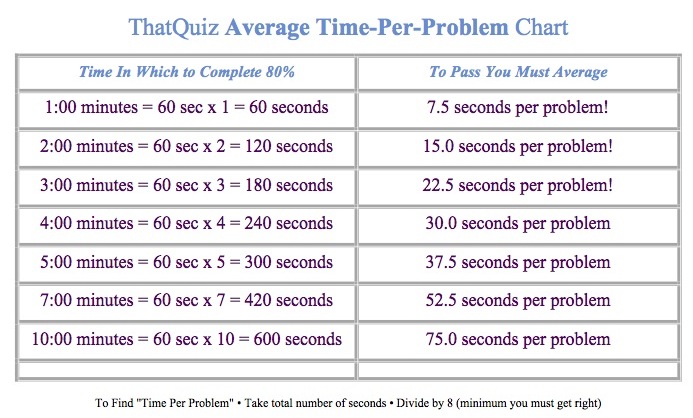
ThatQuiz Average Time-To-Complete-Problem Chart • Post in every lab and classroom

See also: How to Get the Best out of “ThatQuiz”: Quiz Settings, Ideal Number of Problems, Time Pressure, etc.

That Quiz Time Per Problem Chart

  • Students should understand:
    • the goal of ThatQuiz: develop automaticity (speed + accuracy) with core skills & concepts of mathematics to free their minds to solve real-problem problems.
    • how many seconds they have to complete each problem while hitting the 80% TargetScore.
  • Math Lab Coaches should share:
    • Time Data from ThatQuiz Grade Report (Click on Grades and then Student Name–or click on an individual test in Grade Report and you’ll aThatQuiz- Get Data on One Quiz to show students how close/or far away they are.
      • For instance Student 1 averaged 7.7 seconds per problem for the 2’s Times Tables, and 14.3 seconds per problem for the 4’s Times Tables. But since she had 3:00 to finish 8 problems (22.5 seconds per problem) she was in great shape.) Continue reading →

Saxon Math Warrior – Biography of John Saxon

It began with the 1960s “new math.” Then in 1989 the leadership codified a set of national standards that turned classrooms into social engineering projects. The specific goal was to have girls and minorities “like” math. Two decades later the math education disaster has reached new levels, yet math leaders refuse to accept their roles in the devastating results of their academic experiments on America’s school children. The worse part is that government leaders let them get away with it.

John Saxon, a retired military officer who became a math teacher, author, and publisher, began challenging the leadership establishment aggressively in 1981 after he published his first textbook. He accused them of pushing their unproven ideology onto teachers and students. He showed how mathematics could indeed remain true to itself—a historically rich discipline—and still cause students from all academic levels (and races and genders) to say, “I love math!” The math establishment immediately spurned him. Not being a certified teacher, he couldn’t possibly know how to teach. Worse, he refused to support their ideological reform program that said process was the “real” product of learning. To them, mathematical results were a by-product.

This complete biography of John Saxon tells of his life before and after he decided to take on the powerful American mathematics establishment. The belittlement he experienced as a child, the success he achieved as a West Point graduate and decorated pilot, the close family ties he built among his four children, the incremental construction of his proven user-friendly math program over a 15-year period, and the zealous loyalty of his employees are described in detail. It shows why, when he died in 1996, Saxon Publishers had sales of $27 million in spite of major efforts by math education leaders and their political allies to destroy him personally and professionally.

via Saxon Math Warrior – Home Page.

John Saxon (of Saxon Math fame) biography

“Beautiful explanations do not lead to understanding,” said Saxon. He didn’t care if the students didn’t like math. John Saxon knew that when they learned to do the math they would feel good about it. Once you get it, you cannot understand why everyone doesn’t use Saxon Math.

via HAYES: SAXON MATH IS RIGHT — FUZZY, COMMON CORE MATH IS WRONG |Education News.