Testing 1, 2, 3: Creating Quizzes to Gauge Science Knowledge – NYTimes.com

By SHANNON DOYNE and HOLLY EPSTEIN OJALVO MARCH 17, 2010

Interactive Quiz on Galileo

Overview | How can quizzes be used as learning tools and assessments? What is the educational value of not only taking a quiz, but also creating one? Are there significant differences between interactive and traditional quiz formats? In this lesson, students take an online quiz, then create their own quizzes about scientists or science-related topics. They then take one another’s quizzes and consider their efficacy for introducing a new topic, reviewing material and assessing knowledge in a graded exam.

Teachers | How and when do you use interactive materials like online quizzes? How do you usually review material before a quiz or test? Tell us here.

Materials | Computers with Internet access, research materials.

Warm-Up | Play a short round of a quiz game, in the style of “Jeopardy!,” with the class. Tell students that you are the host, and the category is Scientists. Here are the five clues:

  1. This theoretical physicist has offered a new approach to investigating the origin and evolution of the universe. (Answer:Stephen Hawking.)
  2. This scientist spent years in Africa closely observing chimpanzees, work that greatly increased human understanding of chimps and raised provocative questions about human evolution. (Answer: Jane Goodall.)
  3. The discovery that the universe continues to expand is the work of this astronomer, for whom a space telescope is named. (Answer: Edwin Hubble.)
  4. He discovered the moons of Jupiter and the phases of Venus, but contrary to popular belief, he did not invent the telescope. (Answer: Galileo Galilei.)
  5. This biologist’s 1962 book “Silent Spring” catalyzed a national debate about the use of pesticides. (Answer: Rachel Carson.)

Then debrief the activity. Ask: How many of the five questions did most of you know the answer to? If you didn’t know the answers, do you feel like you learned something new? Did the quiz pique your interest in any of these scientists? If so, which ones, and why? If not, why not? And if you did know the answers, did this activity refresh your memory? Could these questions be useful for a review before an exam? How about for the exam itself? Did you find competing against classmates encouraging? Discouraging? Would you have preferred to take the quiz on paper or computer? Would you like to do more quizzes like this in class?

End the warm-up with a discussion of learning styles. Ask students to tell about their experiences with preparing for tests by using flash cards, rewriting their notes, listening to recordings of reading their notes aloud, having friends or family members “quiz” them, etc., and which methods they prefer and find the most effective.

Related | Have students take the interactive quiz All About Galileo. If Internet access is not available in class

via Testing 1, 2, 3: Creating Quizzes to Gauge Science Knowledge – NYTimes.com.
How I Blended My Math Class – Education Week Teacher

By Silvestre Arcos

A little over two years ago, my current principal, Danny Swersky, emailed me about his vision for math instruction at KIPP: Washington Heights Middle School, a charter school that would soon be opening in New York City. Specifically, he told me that he wanted to personalize students’ learning with the help of technology. He encouraged me to play around a little with Khan Academy, the online lesson-content provider. I was immediately intrigued.

At that point in the school year, I had covered all of the standards that would be on the New York state test and was interested in finding new ways to engage my students while continuing to boost their skills So I wheeled a set of school iPads into my classroom and introduced my students to the Khan website. Their response was even more enthusiastic than my own. They quickly started using the site to practice skills, earn “energy points,” and demonstrate mastery. I was excited about the instructional opportunities this kind of tool might present.

Two years later, I’m the founding 5th math grade teacher at KIPP: Washington Heights. My math classroom and my approach to teaching look quite different than they did during the first decade of my teaching career. In particular, my students spend more time working on the computers and in small groups, and I spend far less time teaching whole-class lessons.

Continue reading →

Frequent Tests Can Enhance College Learning, Study Finds – NYTimes.com

By BENEDICT CAREY, Published: November 20, 2013

Grading college students on quizzes given at the beginning of every class, rather than on midterms or a final exam, increases both attendance and overall performance, scientists reported Wednesday.

The findings — from an experiment in which 901 students in a popular introduction to psychology course at the University of Texas took their laptops to class and were quizzed online — demonstrate that the computers can act as an aid to teaching, not just a distraction.

Moreover, the study is the latest to show how tests can be used to enhance learning as well as measure it. The report, appearing in the journal PLoS One, found that this “testing effect” was particularly strong in students from lower-income households.

Psychologists have known for almost a century that altering the timing of tests can affect performance. In the past decade, they have shown that taking a test — say, writing down all you can remember from a studied prose passage — can deepen the memory of that passage better than further study.

The new findings stand as a large-scale prototype for how such testing effects can be exploited in the digital era, experts said, though they cautioned that it was not yet clear how widely they could be applied.

“This study is important because it introduces a new method to implement frequent quizzing with feedback in large classrooms, which can be difficult to do,” said Jeffrey D. Karpicke, a professor of psychology at Purdue, who was not involved in the study.

“This is the first large study to show that classroom quizzing can help reduce achievement gaps” due to socioeconomic background.

On the first day of their Psych 301 course in fall 2011, James W. Pennebaker and Samuel D. Gosling — who have taught it jointly for years — instructed all 901 students to bring a laptop to class, if they had one (they all did).

The students then learned why: They would be taking a short quiz in each subsequent class on their computer. The quizzes would be short and personalized — seven questions that the entire class would answer, and one tailored to each student, usually a question from another quiz that he or she got wrong.

In place of a final exam, grades were based on cumulative quiz scores.

via Frequent Tests Can Enhance College Learning, Study Finds – NYTimes.com.

Test-Taking Cements Knowledge Better Than Studying, Researchers Say – NYTimes.com

To Really Learn, Quit Studying and Take a Test, By PAM BELLUCK – January 20, 2011

Taking a test is not just a passive mechanism for assessing how much people know, according to new research. It actually helps people learn, and it works better than a number of other studying techniques.

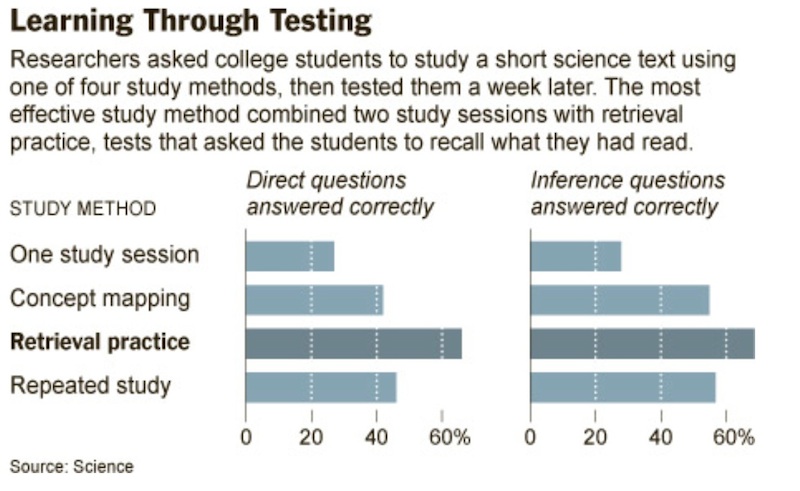
Learning Through Testing Study-NYT Jan 21 2011

Learning Through Testing

The research, published online Thursday in the journal Science, found that students who read a passage, then took a test asking them to recall what they had read, retained about 50 percent more of the information a week later than students who used two other methods.

One of those methods — repeatedly studying the material — is familiar to legions of students who cram before exams. The other — having students draw detailed diagrams documenting what they are learning — is prized by many teachers because it forces students to make connections among facts.

These other methods not only are popular, the researchers reported; they also seem to give students the illusion that they know material better than they do.

In the experiments, the students were asked to predict how much they would remember a week after using one of the methods to learn the material. Those who took the test after reading the passage predicted they would remember less than the other students predicted — but the results were just the opposite.

“I think that learning is all about retrieving, all about reconstructing our knowledge,” said the lead author, Jeffrey Karpicke, an assistant professor of psychology at Purdue University. “I think that we’re tapping into something fundamental about how the mind works when we talk about retrieval.”

Several cognitive scientists and education experts said the results were striking.

The students who took the recall tests may “recognize some gaps in their knowledge,” said Marcia Linn, an education professor at the University of California, Berkeley, “and they might revisit the ideas in the back of their mind or the front of their mind.”

When they are later asked what they have learned, she went on, they can more easily “retrieve it and organize the knowledge that they have in a way that makes sense to them.”

via Test-Taking Cements Knowledge Better Than Studying, Researchers Say – NYTimes.com.

Why Do Americans Stink at Math? (here we go again?)

Takahashi quickly became a convert. He discovered that these ideas came from reformers in the United States, and he dedicated himself to learning to teach like an American. Over the next 12 years, as the Japanese educational system embraced this more vibrant approach to math, Takahashi taught first through sixth grade. Teaching, and thinking about teaching, was practically all he did. A quiet man with calm, smiling eyes, his passion for a new kind of math instruction could take his colleagues by surprise. “He looks very gentle and kind,” Kazuyuki Shirai, a fellow math teacher, told me through a translator. “But when he starts talking about math, everything changes.”

Takahashi was especially enthralled with an American group called the National Council of Teachers of Mathematics, or N.C.T.M., which published manifestoes throughout the 1980s, prescribing radical changes in the teaching of math. Spending late nights at school, Takahashi read every one….

Continue reading →

A Billionaire Mathematician’s Life of Ferocious Curiosity – cf Ilan’s “7 Second Rule” (Before you answer a math problem)

Down one floor from his office complex is Math for America, a foundation he set up to promote math teaching in public schools. Nearby, on Madison Square Park, is the National Museum of Mathematics, or MoMath, an educational center he helped finance. It opened in 2012 and has had a quarter million visitors.

“I wasn’t the fastest guy in the world,” Dr. Simons said of his youthful math enthusiasms. “I wouldn’t have done well in an Olympiad or a math contest. But I like to ponder. And pondering things, just sort of thinking about it and thinking about it, turns out to be a pretty good approach.”

Dr. Sullivan said that Dr. Simons, in his career, had made a series of seminal contributions and that an early one “revolutionized the consciousness of later generations.” He added that in May 2013, to celebrate Dr. Simons’s 75th birthday, four American math and science luminaries gave lectures about fields he had advanced.

Forbes magazine ranks him as the world’s 93nd richest person — ahead of Eric Schmidt of Google and Elon Musk of Tesla Motors, among others — and in 2010, he and his wife were among the first billionaires to sign the Giving Pledge, promising to devote “the great majority” of their wealth to philanthropy. Continue reading →

So, Who Invented Double Entry Bookkeeping? Luca Pacioli or Benedikt Kotruljević? | Steve Mariotti

Italian Inventor of Double Entry Bookkeeping luca-pacioli-portrait

Not Luca Pacioli?

Assets = Liabilities + Owners’ Equity.

Ouch! He was right: The first recorded history of the description of double entry bookkeeping was done by Benedikt in 1458 in his work: Book on the Art of Trade.

Although only in a short appendix, it was the first description of what was as one of the world’s great intellectual breakthroughs — modern accounting. This craft enables merchants, entrepreneurs and their investors to keep track of every penny they received or spent.

Thanks to accounting, it allowed people to organize massive amounts of information into journals and then produces summary financial statements — Continue reading →

No Accounting Skills? No Moral Reckoning

THE GREAT DIVIDE

By JACOB SOLL APRIL 27, 2014

SOMETIMES it seems as if our lives are dominated by financial crises and failed reforms. But how much do Americans even understand about finance? Few of us can do basic accounting and fewer still know what a balance sheet is. If we are going to get to the point where we can have a serious debate about financial accountability, we first need to learn some essentials.

The German economic thinker Max Weber believed that for capitalism to work, average people needed to know how to do double-entry bookkeeping. This is not simply because this type of accounting makes it possible to calculate profit and capital by balancing debits and credits in parallel columns; it is also because good books are “balanced” in a moral sense. They are the very source of accountability, a word that in fact derives its origin from the word “accounting.”

In Renaissance Italy, merchants and property owners used accounting not only for their businesses but to make a moral reckoning with God, their cities, their countries and their families. The famous Italian merchant Francesco Datini wrote “In the Name of God and Profit” in his ledger books. Merchants like Datini (and later Benjamin Franklin) kept moral account books, too, tallying their sins and good acts the way they tallied income and expenditure. Continue reading →

Math-u-See 4 Levels of Arithmetics: 1. Counting 2. Addition 3. Multiplication 4. Exponents

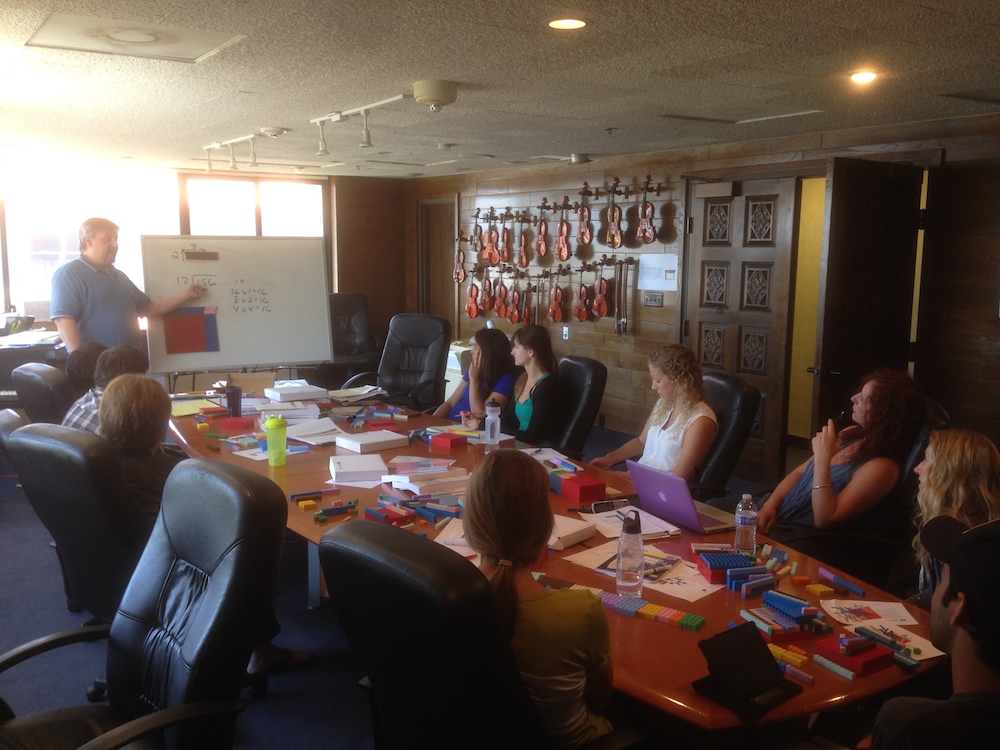
  • They followed that up with a very good Math-u-See* training with Coach Dan.Math-u-See Training
  •  

*Math-u-See Training Today at OTA. Math-u-See is a powerful tool that teachers will be incorporating into TAPS Projects (Think Aloud Problem Solving) and classrooms next year.

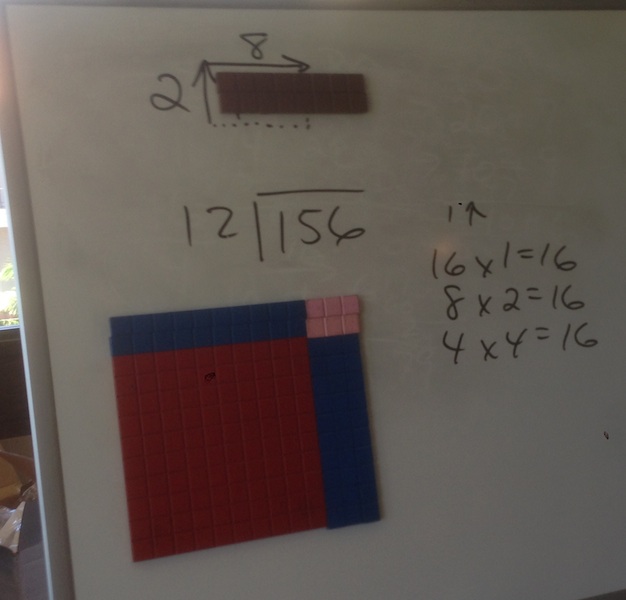
Math-u-See Division is Area

Division problems are Area problems! Given an Area (Dividend) of 16 with a side (Divisor) of 2, find the other side’s dimensions (Quotient). Answer = 8…. W x L = 2 x 8 = 16

Students use ingenious manipulatives to study math concepts and operations as they Build It, Write It, Say It! Students (and Adults^) gain real understanding and see hidden patterns and connections as they study Place Value, Arithmetic Operations at four levels (Counting, Adding, Multplying, Exponents), Fractions, Percents, Algebra and more.

^OTA Parents, Look for “Hour of Math-u-See” Training session which will be offered in August (along with “Hour of Code” Training • “Hour of Piano” • “Hour of ST Math” and many other Parent and Parent-Volunteer Training Courses designed to help you participate in your child’s OTA Lab & Project work at home or by volunteering.

Subitizing – Wikipedia, the free encyclopedia

For instantaneous enlightenment, see Subitism.

Counting or subitizing?

Subitizing, coined in 1949 by E.L. Kaufman et al.[1] refers to the rapid, accurate, and confident judgments of number performed for small numbers of items. The term is derived from the Latin adjective subitus (meaning “sudden“) and captures a feeling of immediately knowing how many items lie within the visual scene, when the number of items present falls within the subitizing range.[1] Number judgments for larger set-sizes were referred to either as counting or estimating, depending on the number of elements present within the display, and the time given to observers in which to respond (i.e., estimation occurs if insufficient time is available for observers to accurately count all the items present).

The accuracy, speed, and confidence with which observers make judgments of the number of items are critically dependent on the number of elements to be enumerated. Judgments made for displays composed of around one to four items are rapid,[2] accurate[3] and confident.[4] However, as the number of items to be enumerated increases beyond this amount, judgments are made with decreasing accuracy and confidence.[1] In addition, response times rise in a dramatic fashion, with an extra 250–350 ms added for each additional item within the display beyond about four.[5]

While the increase in response time for each additional element within a display is relatively large outside the subitizing range (i.e., 250–350 ms per item), there is still a significant, albeit smaller, increase within the subitizing range, for each additional element within the display (i.e., 40–100 ms per item[2]). A similar pattern of reaction times is found in young children, although with steeper slopes for both the subitizing range and the enumeration range.[6] This suggests there is no span of apprehension as such, if this is defined as the number of items which can be immediately apprehended by cognitive processes, since there is an extra cost associated with each additional item enumerated. However,

via Subitizing – Wikipedia, the free encyclopedia.