Does Student Motivation Even Matter (in Math)? — The PISA results

“It’s just fascinating—countries that do very well on PISA in mathematics, countries like Finland, Korea, Japan, and Netherlands, they score terribly on this motivation index,” Loveless aid. “Kids don’t look intrinsically motivated at all.”

What makes kids “like” math is succeeding at math. That is why we like classic Saxon math texts (which make no attempt to motivate students! no photos, no inspiring stories about people who use math when they grow up, no real effort to answer the perennial “When are we going to use this?”). None of this means you shouldn’t ALSO motivate students (while continuing your Saxon Daily 30 Reps”; another case of second rate educational research and analysis, presenting teachers and parents with false dichotomies (motivation or high scores? we choose both!)

via Does Student Motivation Even Matter? — The Atlantic.

Review of: Saxon Math Intermediate series

Saxon Math already has a series of book for kindergarten through third grade, and another series that begins with Math 54 for fourth grade and continues up through Calculus. So why this Intermediate series for grades 3, 4, and 5? For the lower levels, at least part of the answer lies in the differences between the Saxon Math program for K-3 and the rest of the Saxon books from Math 54 up through Calculus. The K-3 program is completely different from the other Saxon books. They were written by a different author, incorporate manipulatives, and have a very teacher-intensive form of lesson presentation.

Math 54 and all the texts beyond that were written by John Saxon, Stephen Hake or both of them together. Saxon Math Intermediate 3, 4, and 5 were written by Stephen Hake and, consequently, are more similar to the upper level books than the K-3 series. Those just starting into Saxon Math at third grade level should probably go with Math Intermediate 3 since it ensures a more comfortable transition into Math 54. Those who have been using the Saxon K-3 series up through second grade can go either way, perhaps deciding based on a preference for manipulatives used in the K-3 courses or a preference for the less teacher-intensive Intermediate 3 course. For older students, you need to choose between Math Intermediate 4 and Math 54, and between Math Intermediate 5 and Math 65.

The Saxon Math Intermediate courses differ some from the Math 54 and up courses in layout, and they require a little more teacher involvement. Parents might need to work through presentation of new concepts with students in each lesson, but some students should be able to work independently through most or all of many lessons.

There are four components to the homeschool kit for each level: the student text, a solutions manual, Power Up Workbook, and Homeschool Testing Book.

Each lesson begins with “Power Up” activities. These are a bit more involved than the “Warm Up” activities that begin each lesson in Math 54 and Math 65. Power Up activities include four categories of problems each time: math fact review, count aloud or “jump start,” mental math, and problem solving. Math Intermediate 3 labels the second category “jump start.” Whatever the label, this second category might include oral counting by increments, drawing hands on a clock, thermometer reading, writing a fact family for three numbers, etc. The count aloud category is dropped from some of the Power Up sections in Math Intermediate 4 and 5 since by fourth and fifth grades students should be able to skip count fairly proficiently and will need only occasional review. The separate Power Up Workbook is used for the written activities for the Power Up section of each lesson with one page to accompany each lesson. The top half of each page is for math fact review problems. Then sections for each of the other three type activities might each contain some content (e.g., clock face in jump start) or simply provide blank space for students to write their responses. I suspect that some students will need assistance in completing some of these activities, especially at the beginning of the school year.

After the Power Up activities, a new concept is introduced along with sample problems that are completely worked out. The series includes some work on conceptual understanding as new skills and concepts are taught. However, concepts are taught with written or pictorial explanations rather than manipulatives (aside from fraction manipulatives used a few times in fourth grade), and conceptual development is not as strong as in Singapore Math or Math-U-See. After the new concept is presented, some lesson practice problems provide students with practice only on the new concept. “Written Practice” problems follow with 15 to 20 problems per lesson for third grade that review previously taught concepts. The number of written practice problems increases to 30 per lesson in fourth and fifth grades.

via Review of: Saxon Math Intermediate series.
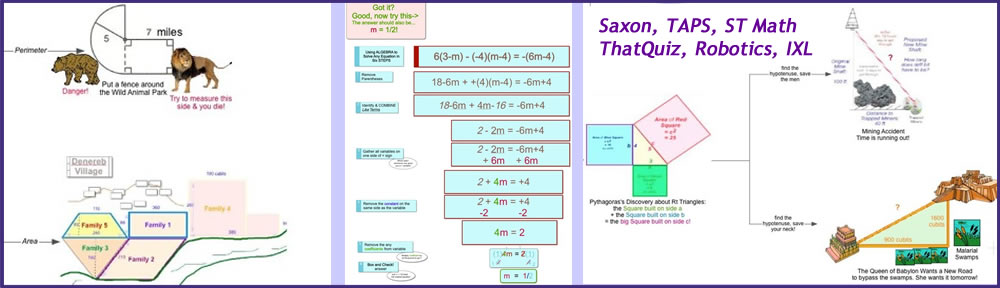
Nine Math Acceleration Tools at Old Town Academy

Click To See ALL Nine Math Acceleration Tools used at OTA:

Math scores went up average of 11% school wide in our first two years… all but two grades are now over 90% advanced or proficient in math, vs. only one class in our first year. In 2013-2014 we added ST Math software to the mix to see if its non-verbal approach to deep understanding can boost scores even higher.

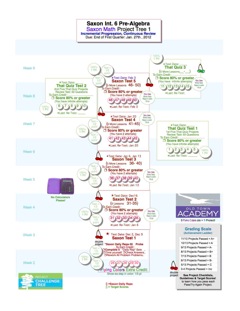
  • 1. Saxon Math Sequence: Incremental progress/continuous review. Why Saxon?
  • 2. Learning Acceleration Math Lab: Thousands of reps with immediate feedback using IXL* (K-3 and 8 algebra) or ThatQuiz* (4th-8th) in the Math Lab + ST Math*.

Click to SEE ALL NINE MATH ACCELERATION TOOLS USED AT OTA

Why Saxon Math — The Word’s Best Math Book?

Genuine learning is demonstrated not only through the understanding of a concept but also through the ability to apply that concept to new situations. Saxon students do both with ease and confidence.Q2-Math-Saxon-project-tree

RESEARCH on the EFFECTIVENESS of the SAXON APPROACH.

The effectiveness of the SAXON APPROACH of INCREMENTAL PROGRESSION + CONTINOUS REVIEW was first demonstrated during the 1980-1981 school year in twenty Oklahoma public schools. Over 1,360 ninth grade Algebra I students participated. In each school one teacher taught one section from a SAXON MATH BOOK and one or more sections from the REGULAR MATH BOOK (new topics every chapter and a daily problem set that drops earlier topics to focus on the new lesson). During the spring, sixteen 10-15 minute tests were given. Each test was on one fundamental skill of beginning algebra and the tests were constructed from problems submitted by the teachers. Overall, the students who used the SAXON MATH BOOK more than doubled the scores of the students who had the same teacher but used a REGULAR MATH BOOK.

For tests on scientific notation and negative exponents, eight classes of Algebra II students were used as controls. The ninth graders who had used the SAXON MATH BOOK more than tripled the scores of the Algebra II students on both of these tests. The test program was monitored by the Oklahoma Federation of Teachers, and they have certified the results.

Students should work every problem in every problem set. This book provides only the problems that are necessary and the problems are not in pairs so that either the odd or the even problems may be assigned. Experience with this book will demonstrate that no extra problems of the new topic are desirable or necessary.* In this book the learning process is spread out and comprehension will come in time. The emphasis is on review and not on an all out attack on the new concept. This development spreads out the learning process, increases the depth of understanding and improves long term retention. Experience with books that use the traditional development of topics has proved that an intensive initial attack on a new concept lends little to long term retention. Remember that SAXON MATH BOOKS never drop a topic once it has been introduced and that the student will continue to wrestle with every concept in every homework problem set.


*  But extra problems of the word problem kind—problems with more life in them than Saxon’s— are necessary and are provided in the Problems Tremendums et Fascinans Course

Why Saxon Math? “Ignition” (Motivation) Talent-Code-Style

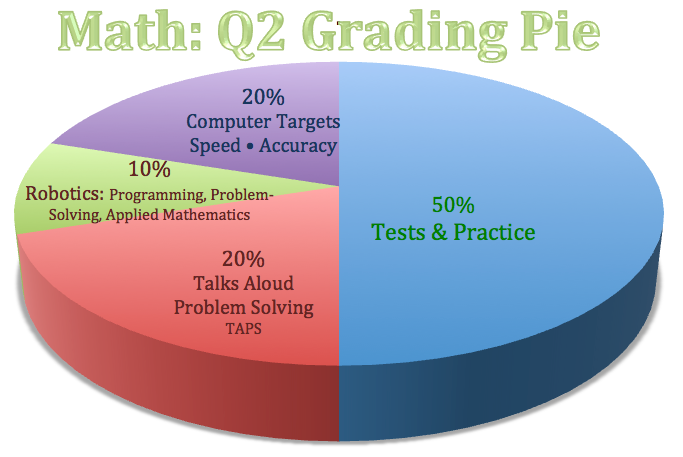
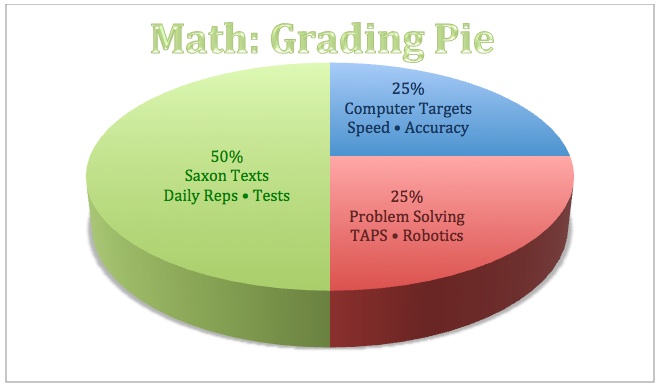
Math Q2 Grading Pie-Robotics

1. Why Do We Use Saxon Math Texts? (How to Study Math–follow this method and, even if you’ve never liked math, you will succeed):
  • Reading & Writing Math: Incremental Progression; Continuous Review
  • Every subject is easy if you take it step-by-step.
  • Saxon doesn’t let you forget the skills you’ve worked so hard to learn. Every Daily Rep problem set is a final exam!
Why Saxon’s the World’s Best Math Book

Continue reading →

How to Use Saxon Math Textbooks

SAXON MATH • OUR MISSION:

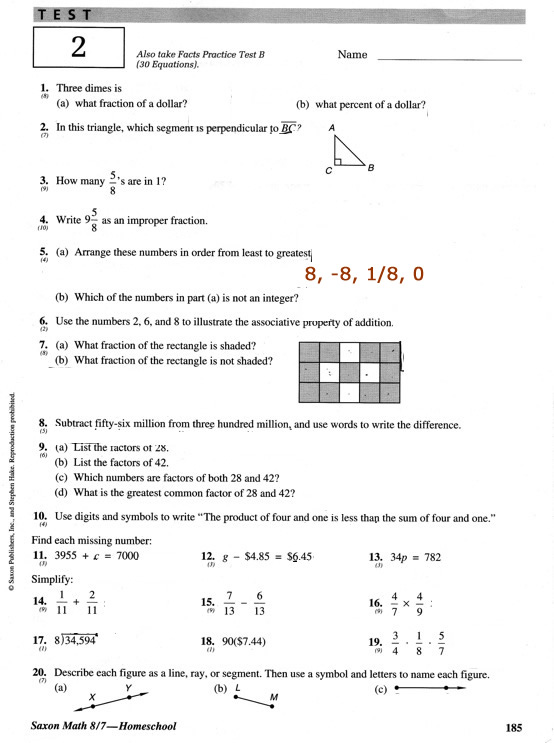
We are dedicated to turning around education by publishing textbooks and instructional Saxon 87 Test 2 (1-10)materials that have proven records of success in the classroom.

Our Philosophy

Learning need not be difficult, but neither does it happen quickly. Time is the elixir that turns things new into things familiar. Therefore, the most effective way for students to learn is through gentle development of concepts and the practice of those concepts extended over a considerable period of time.  At Saxon, we call these methods incremental development and continual review and we have applied to mathematics and the fundamental skills of reading.

Dear Teacher, Stop Talking & Coach!
(See the “Time Thief” Job… for students)

The Teachers job is to make a short presentation of the new lesson and then let the students get to work on their Daily 30 Problem Sets. While they work the teacher goes around the classroom and coaches them on the 2-4 new problems or the 26-28 review problems as needed. The goal is to maximize student Hands-On Practice Time and teachers’ Coaching Time. With good concentration students should be able to finish 50%-100% of their Daily Reps in school.

Many ideas in math that seem complex and overwhelming turn out to be “hard by the yard, but a cinch by the inch.” If we break complex ideas into small easily understandable pieces (increments), we permit the assimilation of one facet of a concept before the next facet is introduced. Both facets are then practiced together until another is introduced.

The incrementalization of topics is combined with continual review, wherein all previously learned material is reviewed in every lesson for the entire year. Topics are never dropped but are instead increased in complexity and practiced every day, providing the time required for concepts to become totally familiar.

As concepts become familiar and the requisite skills become automated, learning becomes a game at which students can succeed and through which they find satisfaction and self-worth. More importantly, the automation of fundamental skills frees students’ minds to think about and solve real math problems (aka Word Problems).

Genuine learnng is demonstrated not only through the understanding of a concept but also through the ability to apply that concept to new situations. Saxon students do both with ease and confidence.

 …….

Students should work every problem in every problem set. Continue reading →

How Tests Make Us Smarter – Low Stakes Quizzes

JULY 18, 2014  By HENRY L. ROEDIGER III

TESTS have a bad reputation in education circles these days: They take time, the critics say, put students under pressure and, in the case of standardized testing, crowd out other educational priorities. But the truth is that, used properly, testing as part of an educational routine provides an important tool not just to measure learning, but to promote it.

In one study I published with Jeffrey D. Karpicke, a psychologist at Purdue, we assessed how well students remembered material they had read. After an initial reading, students were tested on some passages by being given a blank sheet of paper and asked to recall as much as possible. They recalled about 70 percent of the ideas.

Other passages were not tested but were reread, and thus 100 percent of the ideas were re-exposed. In final tests given either two days or a week later, the passages that had been tested just after reading were remembered much better than those that had been reread.

What’s at work here? When students are tested, they are required to retrieve knowledge from memory…

via How Tests Make Us Smarter – NYTimes.com.

Testing 1, 2, 3: Creating Quizzes to Gauge Science Knowledge – NYTimes.com

By SHANNON DOYNE and HOLLY EPSTEIN OJALVO MARCH 17, 2010

Interactive Quiz on Galileo

Overview | How can quizzes be used as learning tools and assessments? What is the educational value of not only taking a quiz, but also creating one? Are there significant differences between interactive and traditional quiz formats? In this lesson, students take an online quiz, then create their own quizzes about scientists or science-related topics. They then take one another’s quizzes and consider their efficacy for introducing a new topic, reviewing material and assessing knowledge in a graded exam.

Teachers | How and when do you use interactive materials like online quizzes? How do you usually review material before a quiz or test? Tell us here.

Materials | Computers with Internet access, research materials.

Warm-Up | Play a short round of a quiz game, in the style of “Jeopardy!,” with the class. Tell students that you are the host, and the category is Scientists. Here are the five clues:

  1. This theoretical physicist has offered a new approach to investigating the origin and evolution of the universe. (Answer:Stephen Hawking.)
  2. This scientist spent years in Africa closely observing chimpanzees, work that greatly increased human understanding of chimps and raised provocative questions about human evolution. (Answer: Jane Goodall.)
  3. The discovery that the universe continues to expand is the work of this astronomer, for whom a space telescope is named. (Answer: Edwin Hubble.)
  4. He discovered the moons of Jupiter and the phases of Venus, but contrary to popular belief, he did not invent the telescope. (Answer: Galileo Galilei.)
  5. This biologist’s 1962 book “Silent Spring” catalyzed a national debate about the use of pesticides. (Answer: Rachel Carson.)

Then debrief the activity. Ask: How many of the five questions did most of you know the answer to? If you didn’t know the answers, do you feel like you learned something new? Did the quiz pique your interest in any of these scientists? If so, which ones, and why? If not, why not? And if you did know the answers, did this activity refresh your memory? Could these questions be useful for a review before an exam? How about for the exam itself? Did you find competing against classmates encouraging? Discouraging? Would you have preferred to take the quiz on paper or computer? Would you like to do more quizzes like this in class?

End the warm-up with a discussion of learning styles. Ask students to tell about their experiences with preparing for tests by using flash cards, rewriting their notes, listening to recordings of reading their notes aloud, having friends or family members “quiz” them, etc., and which methods they prefer and find the most effective.

Related | Have students take the interactive quiz All About Galileo. If Internet access is not available in class

via Testing 1, 2, 3: Creating Quizzes to Gauge Science Knowledge – NYTimes.com.

Frequent Tests Can Enhance College Learning, Study Finds – NYTimes.com

By BENEDICT CAREY, Published: November 20, 2013

Grading college students on quizzes given at the beginning of every class, rather than on midterms or a final exam, increases both attendance and overall performance, scientists reported Wednesday.

The findings — from an experiment in which 901 students in a popular introduction to psychology course at the University of Texas took their laptops to class and were quizzed online — demonstrate that the computers can act as an aid to teaching, not just a distraction.

Moreover, the study is the latest to show how tests can be used to enhance learning as well as measure it. The report, appearing in the journal PLoS One, found that this “testing effect” was particularly strong in students from lower-income households.

Psychologists have known for almost a century that altering the timing of tests can affect performance. In the past decade, they have shown that taking a test — say, writing down all you can remember from a studied prose passage — can deepen the memory of that passage better than further study.

The new findings stand as a large-scale prototype for how such testing effects can be exploited in the digital era, experts said, though they cautioned that it was not yet clear how widely they could be applied.

“This study is important because it introduces a new method to implement frequent quizzing with feedback in large classrooms, which can be difficult to do,” said Jeffrey D. Karpicke, a professor of psychology at Purdue, who was not involved in the study.

“This is the first large study to show that classroom quizzing can help reduce achievement gaps” due to socioeconomic background.

On the first day of their Psych 301 course in fall 2011, James W. Pennebaker and Samuel D. Gosling — who have taught it jointly for years — instructed all 901 students to bring a laptop to class, if they had one (they all did).

The students then learned why: They would be taking a short quiz in each subsequent class on their computer. The quizzes would be short and personalized — seven questions that the entire class would answer, and one tailored to each student, usually a question from another quiz that he or she got wrong.

In place of a final exam, grades were based on cumulative quiz scores.

via Frequent Tests Can Enhance College Learning, Study Finds – NYTimes.com.