Dear 8th Grade Parents, Click on the links below to try sample Zingy Science Modules:
- Question
- Exploration
- Test Yourself
DRAFT Zingy Lessons Re-Ordered for OTA 4th-5th v2
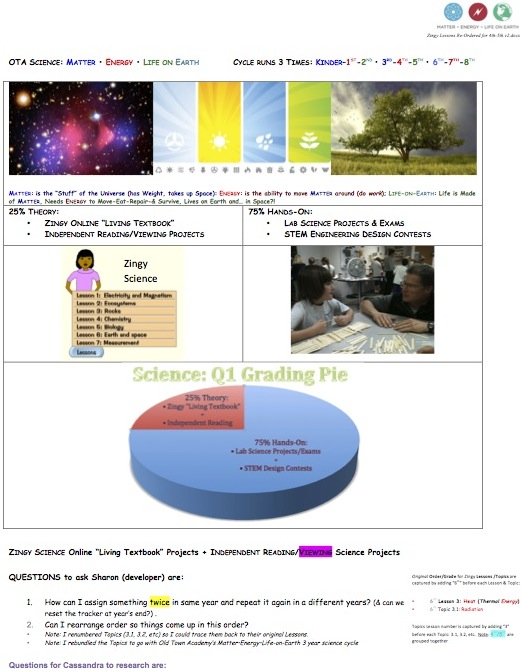
25% Theory | 75% Lab Science Project & Exams???? or 40% | 60% in 2014-2015
Dear 8th Grade Parents, Click on the links below to try sample Zingy Science Modules:
DRAFT Zingy Lessons Re-Ordered for OTA 4th-5th v2
25% Theory | 75% Lab Science Project & Exams???? or 40% | 60% in 2014-2015
JULY 18, 2014 By HENRY L. ROEDIGER III
TESTS have a bad reputation in education circles these days: They take time, the critics say, put students under pressure and, in the case of standardized testing, crowd out other educational priorities. But the truth is that, used properly, testing as part of an educational routine provides an important tool not just to measure learning, but to promote it.
In one study I published with Jeffrey D. Karpicke, a psychologist at Purdue, we assessed how well students remembered material they had read. After an initial reading, students were tested on some passages by being given a blank sheet of paper and asked to recall as much as possible. They recalled about 70 percent of the ideas.
Other passages were not tested but were reread, and thus 100 percent of the ideas were re-exposed. In final tests given either two days or a week later, the passages that had been tested just after reading were remembered much better than those that had been reread.
What’s at work here? When students are tested, they are required to retrieve knowledge from memory…
By SHANNON DOYNE and HOLLY EPSTEIN OJALVO MARCH 17, 2010
Interactive Quiz on Galileo
Overview | How can quizzes be used as learning tools and assessments? What is the educational value of not only taking a quiz, but also creating one? Are there significant differences between interactive and traditional quiz formats? In this lesson, students take an online quiz, then create their own quizzes about scientists or science-related topics. They then take one another’s quizzes and consider their efficacy for introducing a new topic, reviewing material and assessing knowledge in a graded exam.
Teachers | How and when do you use interactive materials like online quizzes? How do you usually review material before a quiz or test? Tell us here.
Materials | Computers with Internet access, research materials.
Warm-Up | Play a short round of a quiz game, in the style of “Jeopardy!,” with the class. Tell students that you are the host, and the category is Scientists. Here are the five clues:
Then debrief the activity. Ask: How many of the five questions did most of you know the answer to? If you didn’t know the answers, do you feel like you learned something new? Did the quiz pique your interest in any of these scientists? If so, which ones, and why? If not, why not? And if you did know the answers, did this activity refresh your memory? Could these questions be useful for a review before an exam? How about for the exam itself? Did you find competing against classmates encouraging? Discouraging? Would you have preferred to take the quiz on paper or computer? Would you like to do more quizzes like this in class?
End the warm-up with a discussion of learning styles. Ask students to tell about their experiences with preparing for tests by using flash cards, rewriting their notes, listening to recordings of reading their notes aloud, having friends or family members “quiz” them, etc., and which methods they prefer and find the most effective.
Related | Have students take the interactive quiz All About Galileo. If Internet access is not available in class
via Testing 1, 2, 3: Creating Quizzes to Gauge Science Knowledge – NYTimes.com.
The Power of Introverts: An Essential Understanding for Teachers | Edutopia.
Here’s a nugget of Cain’s advice for teachers: “If you’re a teacher, enjoy your gregarious and participatory students. But don’t forget to cultivate the shy, the gentle, the autonomous — the ones with single-minded enthusiasm for chemistry sets or parrot taxonomy or nineteenth-century art. They are the artists, engineers, and thinkers of tomorrow.” She also writes a lot about how teachers can work with introverted students.
In the United States, just 9 percent of 15-year-olds scored in the top two levels of proficiency in math, compared with an average of 13 percent among industrialized nations and as high as 55 percent in Shanghai, 40 percent in Singapore, and 17 percent in Germany and Poland.
Jack Buckley, the commissioner of the National Center for Education Statistics, noted that American students from families with incomes in the highest quartile did not perform as well as students with similar backgrounds in other countries.
via American 15-Year-Olds Lag, Mainly in Math, on International Standardized Tests – NYTimes.com.
October 7, 2010 by questmiddleschool
Science Test #2 next Thursday! Oct 28.
Topics: Electromagnetic Energy: Permanent and Electromagnets
Optional Science Reading Projects: The Story of Science: Newton at the Center, by Joy Hakim:
READING Project 1: Chapter 31 (A Shocking Science: Energy, Franklin, Static Electricity)
READING Project 2: Chapter 32 (Michael Faraday Has a Field Day: Electromagnetic Fields and Motors). Continue reading
Direct Current (DC) Electricity – Succeed in Understanding Physics: School for Champions.
DC electricity is the continuous movement of electrons through a conducting material such as a metal wire. The electrons move toward a positive (+) potential in the wire.
DC movement of electrons in wire
In reality, there are millions of electrons weaving their way among the atoms in the wire. This is just an illustration of the movement.
What’s the relation between Watts, Ohms, Amps, and Volts?
Memorizing facts? That’s not learning. Tie it all together instead. Ohm’s law and electrical energy.
What Is “Electricity?”
There is a simple answer to this question. Really. Not the one you expect, though.
Electricity: Frequently-asked Questions (FAQ)
Browse these Electricity Answers, or submit a new question.
How transistors REALLY work
Problems with traditional transistor explanations… Continue reading
Note: Zingy Science groups the CA Science Topics for 4th & 5th into One Module.
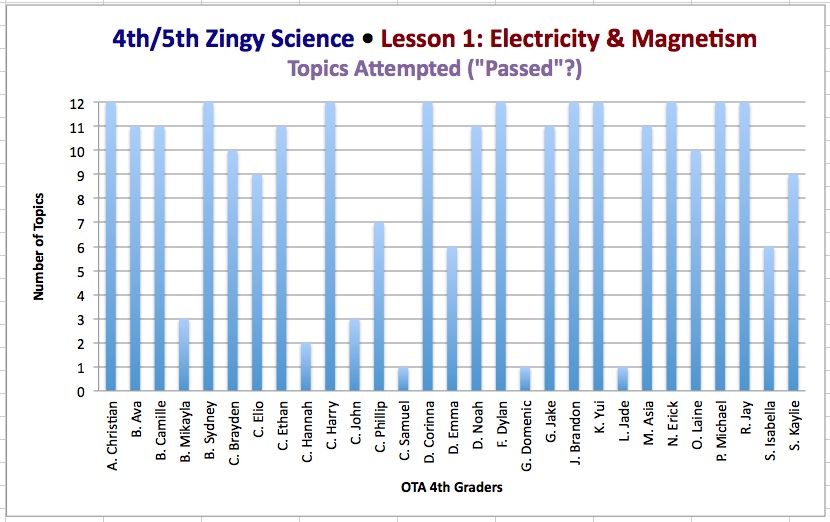
******** OTA 5th Graders Zingy Progress Graph below…. *************
DRAFT Zingy Lessons Re-Ordered for OTA 4th-5th v2
===== pg 2 ===== Continue reading