
Category Archives: Oceanography
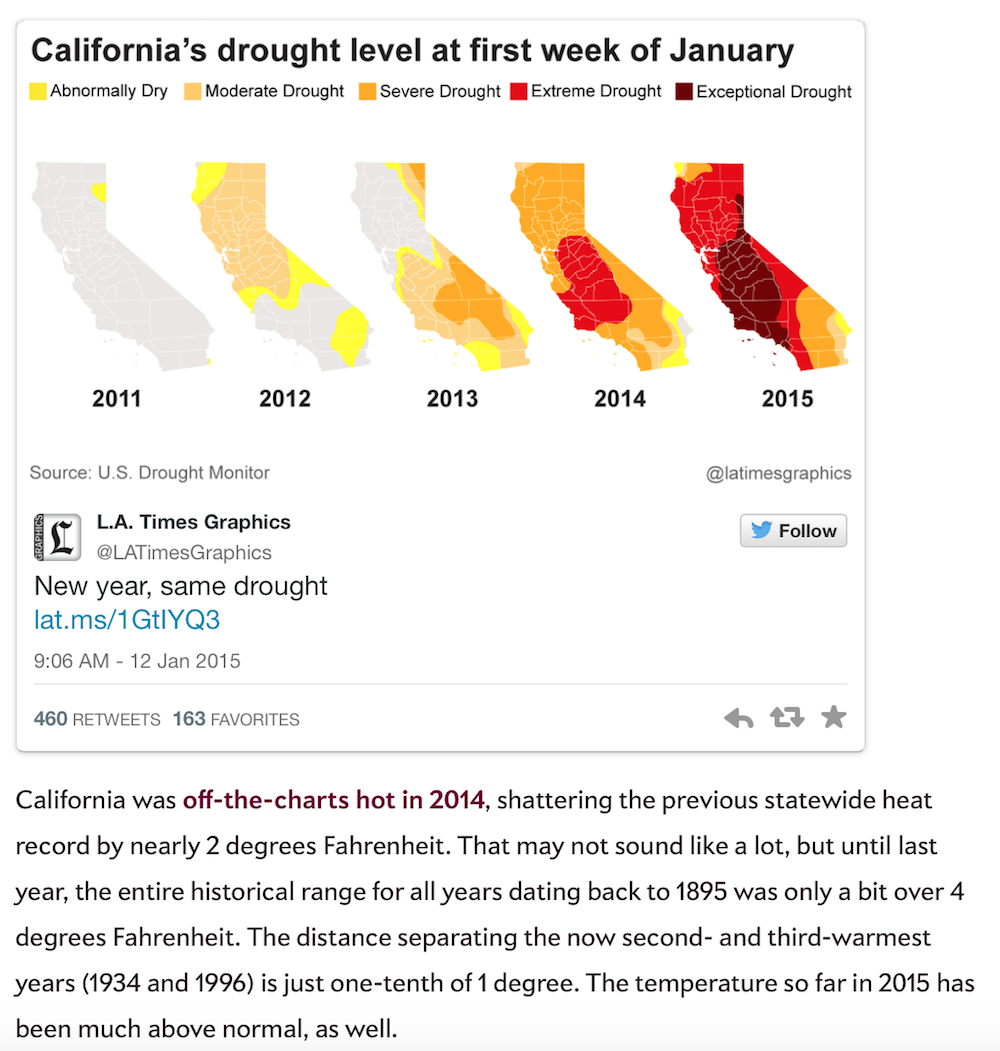
California Drought Map 2012-2015
How Bad is the California Drought?
Southern california underwater marine life field guide: Submit Your Photos!
Underwater Field Guide to the Flora and Fauna of Southern California
California Fish ID
Welcome to the Southern California Underwater field guide. More than 450 species are represented here, covering a geographic area from San Diego to Santa Barbara.
- You are invited to contribute photos to this field guide. To make a submission, or for assistance in identifying something unknown, please email sgietler@yahoo.com
- All photos are copyrighted by each photographer and should not be used without their permissions. Field guide contributors are listed below.
We hope these galleries help you appreciate the marvelous wonders in our oceans. If this field guide was useful, please feel free to sign the guestbook at the very bottom of the page, and add your comments. Thanks – Scott Gietler
Reef and Pelagic Fish Perch, bass, wrasses, garibaldis, mackerals click here
Bottom Dwelling fish Eels, flatfish, gobies, blennies, kelpfish, poachers click here
Rockfish, Sculpins, Scorpionfish click here
Sharks and Rays click here
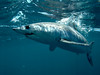
Octopus vs. Sea Lion—First Ever Video
- Sea Lions always feed on the seafloor, never on pelagic prey
New National Geographic Crittercam footage shows never before seen eating habits of the Australian sea lion—including video of a sea lion hunting a large octopus. The footage is from a project intended to help save the endangered sea lions, in part by uncovering where and how the animals eat.
La Jolla Marine Preserve • Tide Pools (“Dike Rock”-Scripps Pier) • PROJECT 4: Geology of La Jolla Marine Preserve
Geology of Dike Rock Tide Pools (North of Scripps Pier)
“This tidepool area is interesting for several reasons. First, the geology is unique. Most of the rocks in the coastal areas of Southern California represent ancient beach deposits and are largely sandstones and siltstones. The layering is obvious in the cliffs on either side of the tide pool. These rocks are about 40 to 50 million years old.
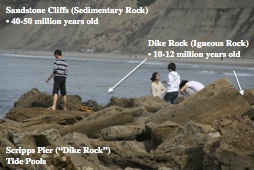
“But if you look carefully at the main rock bench that extends out into the ocean and forms the foundation for the tide pools, you’ll see that it is not the same rock that makes up the cliffs . It is darker and harder, and looks similar to the lava rock common on volcanic islands. This vertical outcrop, or “Dike,” was formed from hot, molten rockthat forced its way up through a crack in the layered beach rocks of the cliffs about 10 to 12 millions years ago (Miocene Epoch). This geologic feature is called a dike, hence the name “Dike Rock,” one of the most prominent features of these tide pools.”
What are the Three Types of Rock and How is Each Created (Rock Cycle)?
-

- Igneous
-
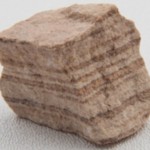
- Sedimentary
-

- Metamorphic
Igneous (from Latin igneus: “fire”): rocks formed from lava or magma (underground molten rock) Continue reading
La Jolla Marine Preserve • Tide Pools (Rocky Shore Intertidal Zone) • PROJECT 3: Learning the Names: Species Scavenger Hunt
** Tide Pools Project 3 ** Learning the Names • Due Monday, Nov 3
“What if a tree fell in the forest and no one knew it’s biological name? Did it exist?”
― Richard Louv, Last Child in the Woods
It can take years to learn all the name and natural history of all the species that live in the La Jolla “Dike” Tide Pools. Fewer and fewer scientists or amateur “Naturalists” are taking the time to “learn the names.” This means when a species population drops, or when a new invasive species is introduced, scientists often don’t even know.
How Many of these Tide Pool Species can you find for yourself?
- __ PHOTOGRAPH or VIDEOTAPE each species you find
- __ Classify them using Wikepedia by Kingdom, Phlyum, Class, Order, Family, Genus, Species. (King Phillip Calls Out For Green Spam)
- __ Make notes (by voice or in journal) on date, location (splash zone? upper intertidal? etc., behavior, identifying characteristics.
- __ To Earn Credit: Take photos or videos of species in at least one species from 4 of these 6 Categories: 1. Birds, 2. Crustaceans, 3. Echinoids, 4. Fish, 5. Invertebrates, 6. Mollusks
 |
 |
Rocky Shore Intertidal Community
Splash Zone Continue reading
La Jolla Tide Pools • Project 2: Nature Photography/Videography Contest Intro Video • “Learning the Names”: Species Census • Photo/Video Contest
** Tide Pools Project 2: Nature Photography/Videography Contest **
Final Entries Due Mon, Nov 3 • All photos must be taken within the Marine Preserve
To Earn Credit:
- __Take photos or videos of species in at least 4 of 6 Categories:
- __Enter your Photos or Videos in the Nature Photography Contest.
For Flying Colors (3 pts) Make a Watercolor or Oil or Acrylic or Colored Pencil Painting of your favorite photo. “Drawing is the queen of the sciences” –Leonardo DaVinci
Prizes awarded for: Best Landscape Photo • Best Seascape Photo • Best Fish Photo/Video • Best Crustacean Photo/Video • Best Echinoid Photo/Video • Best Bird Photo/Video • Best Invertebrate Photo/Video• Best Mollusk Photo/Video
It can take years to learn all the name and natural history of all the species that live in the La Jolla “aka Dike Rock” Tide Pools. Fewer and fewer scientists or amateur “Naturalists” are taking the time to “learn the names.” This means when a species population drops, or when a new invasive species is introduced, scientists often don’t even know.
Life in a San Diego tide pool: Matter•Energy•Life
Many different kinds of plant and animal life call San Diego tide pools their home, nourished with fresh oxygen and food delivered by the daily ocean tides. Animals that thrive in tide pools include sea stars, sea urchins, sea cucumbers, barnacles, mussels, snails, crabs, limpets and anenomes. The Red and Pacific Octopi also live in tide pools. Various algae such as Palm Kelp, Scouring Pad and Surf Grass can also be found in San Diego tide pools.
Species Preview:
–>>Green Crab Eating a Barnacle (Leaf Barnacle or Limpet?)
Sea Slug (Black Sea Hare)
–>>
Species Scavenger Hunt • Photography/Video Contest
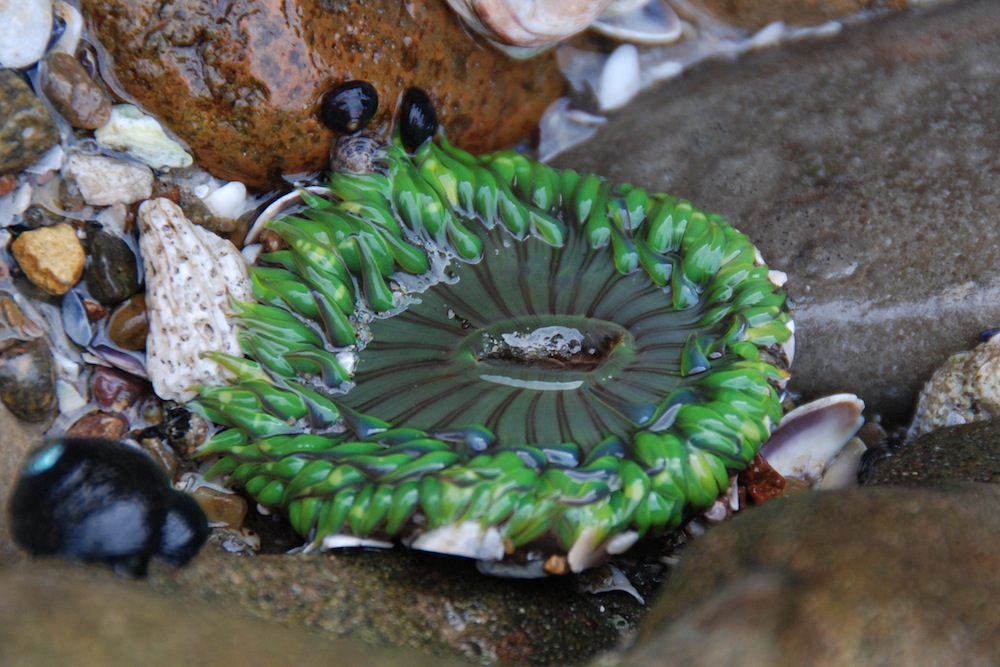
Giant Green Anenome
*
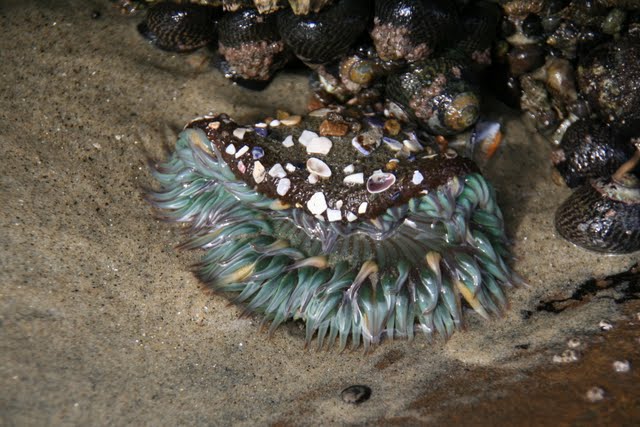
Giant Green Anenome- w/ Shells (Why would it cover itself with shells?)
La Jolla Marine Preserve • Tide Pools • Project 1: Seeing Like a Biologist
** Tide Pools Project 1: Seeing Like a Biologist • Ecosystem Book **
See model from last year. Create a book on the La Jolla Tidepool ecosystem.
Tide Pools (aka the Intertidal Zone):
- Environmental challenges to inhabitants
- Survival of the Fittest Species,
- Adaptations to environmental conditions
The Intertidal-National Geographic Video
Seeing like a BIOLOGIST (not a Tourist!)
(Checklist: Matter, Energy, Life-on-Earth:
6 characteristics of all Living Things):
1. Cellularity? Collecting no longer allowed (with good reason!)-otherwise field microscope, magnifying glass- plant/animal dissection
2. Energy? Where does each species get it?
3. Homeostasis (as tide comes and goes, sun comes and goes, fresh water comes and goes): How do different species maintain a constant salinity, temperature, environment (water vs air), location?
4. Response to Environment. Anenomes? Crabs? Slugs? (see melatonin article and plankton!)
5. Grow: ??
6. Reproduce: Shark Egg “purses”
—————————
X. Struggle for Survival • Natural Selection • Adaptations • Evolution: How is each species adapted to its niche? How does it use space, light, water, food sources?
Y. “Ecological Services”: what do the different zones in the Intertidal Zone (Tide Pools) provide for the whole ecosystem? What does the rocky areas, surf zone, deep water provide? What do the cliffs provide?—
=================
La Jolla Scripps Pier (aka “Dike Rock”) tide pools
Tide pools can be small, shallow puddles found high up on the shore or huge, deep holes nearer to the sea. They’re created when the rising and falling tides of the of the ocean covers the rocks or beach twice a day. Tide pools that are below the low-tide line, are filled with ocean water most of the time. When tide pools are above the low-tide line, they may be exposed to air much of each day, which poses a special challenge to the organisms living there.
Life in a San Diego tide pool
Many different kinds of plant and animal life call San Diego tide pools their home, nourished with fresh oxygen and food delivered by the daily ocean tides. Animals that thrive in tide pools include sea stars, sea urchins, sea cucumbers, barnacles, mussels, snails, crabs, limpets and anenomes. The Red and Pacific Octopi also live in tide pools. Various algae such as Palm Kelp, Scouring Pad and Surf Grass can also be found in San Diego tide pools.
Life in a tide pool can be a challenge
What kinds of ADAPTATIONS allow tide pool species to maintain homeostasis? fight wave and tidal energy?
Organisms living in a tide pool are often exposed to extreme conditions. For example, they may have to survive both wet and dry conditions because smaller tide pools often dry up in between tides. Animals can hide under cool, damp rocks and moist seaweed so that their bodies don’t dry out before the tide comes in again. During a big rainfall, the tide pool may fill with fresh water, a sharp contrast to the usual salt water environment. Also, the water temperature in a tide pool can vary greatly between hot and cold days.
What kinds of ADAPTATIONS allow tide pool species to maintain homeostasis? fight wave and tidal energy?

How to Make Music With a Whale
I myself have never had one of those moments when I looked into the eye of a whale and knew we shared something special — no, nothing like that. My encounters with humpback whales happen mainly through sound. Along with being a philosophy and music professor, I play music for a living: some of my fellow musicians are humans, but just as often they are animals, and sometimes those animals are whales. I sit on a boat, swaying in the waves, headphones on, listening to what goes on below and try to play along.

I don’t do it often — there always seems to be some technical problem setting it up. It’s hard to find a boat with the right amplifier for the underwater speaker. Or I can’t charter a skiff or zodiac for this kind of work because officially it counts as harassment of marine mammals, which is against the law.
Phytoplankton (Plant- Wanderers) – Wikipedia
Phytoplankton

Phytoplankton are the autotrophic components of the plankton community and a key factor of oceans, seas and freshwater basins ecosystems. The name comes from the Greek words φυτόν (phyton), meaning “plant“, and πλαγκτός (planktos), meaning “wanderer” or “drifter”.[1] Most phytoplankton are too small to be individually seen with the unaided eye. However, when present in high enough numbers, they may appear as a green discoloration of the water due to the presence of chlorophyll within their cells (although the actual color may vary with the species of phytoplankton present due to varying levels of chlorophyll or the presence of accessory pigments such asphycobiliproteins, xanthophylls, etc.).