How plants adapt: Calcium waves help the roots tell the shoots

calcium waves help plants react to environment*

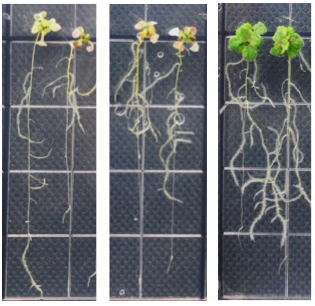
Arabidopsis thaliana growing in salt water. The plant on the right has more of the protein channel TPC1, thought to be involved in calcium signaling in plants. The plant at center has less TPC1 than normal, and the one on the left is considered normal. Credit: Won-Gyu Choi/Gilroy Lab
It’s a finding that has implications for those interested in how plants adapt to and thrive in changing environments. For instance, it may help agricultural scientists understand how to make more salt- or drought-tolerant plants.

“How do you think plants live?” Gilroy asks. “If I poke you, I see an instant response. You move away. Plants live in a slightly different world. They are rooted to the ground, literally, and they respond to the world either by growing or creating chemicals.”

Calcium is involved in transmitting information in the cells of humans and other animals, contracting muscles, sending nerve signals and more.

In plants, scientists believed it had to also play a role in processing information and sending rapid signals so that plants can respond quickly to their environments.

Imagine you are a plant being eaten by a caterpillar: “It’s like a lion chewing your leg,” says Gilroy. “If an insect is chewing your leaf, you’re gone unless you determine something effective immediately.”

But no one had ever been able to see it before. Even Gilroy’s team found it by accident.

via How plants adapt: Calcium waves help the roots tell the shoots.

How Caffeine Evolved to Help Plants Survive and Help People Wake Up

Cocoa BeansScientists had already determined that caffeine was also made in other plants, like tea and cacao, by N-methyltransferases. But by sequencing the coffee genome, Dr. Albert and his colleagues were able to make a more detailed comparison of the genes in different species. They discovered that in cacao, the enzymes manufacturing caffeine did not evolve from the same ancestors as those in coffee.

In other words, the coffee plant and cacao plant took different evolutionary paths to reach the same destination. Evolutionary biologists call this sort of process convergent evolution.

Continue reading →

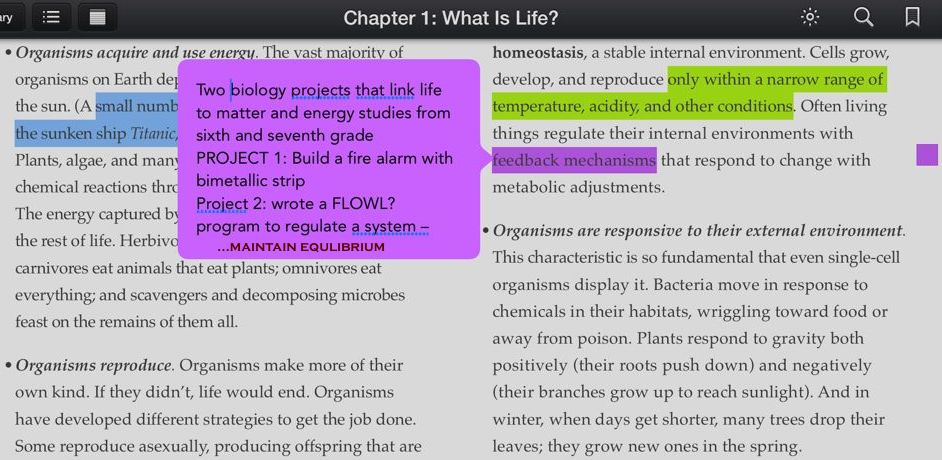
“Active Learning” Projects to Accompany E.O. Wilsons Life on Earth iBook– Homeostasis (5th Characteristic of Living Things)

Wilson’s textbook, Life on Earth: Unit 1: Unity and Diversity of Life on Earth, is an intelligent, physics first approach to biology, but the “projects are too often “Cookbook Labs” (some might be salvageable)

So, here are ideas for OTA Active Learning, Physics First, Projects to accompany the book…

If we’re going to look at homeostasis as one of the six characteristics of living things, why not go back to skills and themes (1. Matter, 2. Energy 3. Life-on-Earth 4. Measuring & Math: Unlocking Nature’s Secrets and 5. STEM: Applications of 1-4…. to do work they learned (or someday will!) in 6th & 7th and dwell on it for few days (while they keep reading outside of class).
  • PRACTICE in the LAB: to build those homeostatic control devices &
  • THEORY on the Computers/iPads: write code to regulate the same kind of system (get some insight into what DNA-RNA code must be doing—“rules of thumb” that evolution blindly stumbles upon)
Same with thermal energy (from a later chapter on chemistry of life) conductivity of different… see idea for that below.

Two Active Learning Homeostasis Projects

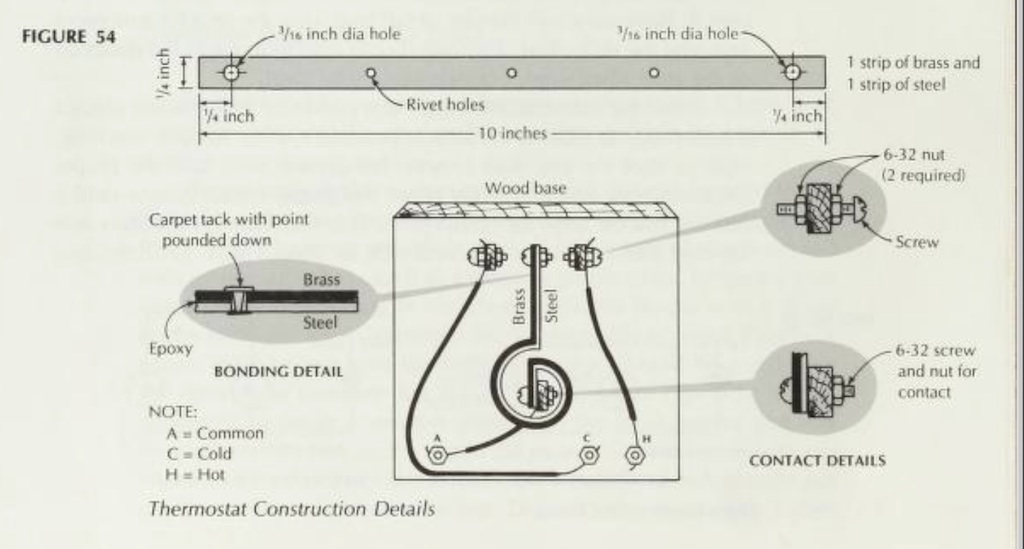
Directions for Bi-metallic Metal Strip Thermostat to regulate a homeostatic system.

  • Truly from scratch–even build your own bi-metallic strip (Brass + Steel, glued together)

Bimettalic Strip Thermostat Directions


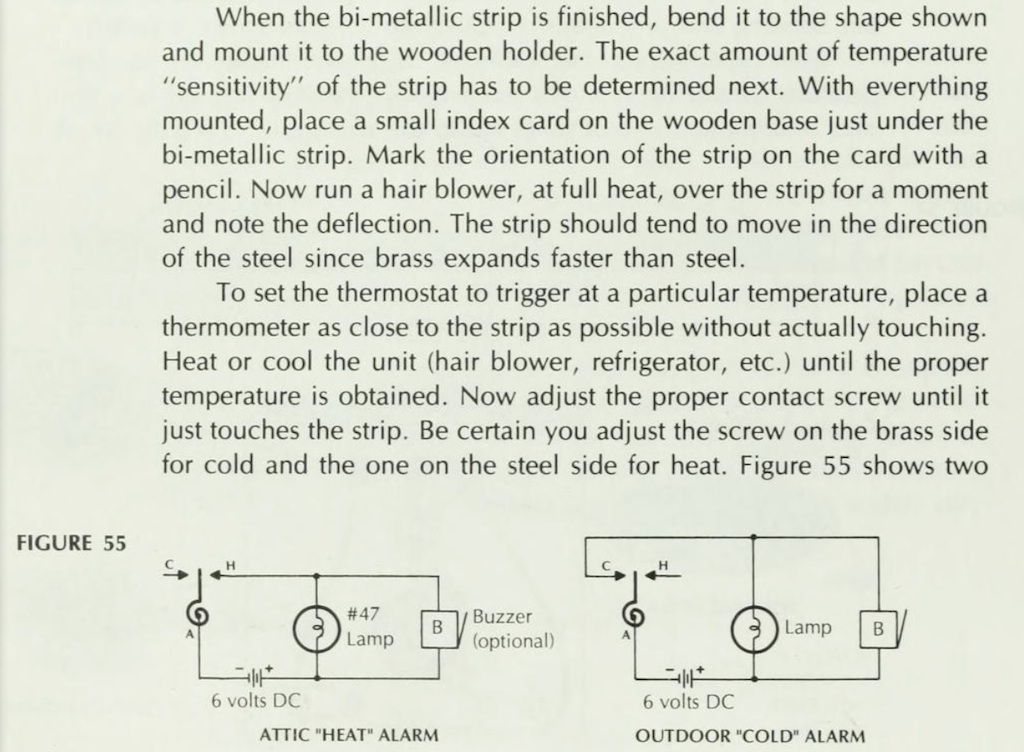
Directions for Calibrating your Bi-Mettalic Metal Strip Thermostat to the desired temperature

  • (98.6 °F,  37° C?)

Calibrating Your Bimettalic Thermostat

Plus two more applications of your Thermostat.

How do you design the circuit diagram for a fire alarm system?

Radon 360 makes excellent points, but not all systems operate in that fashion and you will find different regulations in different countries (and unfortunately in different provinces or states.)

Most systems in the European community operate with closed loops circuits and an open circuit is an alarm. In the U.S. it’s backwards, most systems close the circuit on alarm or lower the resistance on an initiaing circuit to the “alarm threshold”.

There are pros and cons to both ways.

If the circuit remaining closed is a “safe” condition, this if something is inadvertently shorted or if a fire melts the insulation and the conductors touch, placing a short on the circuit, the system will fail to function properly. Conversely, on a system that needs a circuit closure to activate, then a cut wire, or one conductor melted away would prevent proper operation. Continue reading →