Tick borne diseases are spreading fast.

But enough about the tick-borne diseases in my neck of the woods. Ticks make people sick everywhere in the U.S. People in the South and South Central states—especially North Carolina, Oklahoma, Arkansas, Tennessee, and Missouri—have to contend with Rocky Mountain spotted fever, a nasty bacterial infection spread by dog and wood ticks that can be fatal if antibiotic treatment isn’t started within several days of symptoms. They also have to watch out for ehrlichiosis, a bacterial infection spread by the Lone Star tick; tularemia, a bacterial infection that can be spread by several ticks; Southern tick-associated rash illness, an infection whose cause is unknown and is frequently confused with Lyme; and Heartland virus, which is so new that no one knows much about it yet. Midwesterners have Lyme disease, anaplasmosis, and powassan to deal with. And out West, tick-borne diseases are less common, but they run the gamut: People bitten by ticks can come down with Rocky Mountain spotted fever, anaplosmosis, Lyme, tularemia, and three other lovely ones: Colorado tick fever, tick-borne relapsing fever, and 364D rickettsiosis. Think you’re safe because you live in a big city? Nah. American dog ticks, which can transmit Rocky Mountain spotted fever, are crawling around many urban areas, and in recent years blacklegged ticks have been found in almost every borough of New York City. A whopping half of NYC blacklegged ticks harbor the bacterium that causes Lyme disease. Freaked out yet?

If you don’t remember being scared of tick-borne diseases when you were a kid, or even a decade ago, that’s because you weren’t. The reported prevalence of tick-borne diseases has basically doubled in the U.S. since 2003 and tripled since 1995. Some of this increase may be due to greater awareness and detection, but ticks are also spreading to new areas, “and in some places, the ticks have been getting more abundant and a higher percentage are infected,” Ostfeld explains. (Scientists don’t know exactly why this is happening—it could have something to do with how the U.S. landscape is changing, and climate change may also play a role.)

Source: Tick borne diseases are spreading fast.

Arming the Immune System Against Cancer – Biologist | Cancer Researcher

But your laboratory came up with an answer. What did you discover?

My lab has done a lot of basic research on how T-cells find and mark viruses, bacteria and defective cells. In the 1990s, my team and another group showed that there was a molecule on T-cells that actually acts like an off switch or a brake pedal when T-cells encounter an infected cell.

Instead of attacking the cell, this molecule puts a kind of brake on the immune response. We call it a checkpoint, and it may be why many of those therapeutic anticancer vaccines couldn’t work. We think the immune system may have multiple checkpoints.

I wondered whether we could block this off switch to keep the T-cells turned on. And that’s what we did. We developed an antibody to plug this off-switch. It worked great in mouse models of many types of cancer.

Continue reading the main storyContinue reading the main story

More importantly, it worked for some people with skin cancer. The first drug developed out of this was Yervoy, which was approved by the F.D.A. in 2011 against metastatic and inoperable advanced melanomas.

Long-term follow up of 5,000 melanoma patients who received it found that 22 percent survived for at least 10 years, some longer.

Is that a good number?

Oh, yeah. These were patients with usually seven months, maybe a year, to live.

A woman in Santa Monica was one of the first people to get the drug. She had two kids in high school. She’d failed at everything.

And so Dr. Antoni Ribas at U.C.L.A. said: “Well, we’ve got this experimental thing. We don’t know if it will work. It may be toxic.” She said, “I’ll do anything if I can just live a few more months to see my son graduate high school.” And so they treated her. And her tumors went away within about four months.

I met her 10 years later. She said, “You know, my kids are through school, married, starting families.”

There are a lot of stories like that.

via Arming the Immune System Against Cancer – NYTimes.com.

Gates Foundation Uses Art to Encourage Vaccination – NYTimes.com

By MELENA RYZIKJAN. 6, 2015

A tableau of a vaccination. Credit Alexia Sinclair

Artists, it’s fair to say, usually don’t know much about bacteria. Vik Muniz is an exception. Mr. Muniz, the Brazilian-born photographer known for his unorthodox materials, has been working with the M.I.T. bioengineer and designer Tal Danino on a series of trompe l’oeil images of microscopic organisms: cancer cells, healthy cells and bacteria.

At first glance, they look like ornate and colorful patterns. In reality, they represent teeming, living things. Among his latest: a pink print that could pass for floral wallpaper. But it’s made up of liver cells infected with the Vaccinia virus, which is used to make the smallpox vaccine.

“Normally, patterns are soothing structures,” Mr. Muniz said, “and all of a sudden, there’s a lot of drama.”

The work now has another meaning. It will be used in a new online campaign, The Art of Saving a Life, sponsored by the Bill & Melinda Gates Foundation. The intent is to promote vaccination just in time for an international effort to raise funds to inoculate millions, especially in poor nations.

via Gates Foundation Uses Art to Encourage Vaccination – NYTimes.com.

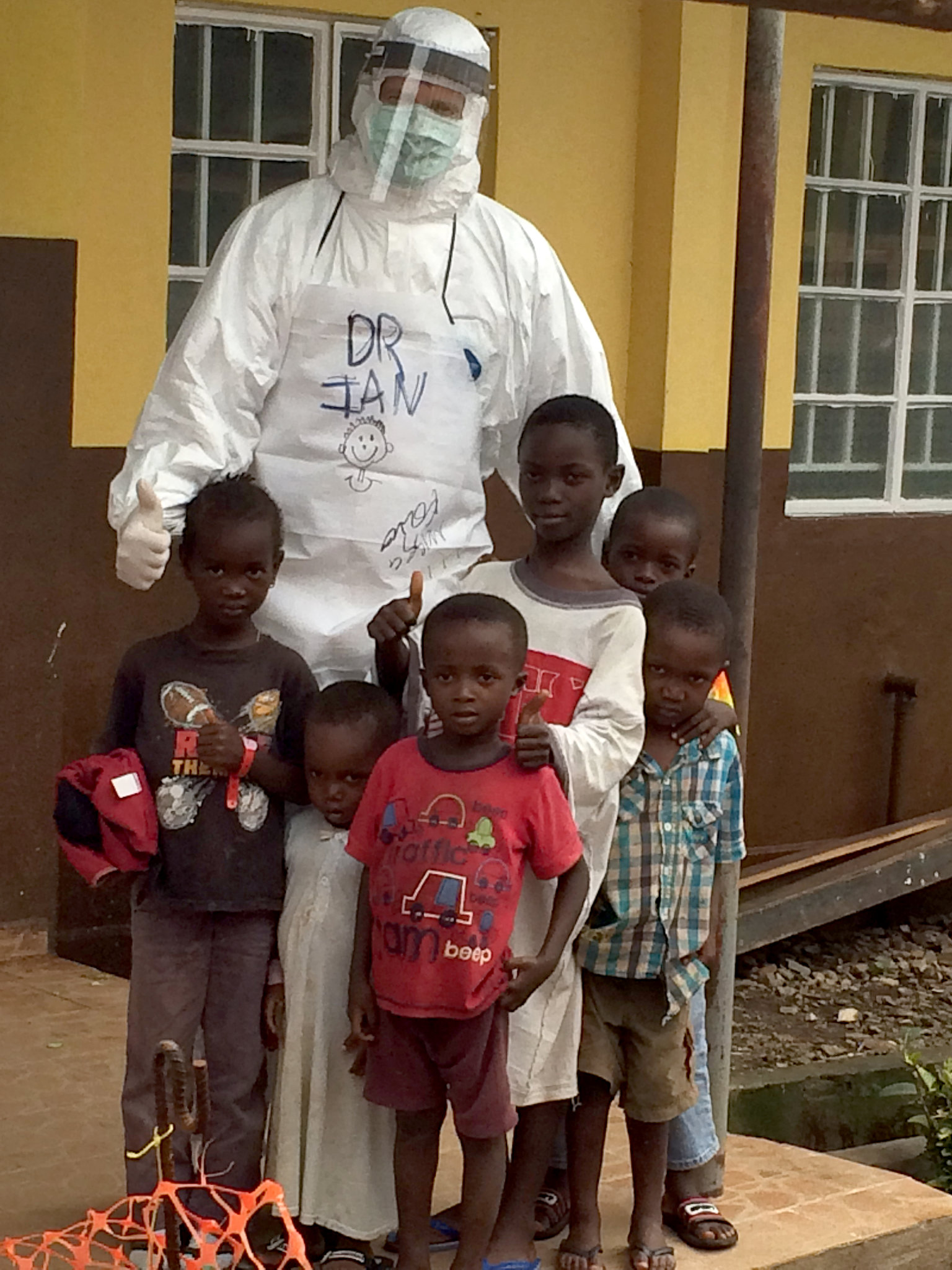
An Ebola Doctor’s Return From the Edge of Death – NYTimes.com

By DENISE GRADY DEC. 7, 2014Photo

Dr. Ian Crozier with children he helped save in Sierra Leone.

PHOENIX — The medical record, from an Ebola case, made for grim reading, but Dr. Ian Crozier could not put it down. Within days of the first symptom, a headache, the patient was fighting for his life. He became delirious, his heartbeat grew ragged, his blood teemed with the virus, and his lungs, liver and kidneys began to fail.

“It’s a horrible-looking chart,” Dr. Crozier said.

It was his own. Dr. Crozier, 44, contracted the disease in Sierra Leone while treating Ebola patients in the government hospital in Kenema. He was evacuated to Emory University Hospital in Atlanta on Sept. 9, the third American with Ebola to be airlifted there from West Africa. He had a long, agonizing illness, with 40 days in the hospital and dark stretches when his doctors and his family feared he might sustain brain damage or die. His identity was kept secret at his request, to protect his family’s privacy.

via An Ebola Doctor’s Return From the Edge of Death – NYTimes.com.

Epidemiology Follow-up 2 • CDC: Flu shot less effective this year because current flu virus has mutated

POSTED 10:53 PM, DECEMBER 3, 2014, BY CNN

(CNN) — This year’s flu vaccine is not as effective against the current strain of the influenza virus because the virus has mutated, the U.S. Centers for Disease Control and Prevention said Wednesday in an advisory to doctors.

The advisory said 52% of the 85 influenza virus samples collected and analyzed from October 1 through November 22 were different than the virus strains included in this year’s vaccine, indicating a mutation, or drift, of the strain.

The most common strain of the virus reported so far this season is influenza A (H3N2). In the past this strain has been linked to higher rates of hospitalization and death, especially for those at high risk for complications, which is usually the very young, the elderly and those with chronic health conditions.

Flu cases on the rise across county

In February a panel of experts decided on 3 strains of the virus to include in this year’s vaccine. The decision is based on common strains circulating around the globe throughout the year. That information is used to predict which strains will be common during the upcoming flu season. Some years the vaccine is a better match to the circulating strains than others.

While the vaccine is not as protective against a mutated strain, it can still decrease the severity of illness caused by the virus. It can also protect against other circulating strains of the virus, which is why the CDC still recommends getting vaccinated.

“The flu is bad, and you want to do anything you can to prevent getting it and to prevent giving it to other people, said Dr. Lisa Thebner, a pediatrician in New York City. “The vaccine isn’t perfect, but it’s the best protection we have for prevention.”

via CDC: Flu shot less effective this year because current flu virus has mutated | FOX5 San Diego – San Diego news, weather, traffic, sports from KSWB.

Epidemiology Unit Follow-Up 1 • San Diego flu cases coming in faster than last year

Dec 03, 2014 4:31 PM PST

Influenza cases around the San Diego region are coming in at a faster rate than last year, county health officials reported Wednesday. A total of 141 lab-confirmed cases have been reported to date this flu season, 86 more than at the same time last year, according to the county Health and Human Services Agency.

No one has died from flu complications thus far, according to the HHSA. Last winter, 70 people died from influenza-related causes. The death toll was 65 the year before.The U.S. Centers for Disease Control and Prevention recommends that everyone 6 months and older get a flu vaccine every year. The vaccine, which health officials say is safe and effective, takes two weeks for immunity to develop.

Vaccination is especially important for people who are at high risk of developing serious complications from influenza, such as those who have chronic medical conditions, are pregnant, elderly, or live with or care for others who are at higher risk. The majority of fatalities involved people who were seniors or already suffering health problems.

The HHSA said this seasons vaccine covers the same strains of influenza as last year because they’re the ones that have been circulating in countries around the world.

Other suggestions to avoid getting sick are washing hands thoroughly and often; using hand sanitizers; staying away from sick people; avoiding touching the eyes, nose, and mouth; cleaning commonly touched surfaces; and staying home and avoiding contact with others if youre sick.

The flu vaccine is available at doctors offices and retail pharmacies. Those without medical insurance can go to a county public health center to get vaccinated. A list of locations is available online at www.sdiz.org or by calling 2-1-1.

via San Diego flu cases coming in faster than last year – KUSI News – San Diego, CA.

8th Grade Science Reading Projects 4-7 • Project 4: Article: Ebola and the Vast Viral Universe • Projects 5, 6, 7: Finish First Chapters 2, 3, 4 of Life on Earth

  • Classification of Life (Do Viruses meet six characteristics of living things? Reread Chapter 1.3, Life on Earth)

http://nyti.ms/1wvsCka

By all evidence, researchers say, viruses like Ebola have been parasitizing living cells since the first cells arose on earth nearly four billion years ago. Some say that viruses actually invented cells.

Aids Virus Electron Microscope

Continue with your Life on Earth Reading- Goal is to finish the four Unit 1 Chapters (Passing all Open-Book Quizzes with 100%) by Nov 7

Table of Contents
Unit 1: Unity and Diversity of Life on Earth
1. What Is Life?
2. The Chemistry of Life
3. Evolutionary Mechanisms
4. History of Life on Earth


(Read through the Dale-chall difficult word list definitions- see links to videos when necessary)


Small Pox and the Cree Indian Epidemic| Brian Altonen, MPH, MS

Saskatchewan River Watershed-Diseases travel along water routes and trade routes

One could say that as this disease began its path of diffusion eastward along the overland routes, that it pretty much followed the river banks making its way towards Lake Winnepeg.  To remain in an infectious state, it had to travel mostly from person to person, cabin to cabin, encampment to encampment, tipi to tipi.  At the time there were a number of Mandan villages situated along the South Saskatchewan.  These Mandans had trade relations with other Native American groups south of the Canadian Border down in the Dakotas. Most of the Mandans and their partners resided on the Missouri River or one of its tributaries, such as the Red River.  This trade facilitated the diffusion of small pox along these trade routes,  So in due time, as the disease made its way eastward towards more settled parts of Canada, the numerous business establishments where Native Americans tended to aggregate assisted it in making its way along the path leading to Hudson Bay. For now (as of 10/2011) there is very little if any evidence suggesting an initial introduction of measles by way of any south to southeastern routes; the population requirements were there, but no documented introduction of measles from Toronto, the Great Lakes, or any of the many former New France settlements could be found.

Once the final destination of this smoldering epidemic was reached, the shoreline of Hudson Bay, this disease stopped because it had reached the end of its routes geographically.  Fortunately, the travel across Hudson Bay wasn’t able to spread the disease much beyond the immediate Cree settlements.  Even the trip towards the relatively close Severn House, from both directions, seemed to be protected from this contagion.

Caution-graphic photos:
Continue reading →

U.S. Stockpiles Smallpox Drug in Case of Bioterror Attack – NYTimes.com

Wary of Attack With Smallpox, U.S. Buys Up a Costly Drug

By DONALD G. McNEIL Jr. Published: March 12, 2013

The United States government is buying enough of a new smallpox medicine to treat two million people in the event of a bioterrorism attack, and took delivery of the first shipment of it last week. But the purchase has set off a debate about the lucrative contract, with some experts saying the government is buying too much of the drug at too high a price.

Lining up for SMALLPOX vaccinations 1947

Lining up for smallpox vaccinations in 1947.

The government is stockpiling a new drug for use if there is a bioterrorism attack.A small company, Siga Technologies, developed the drug in recent years. Whether the $463 million order is a boondoggle or a bargain depends on which expert is talking. The deal will transform the finances of Siga, which is controlled by Ronald O. Perelman, a billionaire financier, philanthropist and takeover specialist.Smallpox was eradicated by 1980, and the only known remaining virus is in government laboratories in the United States and Russia. But there have long been rumors of renegade stocks that could be sprayed in airports or sports stadiums. Experts say the virus could also be re-engineered into existence in a sophisticated genetics lab.

As part of its efforts to prepare for a possible bioterrorism attack, the government is paying more than $200 for each course of treatment.

via U.S. Stockpiles Smallpox Drug in Case of Bioterror Attack – NYTimes.com.