Tick borne diseases are spreading fast.

But enough about the tick-borne diseases in my neck of the woods. Ticks make people sick everywhere in the U.S. People in the South and South Central states—especially North Carolina, Oklahoma, Arkansas, Tennessee, and Missouri—have to contend with Rocky Mountain spotted fever, a nasty bacterial infection spread by dog and wood ticks that can be fatal if antibiotic treatment isn’t started within several days of symptoms. They also have to watch out for ehrlichiosis, a bacterial infection spread by the Lone Star tick; tularemia, a bacterial infection that can be spread by several ticks; Southern tick-associated rash illness, an infection whose cause is unknown and is frequently confused with Lyme; and Heartland virus, which is so new that no one knows much about it yet. Midwesterners have Lyme disease, anaplasmosis, and powassan to deal with. And out West, tick-borne diseases are less common, but they run the gamut: People bitten by ticks can come down with Rocky Mountain spotted fever, anaplosmosis, Lyme, tularemia, and three other lovely ones: Colorado tick fever, tick-borne relapsing fever, and 364D rickettsiosis. Think you’re safe because you live in a big city? Nah. American dog ticks, which can transmit Rocky Mountain spotted fever, are crawling around many urban areas, and in recent years blacklegged ticks have been found in almost every borough of New York City. A whopping half of NYC blacklegged ticks harbor the bacterium that causes Lyme disease. Freaked out yet?

If you don’t remember being scared of tick-borne diseases when you were a kid, or even a decade ago, that’s because you weren’t. The reported prevalence of tick-borne diseases has basically doubled in the U.S. since 2003 and tripled since 1995. Some of this increase may be due to greater awareness and detection, but ticks are also spreading to new areas, “and in some places, the ticks have been getting more abundant and a higher percentage are infected,” Ostfeld explains. (Scientists don’t know exactly why this is happening—it could have something to do with how the U.S. landscape is changing, and climate change may also play a role.)

Source: Tick borne diseases are spreading fast.

Octopus vs. Sea Lion—First Ever Video

  • Sea Lions always feed on the seafloor, never on pelagic prey

New National Geographic Crittercam footage shows never before seen eating habits of the Australian sea lion—including video of a sea lion hunting a large octopus. The footage is from a project intended to help save the endangered sea lions, in part by uncovering where and how the animals eat.

via Octopus vs. Sea Lion—First Ever Video.

Flight of the RoboBees | Replacing dying bees with robots

As the rapid advancement of CCD began to reach feverish levels in June of this year, President Obama created a task force charged with solving the mystery within 180 days. The response from America’s brightest minds was swift and penetrating.

Harvard University scientists have come up with a deceptively simple solution that could also provide a potential boon for the nation’s growing drone industry: Replace the dead bees with micro-aerial vehicles that pollinate on command—robo-bees. It’s a gamble, but in these disruptive times, even nature needs to innovate if it wants to stay relevant.

Like “a mechanical flash mob,” as one journalist put it, the robo-bees are able to efficiently function within a swarm of thousands and self-assemble into a variety of shapes, including letters, numbers and even a five pointed star.

But it’s not just anthophila that are dying en masse. Neonic pesticides have also been linked to a more general decline in insect populations across the map, which has created a schism in nature’s managerial structure — fewer insects means less food for birds, which means fewer birds and so on and so forth.

From an engineering perspective, birds present a more complex challenge. One area where their robotic analogs could be of use is to replace a bird’s traditional function of spreading seeds from the various plant life it consumes.

via Flight of the RoboBees | Adbusters.

Q2 Plant Science: Project 2b: Grower’s Calendar • Wisconsin Fast Plants® Program

GROWER’S CALENDAR

Follow the grower’s calendar for Fast Plants® to help get your plan underway. Use the links to find more detailed instructions about each task.Fill in the dates as you plan for planting and growing your Fast Plants®.

Task Day of Cycle (time required) Activities
Preparation Start (1 1/2 hrs)Date:____________
  1. Assemble light bank and rack or light box.
  2. Set up reservoirs.
  3. Saturate water mat according to growing instructions.
  4. Arrange all planting materials.
Planting Day 1 (1 hr)Date:____________
  1. Plan to start life cycle on a Monday or Tuesday.
  2. Plant, water from above, label, set planters (quads, deli containers, or bottle tops) on water source (watermat or water reservoir bottom) with soil surface 5–10 cm (~2 inches) from the lights.
Germination Days 2– 3Date:____________
  1. Water from top with pipet.
  2. Cotyledons emerge.
Tending Days 4–5 (30 min)Date:____________
  1. Thin to 1 plant per cell.
  2. Transplant if necessary to obtain 1 plant in every cell.
  3. Check the water level in the reservoir!
Growth Days 6–11 (15 min/day)Date:____________
  1. Check plants and reservoir level daily throughout the rest of the life cycle.
  2. Observe growth and development.
Flowering Day 12 (30 min)Date:____________
  1. Flower buds beginning to open.
  2. Make bee sticks.
Pollination Days 13–18 (15 min/day)Date:____________
  1. Pollinate for 2–3 consecutive days.
  2. On the last day of pollination, pinch off any remaining unopened buds.
Seed Development Days 17–35 (10 min/day)Date:____________
  1. Observe seed pod development.
  2. Embryos mature in 20 days.
Seed Maturation Day 36 (30 min)Date:____________
  1. Twenty days after the last pollination, remove plants from water reservoir.
  2. Allow plants to dry for 5 days
Harvesting Day 40 (30 min)Date:____________
  1. Harvest seeds from dry pods.
  2. Clean up all equipment.
  3. Plant your own seeds or store them appropriately.

GROWER’S CALENDAR

Continue reading →

Q2 Plant Science Project 3: Brassica Butterfly and Wisconsin Fast Plants

BRASSICA BUTTERFLY

Plants and butterflies … they coexist in nature. Isn’t it time they were brought together in the classroom?
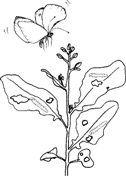
How an insect gets from a tiny egg to an adult butterfly is a fascinating process. The butterfly life cycle investigation begins with eggs. From day one, students are making observations, predictions, collecting data and asking questions about the life cycle. Once the eggs have hatched, the biology of this organism will unfold, challenging students to understand not only the various life cycle stages of the organism but also how this organism interacts with plants (brassicas) and other components of its environment. Each stage of the butterfly’s development provides students with opportunities for observations, ideas, analysis, experimentation and creative communication. Through raising butterflies plant material and understanding its life cycle, the foundation is set for students to launch into experimentation and inquiry-based learning.

SEARCH THE DIGITAL LIBRARY FOR ACTIVITIES »

Brassica and Butterfly

Investigating Life with the Cabbage White Butterfly and Brassicas in the Classroom 

Materials developed for the “Brassica and Butterfly” workshops (Summer/Fall 2002, funded by NASA). Includes life cycle information, rearing instructions, activities for the classroom, and troubleshooting.

BRASSICA BUTTERFLY

Plants and butterflies … they coexist in nature. Isn’t it time they were brought together in the classroom?

How an insect gets from a tiny egg to an adult butterfly is a fascinating process. The butterfly life cycle investigation begins with eggs. From day one, students are making observations, predictions, collecting data and asking questions about the life cycle. Once the eggs have hatched, the biology of this organism will unfold, challenging students to understand not only the various life cycle stages of the organism but also how this organism interacts with plants (brassicas) and other components of its environment. Each stage of the butterfly’s development provides students with opportunities for observations, ideas, analysis, experimentation and creative communication. Through raising butterflies plant material and understanding its life cycle, the foundation is set for students to launch into experimentation and inquiry-based learning.

SEARCH THE DIGITAL LIBRARY FOR ACTIVITIES »

Brassica and Butterfly

Investigating Life with the Cabbage White Butterfly and Brassicas in the Classroom

Materials developed for the “Brassica and Butterfly” workshops (Summer/Fall 2002, funded by NASA). Includes life cycle information, rearing instructions, activities for the classroom, and troubleshooting.

Download Investigating Life with the Cabbage White Butterfly and Brassicas in the Classroom »

via Wisconsin Fast Plants® Program.