‘Mayday! Emergency Landing. We’re on Fire.’ – The Atlantic

For most of human history, the possibility of flight was confined to myths and nighttime dreams. A century-plus past the Wright Brothers, flight now conveys either jam-packed discomfort among the (statistically very safe) airlines, privilege for the private-jet world, or danger for other kinds of small planes. Rege’s video is meant to illustrate some of the beauty of the process — as the Avenger clip does in a different way.

SOAR from hadi dimachkieh on Vimeo.


SOAR from hadi dimachkieh on Vimeo.

Notes for specialists: the airplane Rege is flying is a new Cirrus SR-20. It is made by Cirrus Aircraft in Duluth, the company I’ve written about for years, and is one of the famous “planes with a parachute” that can be lowered safely to the ground by a parachute in the event of an impending crash.

Source: ‘Mayday! Emergency Landing. We’re on Fire.’ – The Atlantic

Arming the Immune System Against Cancer – Biologist | Cancer Researcher

But your laboratory came up with an answer. What did you discover?

My lab has done a lot of basic research on how T-cells find and mark viruses, bacteria and defective cells. In the 1990s, my team and another group showed that there was a molecule on T-cells that actually acts like an off switch or a brake pedal when T-cells encounter an infected cell.

Instead of attacking the cell, this molecule puts a kind of brake on the immune response. We call it a checkpoint, and it may be why many of those therapeutic anticancer vaccines couldn’t work. We think the immune system may have multiple checkpoints.

I wondered whether we could block this off switch to keep the T-cells turned on. And that’s what we did. We developed an antibody to plug this off-switch. It worked great in mouse models of many types of cancer.

Continue reading the main storyContinue reading the main story

More importantly, it worked for some people with skin cancer. The first drug developed out of this was Yervoy, which was approved by the F.D.A. in 2011 against metastatic and inoperable advanced melanomas.

Long-term follow up of 5,000 melanoma patients who received it found that 22 percent survived for at least 10 years, some longer.

Is that a good number?

Oh, yeah. These were patients with usually seven months, maybe a year, to live.

A woman in Santa Monica was one of the first people to get the drug. She had two kids in high school. She’d failed at everything.

And so Dr. Antoni Ribas at U.C.L.A. said: “Well, we’ve got this experimental thing. We don’t know if it will work. It may be toxic.” She said, “I’ll do anything if I can just live a few more months to see my son graduate high school.” And so they treated her. And her tumors went away within about four months.

I met her 10 years later. She said, “You know, my kids are through school, married, starting families.”

There are a lot of stories like that.

via Arming the Immune System Against Cancer – NYTimes.com.

Public Circuit Boards (Gongban) China’s Collaborative Electronics-Design Ecosystem – The Atlantic

A different story emerges in the burgeoning wearable electronics market of Southern China, one that is based on a rapid, flexible and open ecosystem called shanzhai 山寨.

Take, World Peace Industrial (WPI), a Taiwanese electronic sourcing company located in Shenzhen, as an example. The company’s application technology unit (ATU) spends millions annually to develop reference circuit boards, called gongban 公板 (“public board”). A gongban can be used by a variety of different companies, who either incorporate it in their products directly or build atop it as they please via modifications. ATU develops 130 gongbans annually in areas ranging from smart phones, tablets, smart watches, smart homes, and industrial controls—and distributes the designs for free. WPI then makes money by trading in the boards’ components.

"We call this shanzhai in Shenzhen. It’s a mass production artwork,” explains Lawrence Lin head of the Application Technology Unit at WPI. Thirty some companies in Shenzhen are shipping their own smart watches with gongban from ATU and gongmo (‘public case’) sourced from the massive shanzhai ecosystem, which consists of tens of thousands of companies that manufacture and distribute goods.

Shanzhai used to refer to knock-off retail, and later end-consumer electronics, such as mobile phones of major brands like Nokia, Motorola and Ericson, often specifically designed for non-Western markets in China, South East Asia, South America, the Middle East and Africa. The ecosystem grew rapidly and by 2010, it was producing 200 million phones annually and was responsible for a quarter of the global mobile phone market. Since then, the shanzhai ecology has moved beyond cloning and enabled a wealth of iterative innovations including dual-SIM for frequent travelers to avoid roaming charges, seven-speaker phones for workers to listen to music at construction sites, and custom-designed phones for migrant populations unable to afford the latest smartphone.

via Shanzhai: China’s Collaborative Electronics-Design Ecosystem – The Atlantic.

High speed M&M sorting machine from iPhone, Arduino,

M&M sorting machines are a popular project for people who like combining electronics, programming and machine building. I decided I’d try to make my own version but with a different approach to the majority of existing M&M (or Skittles / Smarties!) sorting machines out there.

Most of them send a single M&M down a chute to a simple colour sensor where the colour sensor will then take a second or two to figure out the colour. A servo motor will then rotate a chute that will direct the M&M into the correct pot.

My approach sends M&Ms down a chute to start with. But I don’t stop the M&M for colour recognition. Instead I use an iPhone to capture the colour of the M&M as it is in freefall. As it is still falling the iPhone talks to a Bluetooth module attached to an Arduino and that fires off the correct electro magnet controlled gate. This sends the M&M into the correct pot. Even though this is just a rough prototype it is reasonably fast because the colour recognition and path that the M&M takes down the chute is decided and determined whilst the M&M is moving under gravity. Here’s a video of the prototype:

via High speed M&M sorting machine.

Newton’s Laws of Motion • 5,200 Days in Space – The Atlantic

“What’s it like to live in zero‑G?” asks Sandra Magnus, who took three spaceflights, including 130 days on the station, before her recent retirement from the astronaut corps. “It’s a lot of fun,” she says, then bursts out laughing. “I learned to carry things with my knees—tuck them between my knees and shove off. That way I had my hands free to propel myself. The thing is, in space, Newton’s laws rule your life. If you’re doing something as simple as typing on a laptop, you’re exerting force on the keyboard, and you end up getting pushed away and floating off. You have to hold yourself down with your feet.” Magnus developed calluses on her big toes because she used them continuously, in stocking feet, to navigate and position herself.

Gravity is an indispensable organizing tool, she says, one you don’t appreciate until you have to live without it. “Just look around the room you’re in … There’s stuff sitting on tables, on shelves, in drawers, on the floor. In space, all of that would be all over the place.” Every single item you use needs to be secured, or it will float off. Astronauts mutter quietly about the amount of time they spend searching for misplaced equipment—“Keeping track of stuff can eat your whole day,” says the astronaut Mike Fincke—but securing everything also takes time.

via 5,200 Days in Space – The Atlantic.

‘The Sixth Extinction,’ by Elizabeth Kolbert

The resulting rapid warming of both the atmosphere and the ocean, which Kolbert notes has absorbed about one-third of the carbon dioxide we have produced, is wreaking havoc on earth’s delicately balanced ecosystems. It threatens both the web of living species with which we share the planet and the future viability of civilization. “By disrupting these systems,” Kolbert writes, “we’re putting our own survival in danger.”

Continue reading the main story

RELATED COVERAGE

A Conversation With: ‘The Sixth Extinction’ Looks at Human Impact on the EnvironmentFEB. 10, 2014

The earth’s water cycle is being dangerously disturbed, as warmer oceans evaporate more water vapor into the air. Warmer air holds more moisture (there has been an astonishing 4 percent increase in global humidity in just the last 30 years) and funnels it toward landmasses, where it is released in much larger downpours, causing larger and more frequent floods and mudslides.

The extra heat is also absorbed in the top layer of the seas, which makes ocean-­based storms more destructive. Just before Hurricane Sandy, the area of the Atlantic immediately windward from New York City and New Jersey was up to nine degrees warmer than normal. And just before Typhoon Haiyan hit the Philippines, the area of the Pacific from which it drew its energy was about 5.4 degrees above average.

Our oceans, a crucial food source for billions, have become not only warmer but also more acidic than they have been in millions of years. They struggle to absorb excess heat and carbon pollution — which is why, as Kolbert points out, coral reefs might be the first entire ecosystem to go extinct in the modern era.

The same extra heat pulls moisture from soil in drought-prone regions, causing deeper and longer-lasting droughts. The drying of trees and other vegetation leads also to an increase in the frequency and average size of fires.

Food crops are threatened not only by more pests and the disruption of long-­predictable rainy season-dry season patterns, but also by the growing impact of heat stress itself on corn, wheat, rice and other staples.

Earth’s ice-covered regions are melting. The vanishing of the Arctic ice cap is changing the heat absorption at the top of the world, and may be affecting the location of the Northern Hemisphere jet stream and storm tracks and slowing down the movement of storm systems. Meanwhile, the growing loss of ice in Antarctica and Greenland is accelerating sea level rise and threatening low-lying coastal cities and regions.

Viruses, bacteria, disease-carrying species like mosquitoes and ticks, and pest species like bark beetles are now being pushed far beyond their native ranges. Everywhere the intricate interconnections crucial to sustaining life are increasingly being pulled apart.

via ‘The Sixth Extinction,’ by Elizabeth Kolbert – NYTimes.com.

Flight of the RoboBees | Replacing dying bees with robots

As the rapid advancement of CCD began to reach feverish levels in June of this year, President Obama created a task force charged with solving the mystery within 180 days. The response from America’s brightest minds was swift and penetrating.

Harvard University scientists have come up with a deceptively simple solution that could also provide a potential boon for the nation’s growing drone industry: Replace the dead bees with micro-aerial vehicles that pollinate on command—robo-bees. It’s a gamble, but in these disruptive times, even nature needs to innovate if it wants to stay relevant.

Like “a mechanical flash mob,” as one journalist put it, the robo-bees are able to efficiently function within a swarm of thousands and self-assemble into a variety of shapes, including letters, numbers and even a five pointed star.

But it’s not just anthophila that are dying en masse. Neonic pesticides have also been linked to a more general decline in insect populations across the map, which has created a schism in nature’s managerial structure — fewer insects means less food for birds, which means fewer birds and so on and so forth.

From an engineering perspective, birds present a more complex challenge. One area where their robotic analogs could be of use is to replace a bird’s traditional function of spreading seeds from the various plant life it consumes.

via Flight of the RoboBees | Adbusters.

Q2 Plant Science Project 1b: Constructing a Wisconsin Fast Plants Light Bank

LIGHT BANK SYSTEM

The light bank system is most appropriate for growing large numbers of plants. 
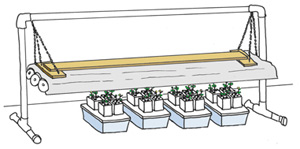
The light bank system is most appropriate for growing large numbers of plants. The light bank uses only 4.5 x 2.5 feet of space, which will accommodate several large classroom experiments. The light bank consists of 6 or more 4-foot fluorescent bulbs side by side. The most common bulb used is a 40-watt Cool White Deluxe™, but other 4-foot bulbs such as a 34-watt or a 40-watt Cool White™ are also acceptable for growing Fast Plants®.

Building Your Own Light Bank

As plants grow, the lights and/or plants are adjusted to keep the top of the plants 5-10 cm from the light bulbs. Appropriate lighting is perhaps the most critical component of a plant’s growing environment. Fast Plants® were bred to do well with the light produced by fluorescent lamps. Plants grown too far from lights or under weak light will be spindly and tend to fall over easily. Aluminim foil curtains can be used to increase the amount of light reaching the plants, especially those growing on the edges.via Wisconsin Fast Plants® Program.

Q2 Plant Science Project 1a: Building a Light Box System Wisconsin Fast Plants® Program

LIGHT BOX SYSTEM

The Plant Light Box is a low-cost alternative for growing Fast Plants® and other plants. It is ideal for small classroom experiments or group projects, and is designed so students and teachers can build their own.

Instructions for Building a 2-crate Plant Light Box SystemThese Light Boxes use two stackable plastic file crates that are cut, lined with aluminum foil, lit with a high efficiency fluorescent bulb, and stacked (after plants are tall). Each Light Box of this type can hold 12-15 small Bottle Growing Systems or 7 Deli-container Growing Systems (or 2-liter Bottle Growing Systems) or 1 Quad Growing System.

Note: Most file crates have slight differences in how they are manufactured; however, we have used all sorts of crates with success by making a few changes to these basic assembly procedures.

Materials
For each 2-crate Plant Light Box, you will need:

  • Two stackable plastic file crates that measure 17 1/4″ x 14 1/4″ x 11 1/2″ (sold at an office supply store). Notice that we like to use crates that have either a solid bottom or a solid plastic spot in the center of the long sides because this is where we will attach the light.
  • Aluminum foil roll, 12″ wide
  • Double-stick tape
  • Clear tape (e.g. Scotch Tape)
  • Hacksaw-type handsaw
  • Scissors
  • Tin snips (optional)
  • 40 or 42 watt compact fluorescent lamp (CFL) – this is a 150 watt equivalent high efficiency bulb “cool white” if available)
  • Drop work light (an extension cord and light socket can also be used; however, extension cords are not allowed in many schools)
  • Drill and 1″ paddle drill bit or sharp pocket knife for cutting a 1″ hole in the plastic crate for the light fixture
  • Plastic zip ties


Assembly Instructions:

via Wisconsin Fast Plants® Program.