How plants adapt: Calcium waves help the roots tell the shoots

calcium waves help plants react to environment*

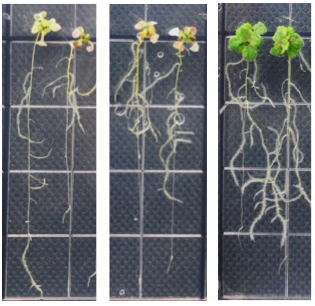
Arabidopsis thaliana growing in salt water. The plant on the right has more of the protein channel TPC1, thought to be involved in calcium signaling in plants. The plant at center has less TPC1 than normal, and the one on the left is considered normal. Credit: Won-Gyu Choi/Gilroy Lab
It’s a finding that has implications for those interested in how plants adapt to and thrive in changing environments. For instance, it may help agricultural scientists understand how to make more salt- or drought-tolerant plants.

“How do you think plants live?” Gilroy asks. “If I poke you, I see an instant response. You move away. Plants live in a slightly different world. They are rooted to the ground, literally, and they respond to the world either by growing or creating chemicals.”

Calcium is involved in transmitting information in the cells of humans and other animals, contracting muscles, sending nerve signals and more.

In plants, scientists believed it had to also play a role in processing information and sending rapid signals so that plants can respond quickly to their environments.

Imagine you are a plant being eaten by a caterpillar: “It’s like a lion chewing your leg,” says Gilroy. “If an insect is chewing your leaf, you’re gone unless you determine something effective immediately.”

But no one had ever been able to see it before. Even Gilroy’s team found it by accident.

via How plants adapt: Calcium waves help the roots tell the shoots.
Dissolving Sugar in Water: Chemical or Physical Change?

Question: Is Dissolving Sugar in Water a Chemical or Physical Change?

Is dissolving sugar in water an example of a chemical or physical change? This process is a little trickier to understand than most, but if you look at the definition of chemical and physical changes, you’ll see how it works. Here’s the answer and an explanation of the process.

Answer: Dissolving sugar in water is an example of a physical change. Here’s why: A chemical change produces new chemical products. In order for sugar in water to be a chemical change, something new would need to result. A chemical reaction would have to occur. However, mixing sugar and water simply produces… sugar in water! The substances may change form, but not identity. That’s a physical change.

via Dissolving Sugar in Water: Chemical or Physical Change?.

Dissolving Salt in Water – Chemical or Physical Change?

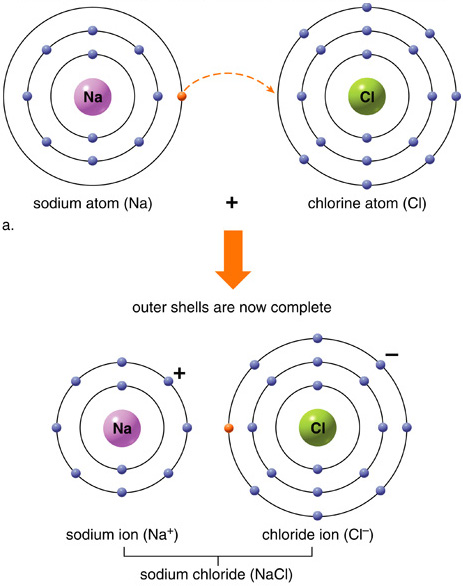
When you dissolve table salt (sodium chloride or NaCl) in water, are you producing a chemical change or a physical change? A physical change results in a change of the material’s appearance, but no new chemical products result. A chemical change involves a chemical reaction, with new substances produced as a result of the change. When you dissolve salt in water the sodium chloride dissociates in Na+ ions and Cl- ions, which may be written as a chemical equation:

NaCl(s) → Na+(aq) + Cl-(aq)

Therefore, dissolving salt in water is an example of a chemical change.

If you search online for the answer to this question, you’ll see about equal numbers of responses arguing that dissolving salt is a physical change as opposed to a chemical change. The confusion arises because one common test to help distinguish chemical and physical changes is whether or not the starting material in the change may be recovered using only physical processes. If you boil the water off of a salt solution, you’ll obtain salt.

So, you’ve read the rationale. What do you think? Would you agree dissolving salt in water is a chemical change?

via Dissolving Salt in Water – Chemical or Physical Change?.

Using Atomic Theory to Understand • Why Salt (NaCl) Dissolves in Water (H2O)

Salt is formed when Sodium and Chlorine atoms share electrons…NaClNaCl ionic Bonds

But salt, NaCl, atoms break apart in Water (a chemical change)… into positive Na ions and negative Cl ions. Why?

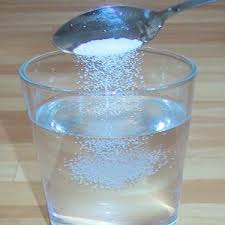
Teaspoon of Salt in Water

Water is a solvent that can dissolve (break apart) many substances.

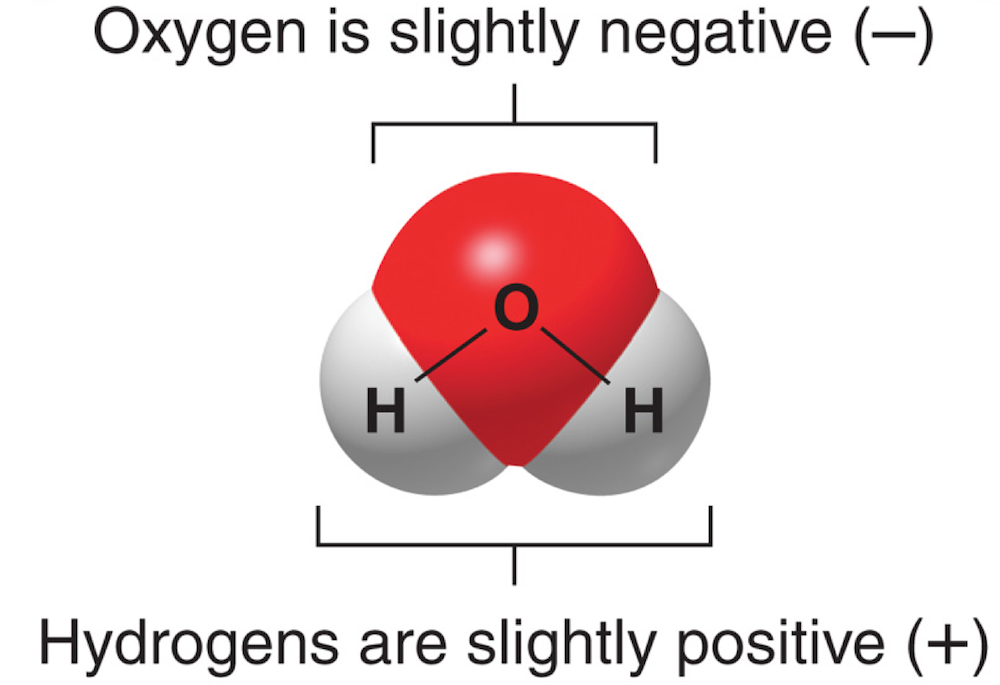
Water molecules are like mini-magnets. One side is more negative, one side more positive)
These mini magnets interact with the charged atoms of many molecules, including NaCL, breaking them apart.

Water H2O molecules are polar
Water molecules are Polar (having + & – poles)

The polar water molecules remain intact and their electro-magnetic energy

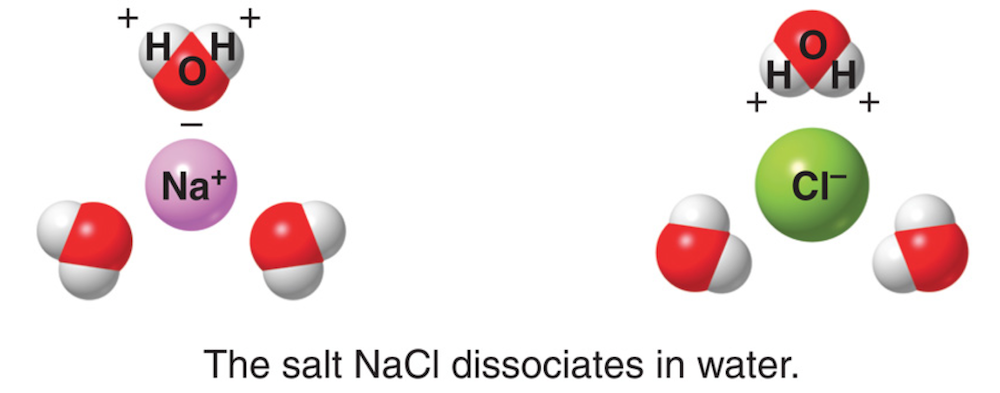
  • attracts the positive Na ions to their negative (Oxygen) side, and
  • attracts the negative Cl ions to their positive (Hydrogen side)

Salt NaCl dissociates in water H2O*

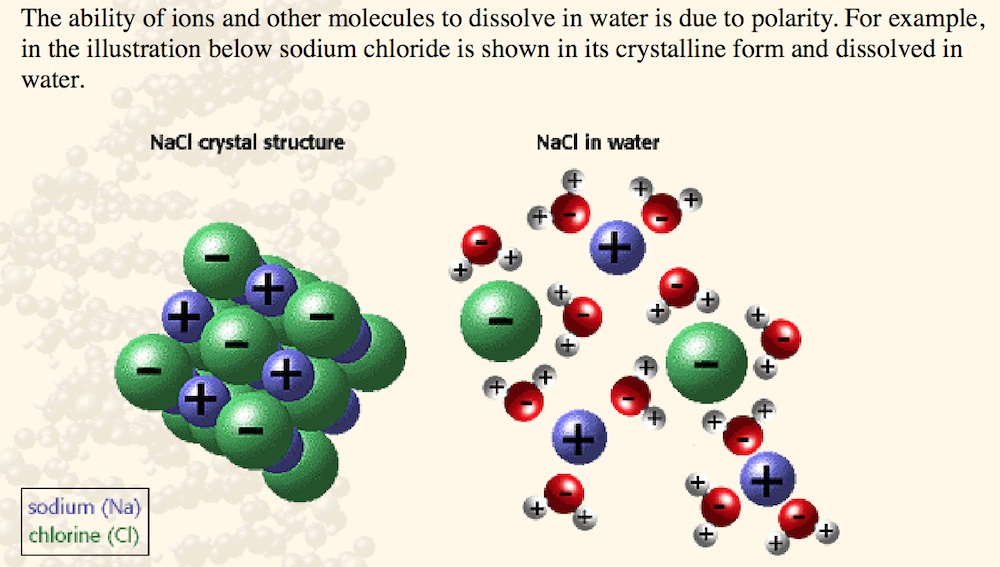
NaCL in Water-Diagram“Magical” properties of Water: Why does is it called the “universal solvent”? (why can it dissolve so many compounds?) Why doesn’t water ice, a solid, sink to bottom of pond?


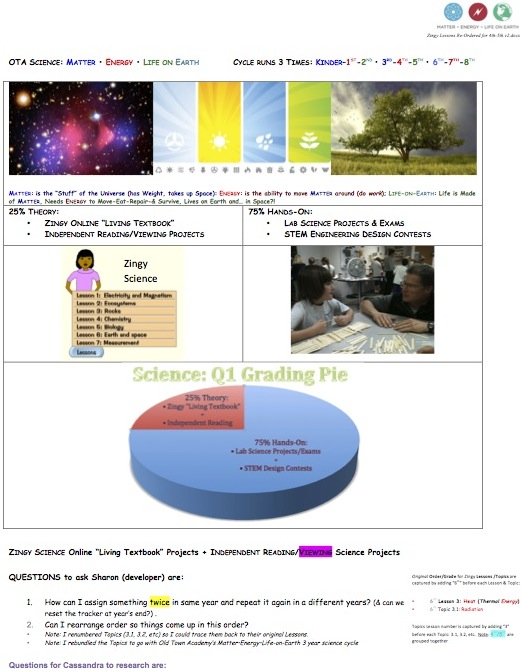
What is Zingy Science? 5 Demos: Gravity, Metric System, Electrons, Alcohol Solution, Density

Dear 8th Grade Parents, Click on the links below to try sample Zingy Science Modules:

DRAFT Zingy Lessons Re-Ordered for OTA 4th-5th v2

25% Theory | 75% Lab Science Project & Exams???? or 40% | 60% in 2014-2015

DRAFT Zingy Lessons Re-Ordered for OTA 4th-5th v2

— Continue reading →

The World of Mars – NYTimes.com

…our science team is composed not of nine men but of 472 men and women representing 13 different countries. In the 16 months since Curiosity’s arrival, we have already achieved our main goals. Just eight months into the mission, the rover discovered that beneath its six flight-grade aluminum wheels was the dried-out husk of an ancient streambed and lake of fresh water. The kind of water that could have supported simple microorganisms  —  low in salt, free of strong acid and full of nutrients. A human might even have been able to drink the stuff, though you may not have wanted to bottle it for resale.

The S.U.V.-size rover  —  with its laboratory of spectrometers, lasers, X-ray diffractometer, radiation detector, neutron generator, 17 cameras, and its own weather station  —  has pushed deep into the environmental records of early Martian history. Data from Curiosity show that sulfur, nitrogen, hydrogen, oxygen, phosphorus and carbon  —  some of the key chemical ingredients for life  —  were available to microbes, had they ever originated on Mars. These primitive organisms could have fed on the chemical energy stored in rocks and minerals, just like a flashlight bulb lights up by using the chemicals stored in a dry cell battery. It all depends on the state of mineral oxidation, the flow of electrons through rocks and microbes, and chemolithoautotrophy (if you want to get into it). Some microbes on Earth survive by consuming exactly this type of energy source. They eat rocks. Might the same have occurred on ancient Mars? It is pretty cool, and it brings us closer to finding out if life ever originated somewhere other than Earth.

As you read this, Curiosity is driving across a flat plain and closing the distance on the base of Mount Sharp, a massive mountain formed from a stack of layered rocks three times higher than the Grand Canyon is deep. Of course, moving forward at about half a football field per day, we are still many months away. That’s O.K. The roads are unpaved and the nearest mechanic is millions of miles distant.

via The World of Mars – NYTimes.com.

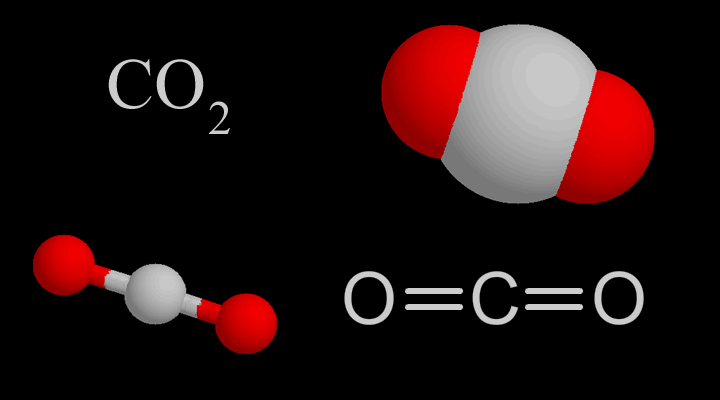
Richard Feynman: Carbon and Oxygen, Fire, Carbon Dioxide… and Trees

  • Matter: Atoms: Carbon, Oxygen; Molecules: Carbon Dioxide;
  • Energy: Fire: Thermal Energy (Heat); Light Energy
  • Life: Carbon-based: Trees

co2 molecule_720x400
*** *** *** The Carbon Dioxide Molecule *** *** ***

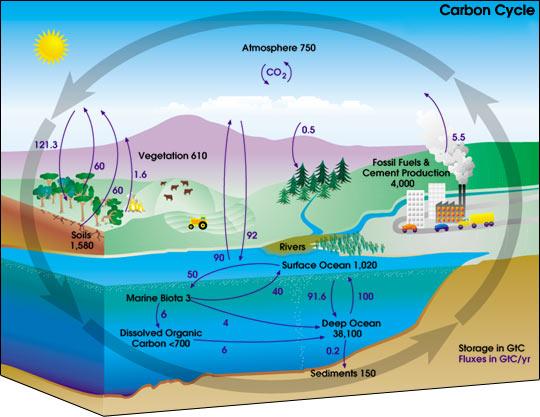
Carbon Cycle (With Ocean) Diagram

The Carbon Cycle: Ocean, Air, Trees…

To see more Richard Feynmann on Jiggling Atoms; Thermal Energy (Heat); Solid, Liquid, Gas, etc.

* Continue reading →