‘Mayday! Emergency Landing. We’re on Fire.’ – The Atlantic

For most of human history, the possibility of flight was confined to myths and nighttime dreams. A century-plus past the Wright Brothers, flight now conveys either jam-packed discomfort among the (statistically very safe) airlines, privilege for the private-jet world, or danger for other kinds of small planes. Rege’s video is meant to illustrate some of the beauty of the process — as the Avenger clip does in a different way.

SOAR from hadi dimachkieh on Vimeo.


SOAR from hadi dimachkieh on Vimeo.

Notes for specialists: the airplane Rege is flying is a new Cirrus SR-20. It is made by Cirrus Aircraft in Duluth, the company I’ve written about for years, and is one of the famous “planes with a parachute” that can be lowered safely to the ground by a parachute in the event of an impending crash.

Source: ‘Mayday! Emergency Landing. We’re on Fire.’ – The Atlantic

Public Circuit Boards (Gongban) China’s Collaborative Electronics-Design Ecosystem – The Atlantic

A different story emerges in the burgeoning wearable electronics market of Southern China, one that is based on a rapid, flexible and open ecosystem called shanzhai 山寨.

Take, World Peace Industrial (WPI), a Taiwanese electronic sourcing company located in Shenzhen, as an example. The company’s application technology unit (ATU) spends millions annually to develop reference circuit boards, called gongban 公板 (“public board”). A gongban can be used by a variety of different companies, who either incorporate it in their products directly or build atop it as they please via modifications. ATU develops 130 gongbans annually in areas ranging from smart phones, tablets, smart watches, smart homes, and industrial controls—and distributes the designs for free. WPI then makes money by trading in the boards’ components.

"We call this shanzhai in Shenzhen. It’s a mass production artwork,” explains Lawrence Lin head of the Application Technology Unit at WPI. Thirty some companies in Shenzhen are shipping their own smart watches with gongban from ATU and gongmo (‘public case’) sourced from the massive shanzhai ecosystem, which consists of tens of thousands of companies that manufacture and distribute goods.

Shanzhai used to refer to knock-off retail, and later end-consumer electronics, such as mobile phones of major brands like Nokia, Motorola and Ericson, often specifically designed for non-Western markets in China, South East Asia, South America, the Middle East and Africa. The ecosystem grew rapidly and by 2010, it was producing 200 million phones annually and was responsible for a quarter of the global mobile phone market. Since then, the shanzhai ecology has moved beyond cloning and enabled a wealth of iterative innovations including dual-SIM for frequent travelers to avoid roaming charges, seven-speaker phones for workers to listen to music at construction sites, and custom-designed phones for migrant populations unable to afford the latest smartphone.

via Shanzhai: China’s Collaborative Electronics-Design Ecosystem – The Atlantic.

High speed M&M sorting machine from iPhone, Arduino,

M&M sorting machines are a popular project for people who like combining electronics, programming and machine building. I decided I’d try to make my own version but with a different approach to the majority of existing M&M (or Skittles / Smarties!) sorting machines out there.

Most of them send a single M&M down a chute to a simple colour sensor where the colour sensor will then take a second or two to figure out the colour. A servo motor will then rotate a chute that will direct the M&M into the correct pot.

My approach sends M&Ms down a chute to start with. But I don’t stop the M&M for colour recognition. Instead I use an iPhone to capture the colour of the M&M as it is in freefall. As it is still falling the iPhone talks to a Bluetooth module attached to an Arduino and that fires off the correct electro magnet controlled gate. This sends the M&M into the correct pot. Even though this is just a rough prototype it is reasonably fast because the colour recognition and path that the M&M takes down the chute is decided and determined whilst the M&M is moving under gravity. Here’s a video of the prototype:

via High speed M&M sorting machine.

Flight of the RoboBees | Replacing dying bees with robots

As the rapid advancement of CCD began to reach feverish levels in June of this year, President Obama created a task force charged with solving the mystery within 180 days. The response from America’s brightest minds was swift and penetrating.

Harvard University scientists have come up with a deceptively simple solution that could also provide a potential boon for the nation’s growing drone industry: Replace the dead bees with micro-aerial vehicles that pollinate on command—robo-bees. It’s a gamble, but in these disruptive times, even nature needs to innovate if it wants to stay relevant.

Like “a mechanical flash mob,” as one journalist put it, the robo-bees are able to efficiently function within a swarm of thousands and self-assemble into a variety of shapes, including letters, numbers and even a five pointed star.

But it’s not just anthophila that are dying en masse. Neonic pesticides have also been linked to a more general decline in insect populations across the map, which has created a schism in nature’s managerial structure — fewer insects means less food for birds, which means fewer birds and so on and so forth.

From an engineering perspective, birds present a more complex challenge. One area where their robotic analogs could be of use is to replace a bird’s traditional function of spreading seeds from the various plant life it consumes.

via Flight of the RoboBees | Adbusters.

Q2 Plant Science Project 1b: Constructing a Wisconsin Fast Plants Light Bank

LIGHT BANK SYSTEM

The light bank system is most appropriate for growing large numbers of plants. 
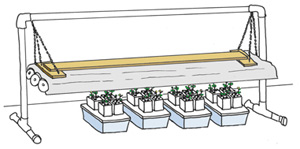
The light bank system is most appropriate for growing large numbers of plants. The light bank uses only 4.5 x 2.5 feet of space, which will accommodate several large classroom experiments. The light bank consists of 6 or more 4-foot fluorescent bulbs side by side. The most common bulb used is a 40-watt Cool White Deluxe™, but other 4-foot bulbs such as a 34-watt or a 40-watt Cool White™ are also acceptable for growing Fast Plants®.

Building Your Own Light Bank

As plants grow, the lights and/or plants are adjusted to keep the top of the plants 5-10 cm from the light bulbs. Appropriate lighting is perhaps the most critical component of a plant’s growing environment. Fast Plants® were bred to do well with the light produced by fluorescent lamps. Plants grown too far from lights or under weak light will be spindly and tend to fall over easily. Aluminim foil curtains can be used to increase the amount of light reaching the plants, especially those growing on the edges.via Wisconsin Fast Plants® Program.

Q2 Plant Science Project 1a: Building a Light Box System Wisconsin Fast Plants® Program

LIGHT BOX SYSTEM

The Plant Light Box is a low-cost alternative for growing Fast Plants® and other plants. It is ideal for small classroom experiments or group projects, and is designed so students and teachers can build their own.

Instructions for Building a 2-crate Plant Light Box SystemThese Light Boxes use two stackable plastic file crates that are cut, lined with aluminum foil, lit with a high efficiency fluorescent bulb, and stacked (after plants are tall). Each Light Box of this type can hold 12-15 small Bottle Growing Systems or 7 Deli-container Growing Systems (or 2-liter Bottle Growing Systems) or 1 Quad Growing System.

Note: Most file crates have slight differences in how they are manufactured; however, we have used all sorts of crates with success by making a few changes to these basic assembly procedures.

Materials
For each 2-crate Plant Light Box, you will need:

  • Two stackable plastic file crates that measure 17 1/4″ x 14 1/4″ x 11 1/2″ (sold at an office supply store). Notice that we like to use crates that have either a solid bottom or a solid plastic spot in the center of the long sides because this is where we will attach the light.
  • Aluminum foil roll, 12″ wide
  • Double-stick tape
  • Clear tape (e.g. Scotch Tape)
  • Hacksaw-type handsaw
  • Scissors
  • Tin snips (optional)
  • 40 or 42 watt compact fluorescent lamp (CFL) – this is a 150 watt equivalent high efficiency bulb “cool white” if available)
  • Drop work light (an extension cord and light socket can also be used; however, extension cords are not allowed in many schools)
  • Drill and 1″ paddle drill bit or sharp pocket knife for cutting a 1″ hole in the plastic crate for the light fixture
  • Plastic zip ties


Assembly Instructions:

via Wisconsin Fast Plants® Program.

Link to Museum of Science and Industry: The Science of Particles

The Science of Particles

Everything we experience in our everyday lives is the result of just a few fundamental particles. Physicists have uncovered much about the structure of matter, but there still remain some huge unsolved mysteries, such as dark matter, antimatter and – up until the discovery of the Higgs boson – how some particles gain mass. Quantum Mechanics.

The Standard Model of particle physics 

The Standard Model of particle physics is the closest physicists have to a theory of everything. It describes all the known particles, and hence everything that makes up the visible universe. Max and Tangle explain in this short animation by the BAFTA award-winning Brothers McLeod.

via What’s On | Collider | The Science of Particles | MOSI.

What K-8 Principals (and Teachers and Parents) Should Know About Hands-On Science

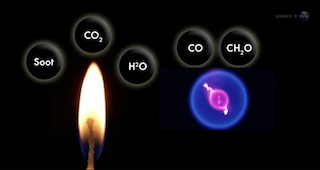
Fire-Flame Byproducts-SmallScience: It Can Be Noisy And Messy, But Students Learn Science Best When They Do It Themselves, 

by Olaf Jorgenson

When you think of a science lesson with children in the elementary and middle grades, what comes to mind? If your experience as a school leader, teacher, or parent is typical, you probably imagine a teacher demonstrating an interesting experiment with children hovering a safe distance away; or perhaps you envision children with their noses buried in textbooks, passively skimming for answers on a worksheet while the teacher circulates to offer assistance.

This is not what I would call active science, but it characterizes instruction in the vast majority of K–8 science classrooms nationwide. It is conceivably even more prevalent in schools with high proportions of at-risk or disadvantaged students, where material costs, extensive classroom preparation, and specialized teacher training —all prerequisite to effective hands-on science instruction—are rarely top priorities for principals or school boards dealing with more pressing issues. ….

Read Entire Article: What K-8 Principals Should Know About Science

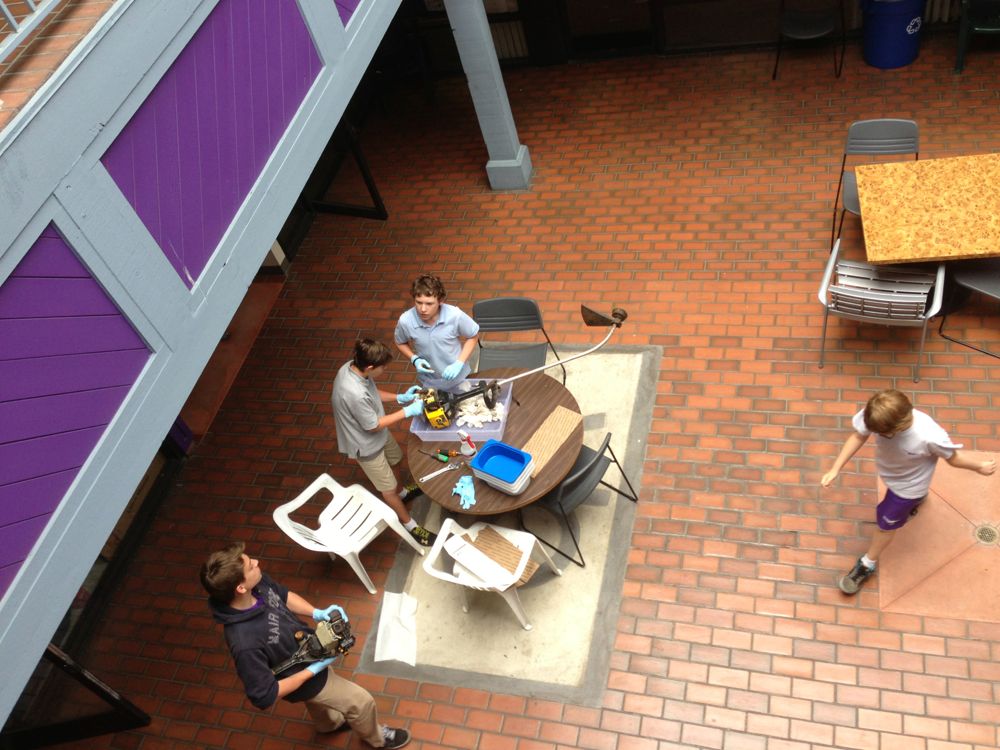
OTA 7th Grade Science – Internal Combustion Engine Deconstruction

Mr Major’s 7th Grade Science class studied theory and applications of Electromagnetic Energy for 3 quarters this year (building electric circuits, electric switches, electric telegraphs, electric buzzers, electric motors; learning to read circuit symbols and diagrams; learning to measure electricity; and much much more….).

7th Engine Project 1In 4th quarter they turn their attention to the theory and applications of Thermal Energy (taking apart one-cylinder internal combustion engines, studying two-cylinder engines, getting a lesson in motorcycle engine mechanics from master restorer Paul Kamanski, and much much more…!)

To see Slideshow and Internal Combustion Engine Project Exam Checklist …

Continue reading →