How plants adapt: Calcium waves help the roots tell the shoots

calcium waves help plants react to environment*

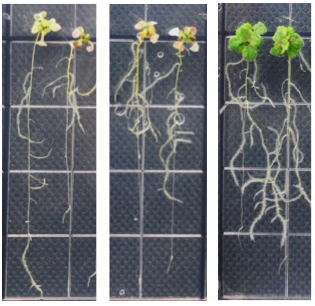
Arabidopsis thaliana growing in salt water. The plant on the right has more of the protein channel TPC1, thought to be involved in calcium signaling in plants. The plant at center has less TPC1 than normal, and the one on the left is considered normal. Credit: Won-Gyu Choi/Gilroy Lab
It’s a finding that has implications for those interested in how plants adapt to and thrive in changing environments. For instance, it may help agricultural scientists understand how to make more salt- or drought-tolerant plants.

“How do you think plants live?” Gilroy asks. “If I poke you, I see an instant response. You move away. Plants live in a slightly different world. They are rooted to the ground, literally, and they respond to the world either by growing or creating chemicals.”

Calcium is involved in transmitting information in the cells of humans and other animals, contracting muscles, sending nerve signals and more.

In plants, scientists believed it had to also play a role in processing information and sending rapid signals so that plants can respond quickly to their environments.

Imagine you are a plant being eaten by a caterpillar: “It’s like a lion chewing your leg,” says Gilroy. “If an insect is chewing your leaf, you’re gone unless you determine something effective immediately.”

But no one had ever been able to see it before. Even Gilroy’s team found it by accident.

via How plants adapt: Calcium waves help the roots tell the shoots.

How Caffeine Evolved to Help Plants Survive and Help People Wake Up

Cocoa BeansScientists had already determined that caffeine was also made in other plants, like tea and cacao, by N-methyltransferases. But by sequencing the coffee genome, Dr. Albert and his colleagues were able to make a more detailed comparison of the genes in different species. They discovered that in cacao, the enzymes manufacturing caffeine did not evolve from the same ancestors as those in coffee.

In other words, the coffee plant and cacao plant took different evolutionary paths to reach the same destination. Evolutionary biologists call this sort of process convergent evolution.

Continue reading →

Resurrecting Smallpox? Easier Than You Think – NYTimes.com

By LEONARD ADLEMAN OCT. 15, 2014

LOS ANGELES — ON Oct. 16, 1975, 3-year-old Rahima Banu of Bangladesh became theSmallpox keep out sign last human infected with naturally occurring smallpox (variola major). When her immune system killed the last smallpox virus in her body, it also killed the last such smallpox virus in humans. In what is arguably mankind’s greatest achievement, smallpox was eradicated.

Our war with this smallpox virus was brutal. It appears likely that the virus killed about one billion of us. Initially, our only defense was our immune system, but eventually we developed new tools, including vaccination. In the late 1950s, the World Health Organization began responding to outbreaks by vaccinating everyone in the surrounding area to prevent the virus from spreading. By 1975, we had won.

The smallpox virus had only a single host species: us. Other viruses have multiple hosts. For example, some strains of flu live in both humans and pigs, hence “swine flu.” If smallpox had had a second host, eradicating it in humans would have been of little value, since it would have thrived in its second host and later re-emerged in humans.

A few samples of the virus are still kept in special labs: one in the United States and one in Russia. We don’t bother vaccinating against smallpox anymore; if the virus escapes from one of these labs, the war will begin again. Currently, there is debate about whether these samples should be destroyed or kept for scientific purposes.

But the debate should be broadened. Even if we destroy those samples, the war is not over; the smallpox virus has now found a second host. It is not the pig. In fact, it is not even what we think of as a living thing. It is the computer.

via Resurrecting Smallpox? Easier Than You Think – NYTimes.com.

Light Energy • Secrets of the Color Wheel • Mixing Colors from Pigment (Chemicals)

Color

To understand blend modes, you need to know a little about color. Color is light, and likewise, light is made up of many colors. Objects absorb or reflect these light waves. Our eyes perceive these wavelengths as color. Let’s start with the color wheel.

The COLOR WHEEL has 12 segments that consist of primary, secondary and tertiary hues, or colors.

The three PRIMARY colors are RED, YELLOW, and BLUE. They form a triangle on the wheel. These colors cannot be mixed by combining any other colors. They are indicated on the color wheel with a P.

The three SECONDARY colors of ORANGE, VIOLET, and GREEN (marked on the chart by an S) are created by mixing equal parts of the primary colors they fall in between; ie, VIOLET is the secondary color produced by mixing equal parts of RED and BLUE.

The TERTIARY colors are the colors that result from mixing the primary and secondary colors on either side of them: ie, mixing the secondary color ORANGE with the primary color RED results in red-orange. These colors are marked on the color wheel with a T.

Using the color wheel you can determine color schemes fpr balance and harmony in your artwork, webpages, desktop publishing designs or home decorating.

Hue: Hue refers to the color…red, blue, etc.

The primary, secondary, and tertiary colors, or hues, are these colors at their full saturation or brightness; that is, there, there is no white, gray, or black added.

Value: the lightness or darkness of a color, or the relative amount (percentage) of white or black in a hue.

Luminosity, or Lightness: A measure of the amount of light reflected from a hue. Those hues with a high content of white have a higher luminance, or value. Continue reading →

Independent Reading & Research • Chapter 9: Introduction to the Biosphere

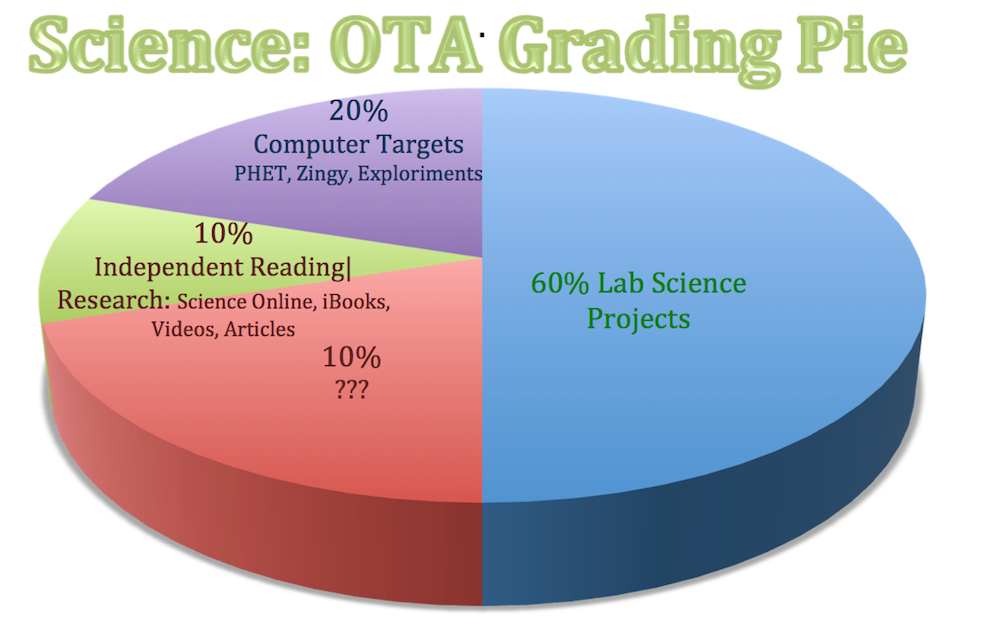
DRAFT 8th science grading pie-independent reading

Draft Pie–Add 20% : Matter-Energy Review 7th Grade Atomic Theory + Lab Projects Electro-Magnetic Energy with Extensions: Electronics, Measuring/Math, Life-on-Earth Connections

Pass a Science Independent Reading Pie Exam on Chapter 9 from
FUNDAMENTALS OF PHYSICAL GEOGRAPHY (2nd Edit)

via Chapter 9: Introduction to the Biosphere.

Survey Question 3: Soil Type Near Your Home? How to Improve Your Soil

Types of Soil

Height of corn shows type of soil

Soil Preparation

In my 70 plus years of gardening and observing others try their hand at having a successful garden, the single most important principle in gardening is soil preparation.

The underlying principle that you need to understand is that the roots of plants need to have air and water to develop and grow well. It is much the same way with our bodies. When our arteries start getting blocked and blood flow is reduced, the organs of our body are compromised and our health deteriorates.
Types of Soil - Clay and LoamyYou will find that a healthy plant will have a well-developed root system to extract the necessary nutrients from the soil and to transfer these nutrients to the upper part of the plant. As we eat the plant, we then take in these vital nutrients.

Clay: This is what my garden soil looked like before I started working with it. Loamy: This is what my soil looks like now. You can change different types of soil into rich loamy garden soil. Continue reading →

What is Zingy Science? 5 Demos: Gravity, Metric System, Electrons, Alcohol Solution, Density

Dear 8th Grade Parents, Click on the links below to try sample Zingy Science Modules:

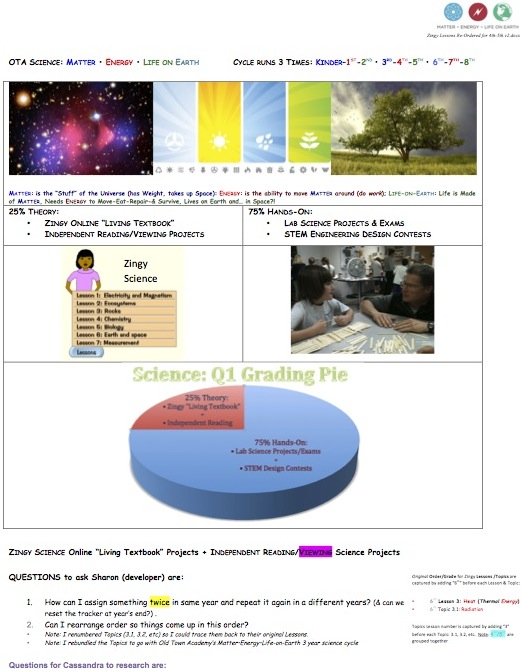
DRAFT Zingy Lessons Re-Ordered for OTA 4th-5th v2

25% Theory | 75% Lab Science Project & Exams???? or 40% | 60% in 2014-2015

DRAFT Zingy Lessons Re-Ordered for OTA 4th-5th v2

— Continue reading →