
 *
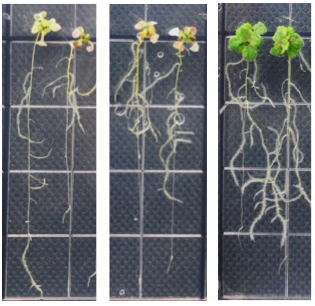
Arabidopsis thaliana growing in salt water. The plant on the right has more of the protein channel TPC1, thought to be involved in calcium signaling in plants. The plant at center has less TPC1 than normal, and the one on the left is considered normal. Credit: Won-Gyu Choi/Gilroy Lab
It’s a finding that has implications for those interested in how plants adapt to and thrive in changing environments. For instance, it may help agricultural scientists understand how to make more salt- or drought-tolerant plants.
“How do you think plants live?” Gilroy asks. “If I poke you, I see an instant response. You move away. Plants live in a slightly different world. They are rooted to the ground, literally, and they respond to the world either by growing or creating chemicals.”
Calcium is involved in transmitting information in the cells of humans and other animals, contracting muscles, sending nerve signals and more.
In plants, scientists believed it had to also play a role in processing information and sending rapid signals so that plants can respond quickly to their environments.
Imagine you are a plant being eaten by a caterpillar: “It’s like a lion chewing your leg,” says Gilroy. “If an insect is chewing your leaf, you’re gone unless you determine something effective immediately.”
But no one had ever been able to see it before. Even Gilroy’s team found it by accident.
via How plants adapt: Calcium waves help the roots tell the shoots.