Does Vinyl Really Sound Better? An Engineer Explains

Adam Gonsalves cuts vinyl records on his lathe

Mastering engineer Adam Gonsalves cuts lacquers for vinyl records in his Southeast Portland studio with a 1960s Scully lathe and other audio gear. David Greenwald/The Oregonian

Fighting the loudness wars: Digital music engineering, particularly for radio-bound music, is often marred by a volume arms race, which leads to fatiguing, hyper-compressed songs that squish out the dynamics and textures that give recordings their depth and vitality. Vinyl’s volume is dependent on the length of its sides and depth of its grooves, which means an album mastered specifically for the format may have more room to breathe than its strained digital counterpart. The longer an album, the quieter it gets: Gonsalves played me Interpol’s lengthy debut album and a 12-inch Billy Idol single, and the decibel difference — without any distortion creeping in — was remarkable.

That warm vinyl sound: “I think this is what people like about it: it pins very closely to the way that human beings hear music organically,” Gonsalves said. “It’s very mid-range-y and very warm,” a sound that flatters the fuzzy guitars of rock ‘n’ roll.

The bad

“All-analog” doesn’t always happen: Many modern vinyl records are produced from digital masters, either recordings made natively in software such as Pro Tools or converted from tape before being sent along for mass production. When I visited Gonsalves, he was working on My Brightest Diamond’s new album — from his computer. But analog-to-digital conversion (and vice versa) has come along quite a bit since the birth of the CD, and Gonsalves says he asks for high-definition, 24-bit files to master from if digital’s the option.

Still, as artists and labels hop on the vinyl trend, some new vinyl releases may be mastered from CD-quality audio, not the high-resolution formats audiophiles and folks like Neil Young adore. Is a CD-quality album going to sound more accurate on vinyl than a CD? Nope. But it will sound more vinyl-y, if that’s your preference.

“There’s basically nothing you can do to make an hour-long album on one record sound good,” Gonsalves said. Vinyl’s capable of a lot, but only if the grooves are wide enough for the needle to track them properly. A longer album means skinnier grooves, a quieter sound and more noise. Likewise, the ear-rattling sounds of dubstep weren’t really meant for your turntable. “If you had taken Skrillex into Motown Studios, they would’ve said, ‘It’s uncuttable!’” Gonsalves said, thanks to the strain the high-energy music would put on the needle’s journey.

Vinyl can struggle with highs and lows: High-pitched frequencies (drum cymbals, hi-hats) and sibilance (think “s” sounds) can cause the ugly crackle of distortion, while deep bass panned between the left and right channels can knock around the needle. “It should basically be in mono,” Gonsalves said. Otherwise, “that’s a hard path for a needle to trace.”

The beginning of an album side sounds better than the end: As the album’s circumference shrinks toward the middle, the needle speed changes and it can’t follow every millimeter of the groove. If the song that closes side A or B is a complicated one — say, one with a busy harmonica solo — it may well sound less than hi-fi. That’s why those double-LPs are worth the extra flipping.

Via http://www.oregonlive.com/music/index.ssf/2014/11/does_vinyl_really_sound_better.html

How to Make Music With a Whale

I myself have never had one of those moments when I looked into the eye of a whale and knew we shared something special — no, nothing like that. My encounters with humpback whales happen mainly through sound. Along with being a philosophy and music professor, I play music for a living: some of my fellow musicians are humans, but just as often they are animals, and sometimes those animals are whales. I sit on a boat, swaying in the waves, headphones on, listening to what goes on below and try to play along.

Photo

CreditDavid Rothenberg


I don’t do it often — there always seems to be some technical problem setting it up. It’s hard to find a boat with the right amplifier for the underwater speaker. Or I can’t charter a skiff or zodiac for this kind of work because officially it counts as harassment of marine mammals, which is against the law.

via How to Make Music With a Whale – NYTimes.com.

Mechanical/Sound Energy • The Science of Boomwhackers

Mechanical Energy-Sound•Science of Boomwhackers.

BACKGROUND:

Boomwhackers create distinct tones when whacked against a surface. The tone is determined by the length of the tube. The tubes are cut to the correct lengths to form the eight notes in a C major diatonic scale (C-D-E-F-G-A-B-C).

The tubes create tones in much the same way as other tube-shaped instruments. They filter a particular tone from noise that is introduced into the tube. A clarinet is played by vibrating a reed at one end. The reed does not vibrate at any particular frequency, but produces a range of frequencies (a buzzing noise). The shape of the clarinet and which holes are covered determine which frequency is amplified. Boomwhackers work in much the same way. Whacking the tube produces a noisy sound that contains many frequencies. The tube, because of its length, resonates and amplifies one of the frequencies. Notice, in the figures below, that the resonant wavelength is one that has antinodes at both ends of the tube.

EXPERIMENTS:

1. Pitch/Wavelength: Whack two different tubes. Which tube produces the lower tone? How do the lengths of the tubes compare? Longer tubes produce lower tones because they amplify a longer wavelength (lower frequency).

Continue reading →

What is Sound? Sound Waves, Wavelength, Reflection and Refraction of Sound Waves – Pass My Exams: Easy exam revision notes for GSCE Physics

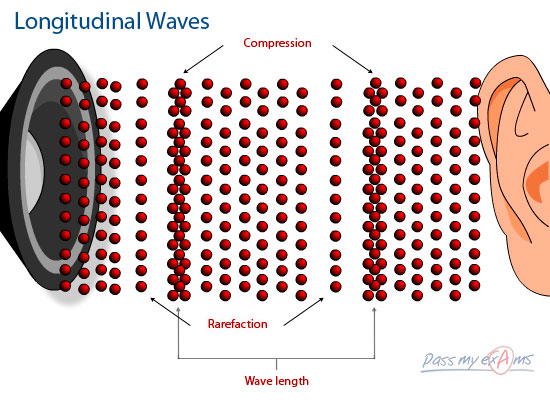
Sound is caued by mechanical vibrations transmitted through a solid, liquid and gas and travel as a wave.

Sound refers to those vibrations with frequencies detectable by the human ear. This is in the range 20 – 20,000 Hertz (Hz).

  • __Create a sound that is outside the range of human hearing

The animation of a vibrating diaphragm of a radio speaker below shows the generation and propagation of a sound wave.

via Sound, Wavelength, Reflection and Refraction of Sound Waves – Pass My Exams: Easy exam revision notes for GSCE Physics.

The Physics of Hearing – External Ear (is a Pre-Amplifier)

The function of the external or outer ear is mainly to direct and amplify sound waves into the middle ear. There are three main parts of the outer ear, each of which assists in the collection or amplification of sound.

  • 1a. The auricle, or pinna, is the portion of the ear that protrudes from the temporal lobe of the skull and is visible as a collection of folds of skin and cartilage. The position of the auricles at angles of 30°, one on each side of the head, help the listener to localize sound and determine which direction the signal is coming from. In addition,

the cup-like shape of the auricle funnels sound into the ear. Many people cup their hands over their ears to hear better because this action enhances the natural shape of the outer ear and actually amplifies the incoming sound by 5 to 8 decibels (dB).

Once through the auricle, the sound waves enter the head through the

  • 1b. external auditory meatus, more commonly known as the ear canal. This is essentially a tube or pipe open on one side to the environment and closed on the other end by the tympanic membrane, or
  • 1c. eardrum, which is the third component of the external ear. Because of the canal’s structure, standing waves are formed inside. A look at the physics of the external auditory meatus reveals the resonant frequency and wavelength of the canal.

The average length of the external auditory meatus (L) is 2.3 cm or 0.023 m and the speed of sound in air (v) is approximately 343 m/s. This information can be used an equation to find the fundamental frequency (f1) of a tube closed on one end:

  • f1 = v / (4 L)
  • f1 = (343 m/s) / (4 * 0.023 m)
  • f1 = 3728 Hz

The equation gives a resonant frequency of 3728 Hz, or cycles per second. However, because the tympanic membrane at one end of the canal both absorbs and reflects some of the energy, there is a damping effect. As a result, the resonant frequency range is actually broader, spanning a range from 3500 to 4000 Hz.

A second equation can be applied to find the wavelength (λ) of sound waves in the canal using the fundamental frequency just determined:

λ = v / f1

λ = (343 m/s) / 3728 Hz

λ = (0.092 m or 9.2 cm)

Because of these standing waves, “curves of equal loudness” are established in the external auditory meatus. This means that sounds resonating between 3500 and 4000 Hz, or subsequent integral multiples of these frequencies, require less intensity to be heard at the same loudness as other sounds of different frequencies.

image source: http://www.ent.uci.edu/images/How%20Ear%20Works.jpg 

via The Physics of Hearing – External Ear.

Matter * Energy * Life: 2011! Sound Energy: Speaker Design, Round 3

Today the sixth grade used what they’ve learned about sound energy, the human ear (ear drum, acoustic nerve), and vibrating membranes to improve their acoustic speaker designs yet again. Next up–Electric Speakers!

Click on Sound Energy- Acoustic Speakers- Round 3a….. Round 3b to listen to the clips of some of the newest speaker designs. (More clips coming!)