8th Grade Science Textbook • E.O. Wilson’s Life on Earth

“I’m going to ask you to… enter the world of the biologist.”

Available FREE from the iBooks Store

loe-logo-for-homepage-bottom2-640x119

On June 30, 2014, the E.O. Wilson Biodiversity Foundation released the ground-breaking new high school biology textbook E.O. Wilson’s Life on Earth. We believe that education is the most important tool we have to face the challenges confronting our living planet. Life on Earth was created to instruct and inspire students, the future stewards of Earth.

Life on Earth is an iBooks Textbook consisting of 41 chapters in 7 separate units and can be downloaded for free from the iBooks Store. The text provides a complete, original, standards-based, media-rich curriculum to give high school students a deep understanding of all of the central topics of introductory biology.

7_books_stacked-640w

E.O. Wilson’s Life on Earth
Morgan Ryan, Gaël McGill, PhD, & Edward O. Wilson
Published June 30, 2014 by the E.O. Wilson Biodiversity Foundation

An iBooks Textbook available for iPad and Apple laptops and desktops

To create Life on Earth, the E.O. Wilson Biodiversity Foundation brought together a team consisting of educators, writers, multimedia artists, 3D animators trained in science and cinema, and textbook professionals, led by naturalist Edward O. Wilson. The editorial team, headed by Morgan Ryan, worked in full partnership with the Boston-based scientific graphics company Digizyme, Inc, headed by Gaël McGill, PhD, with the goal of creating a cultural landmark—a portal that will introduce students to the grandest story there is, the story of life on Earth, from molecules to ecosystems, from the origin of life to the modern awareness that we control the environment we live in.

via E.O. Wilson Biodiversity Foundation » E.O. Wilson’s Life on Earth.
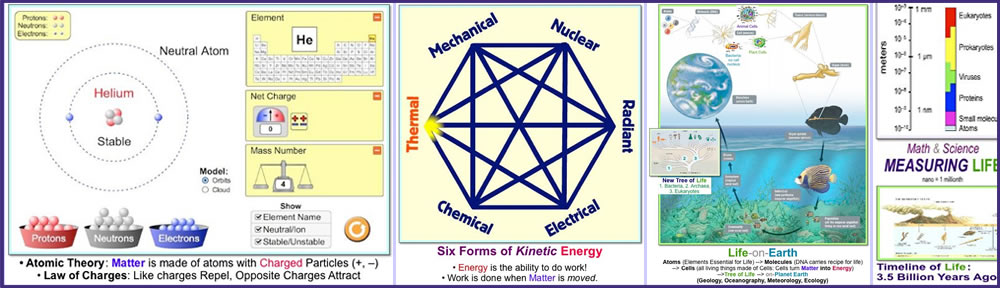
Matter • Energy • Life-on-Earth… Measurement & Math… Technology… Experimental Design

Matter Energy Life-on-Earth Header8

The “Star Trek Game”: While “boldly seeking out new worlds” as captain of the Enterprise… the Admiral allows you an exception to the Prime Directive (non-interference with alien civilization rule)…

a planet is dying and if the natives don’t have a scientific revolution soon they will perish: You may tell the young civilization one scientific secret before you move on. What would you tell them?

Others classes picked:

Continue reading →

The Power of Introverts: An Essential Understanding for Teachers | Edutopia

The Power of Introverts: An Essential Understanding for Teachers | Edutopia.

Here’s a nugget of Cain’s advice for teachers: “If you’re a teacher, enjoy your gregarious and participatory students. But don’t forget to cultivate the shy, the gentle, the autonomous — the ones with single-minded enthusiasm for chemistry sets or parrot taxonomy or nineteenth-century art. They are the artists, engineers, and thinkers of tomorrow.” She also writes a lot about how teachers can work with introverted students.

What K-8 Principals (and Teachers and Parents) Should Know About Hands-On Science

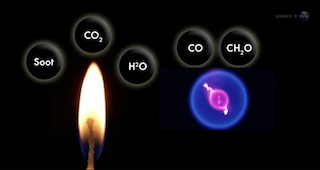
Fire-Flame Byproducts-SmallScience: It Can Be Noisy And Messy, But Students Learn Science Best When They Do It Themselves, 

by Olaf Jorgenson

When you think of a science lesson with children in the elementary and middle grades, what comes to mind? If your experience as a school leader, teacher, or parent is typical, you probably imagine a teacher demonstrating an interesting experiment with children hovering a safe distance away; or perhaps you envision children with their noses buried in textbooks, passively skimming for answers on a worksheet while the teacher circulates to offer assistance.

This is not what I would call active science, but it characterizes instruction in the vast majority of K–8 science classrooms nationwide. It is conceivably even more prevalent in schools with high proportions of at-risk or disadvantaged students, where material costs, extensive classroom preparation, and specialized teacher training —all prerequisite to effective hands-on science instruction—are rarely top priorities for principals or school boards dealing with more pressing issues. ….

Read Entire Article: What K-8 Principals Should Know About Science

Independent Reading… Science Extra Credit Reading Challenges – Joy Hakim

October 7, 2010 by questmiddleschool

Science Test #2 next Thursday! Oct 28.

Topics: Electromagnetic Energy: Permanent and Electromagnets

Optional Science Reading Projects: The Story of Science: Newton at the Center, by Joy Hakim:
READING Project 1:  Chapter 31 (A Shocking Science: Energy, Franklin, Static Electricity)

  • Prep for “Reading Pie” Oral Exam (Slice 1: p. 324; Slice 2: pp 322-333; Slice 3: p. 331.) Pass all three 3 slices for credit.Questions are always the same*
  • Create Mind Map of chapter vocab and scientists for extra credit.

READING Project 2: Chapter 32 (Michael Faraday Has a Field Day: Electromagnetic Fields and Motors). Continue reading →

Independent Reading: Very Good… Thought-Provoking… Short Articles on “Electricity”

Articles on “Electricity” . . . . WJ Beaty.

What’s the relation between Watts, Ohms, Amps, and Volts?
Memorizing facts? That’s not learning. Tie it all together instead. Ohm’s law and electrical energy.

What Is “Electricity?”
There is a simple answer to this question. Really. Not the one you expect, though.

Electricity: Frequently-asked Questions (FAQ)
Browse these Electricity Answers, or submit a new question.

How transistors REALLY work
Problems with traditional transistor explanations… Continue reading →

Matter-Energy-Life: Fostering “Learning Progressions” (different from Standards) • Creating “Progress Maps”

Path for Progress (cf. Montessori’s “Prepared Paths to Excellence”)

A recent National Research Council study argued that schools should focus more on building students’ understanding of “big ideas” in science rather than simply teaching them unconnected facts. The NRC document describes how a “learning progression” can be used to expand gradually students’ knowledge of the central concepts behind matter and atomic- molecular theory in grades K-8.

Big Idea: “Objects are constituted of matter, which exists as many different material kinds. Objects have properties that can be measured, depending on the matter and the material kinds they are made of.”

Sample Progression: (Describing measurements and explanations for properties of objects.)

  • Grades K-2: Objects have certain properties—weight, length, area, and volume—that can be described, compared, and measured.
  • Grades 3-5: Weight and volume are additive properties that can be measured; the weight of an object is a function of its volume and the material of which it is made.
  • Grades 6-8: Mass is a measure of the amount of matter and is constant across location. Weight is a force proportional to mass and varies with gravitational field. Solids, liquids, and gases have different properties. 

To learn more about creating Progressions vs Standards and “Progress Maps” ….

Continue reading →

Education Week: Panel Points Way to Improving K-8 Science Learning

By Sean Cavanagh

To develop a strong understanding of science, students in elementary and middle school should be encouraged to master a relatively small number of crucial concepts, and gradually expand their knowledge of those topics, a new study argues.

Released by the congressionally chartered National Research Council, the report says that too often, students are presented with long lists of disconnected facts and ideas, leaving them with no sense of what is most important and a poor understanding of the overall rules of science.

FOR MORE INFO

Continue reading →