
Category Archives: Videos | Slideshows
Declining Biodiversity • Historical photographs expose decline in coastal fisheries, new Scripps study finds
Published: Tuesday, February 17, 2009 – 15:15 in Earth & Climate
Loren McClenachan, Scripps Institution of Oceanography, UC San Diego
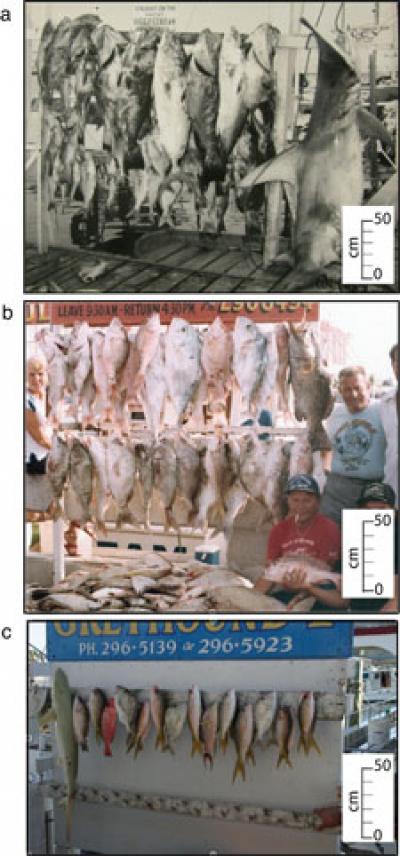
A unique study by a scientist at Scripps Institution of Oceanography at UC San Diego has provided fresh evidence of fishing’s impact on marine ecosystems. Scripps Oceanography graduate student researcher Loren McClenachan accessed archival photographs spanning more than five decades to analyze and calculate a drastic decline of so-called “trophy fish” caught around coral reefs surrounding Key West, Florida. In a paper published online in January and printed in an upcoming issue of the journal Conservation Biology, McClenachan describes a stark 88 percent decline in the estimated weight of large predatory fish imaged in black-and-white 1950s sport fishing photos compared to the relatively diminutive catches photographed in modern pictures. In a companion paper being published in the Endangered Species Research journal, McClenachan employs similar methods to document the decline of the globally endangered goliath grouper fish.
“These results provide evidence of major changes over the last half century and a window into an earlier, less disturbed fish community…” McClenachan said in the Conservation Biology paper.
McClenachan’s studies are part of an emerging field called historical marine ecology, in which scientists study photographs, archives, news accounts and other records to help understand changes in the ocean ecosystem over time and establish baselines for future ecosystem restoration.
Biodiversity Project 2 • Wonders of La Jolla Shores Marine Preserve
8th Graders–Someone has to know the names of the animals! to monitor biodiversity and the health of the local ecosystem…
To Earn Credit for Biodiversity Project 2:
Let the Wonders of La Jolla Shores, slideshow roll, NAME the first five species chosen at random with the dice.
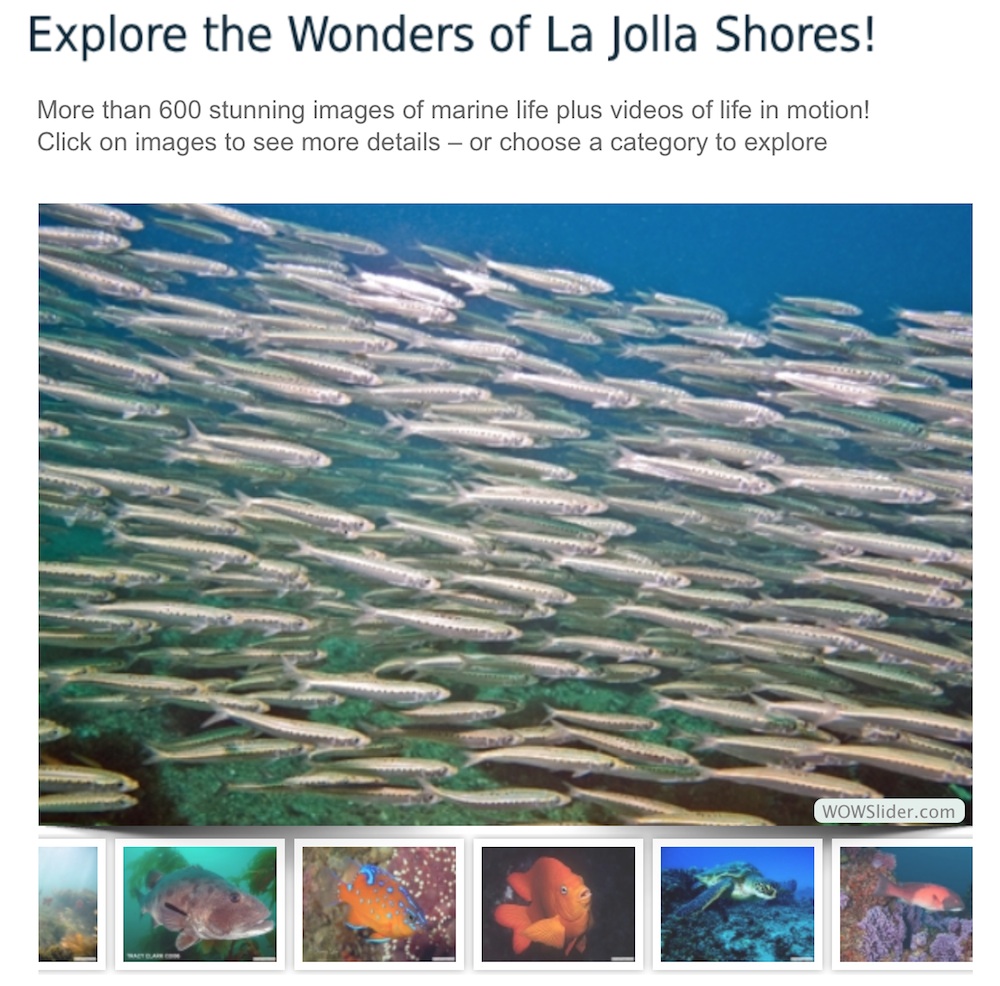
La Jolla • Kelp Forests, 7-Gill Sharks
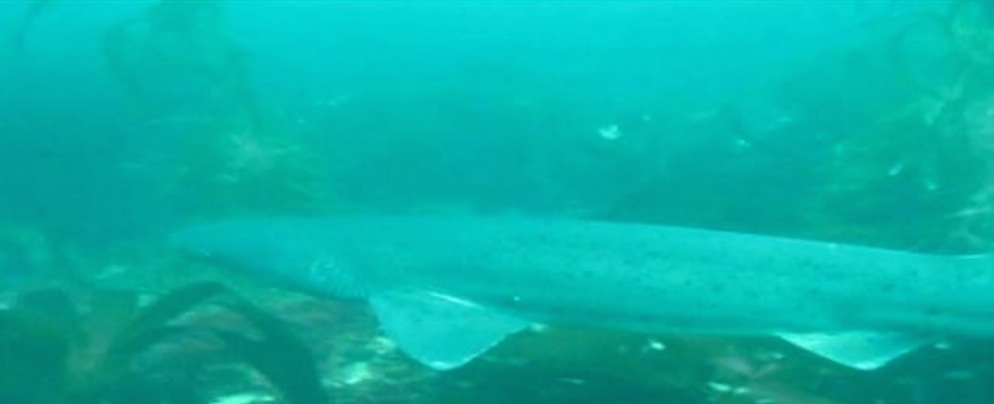
La Jolla Shores • Leopard Sharks, Guitar Fish, Sting Rays, Anchovies • Snorkeling Technique
===
8th Grade Science Textbook • E.O. Wilson’s Life on Earth
“I’m going to ask you to… enter the world of the biologist.”
Available FREE from the iBooks Store


On June 30, 2014, the E.O. Wilson Biodiversity Foundation released the ground-breaking new high school biology textbook E.O. Wilson’s Life on Earth. We believe that education is the most important tool we have to face the challenges confronting our living planet. Life on Earth was created to instruct and inspire students, the future stewards of Earth.
Life on Earth is an iBooks Textbook consisting of 41 chapters in 7 separate units and can be downloaded for free from the iBooks Store. The text provides a complete, original, standards-based, media-rich curriculum to give high school students a deep understanding of all of the central topics of introductory biology.

E.O. Wilson’s Life on Earth
Morgan Ryan, Gaël McGill, PhD, & Edward O. Wilson
Published June 30, 2014 by the E.O. Wilson Biodiversity Foundation
An iBooks Textbook available for iPad and Apple laptops and desktops
To create Life on Earth, the E.O. Wilson Biodiversity Foundation brought together a team consisting of educators, writers, multimedia artists, 3D animators trained in science and cinema, and textbook professionals, led by naturalist Edward O. Wilson. The editorial team, headed by Morgan Ryan, worked in full partnership with the Boston-based scientific graphics company Digizyme, Inc, headed by Gaël McGill, PhD, with the goal of creating a cultural landmark—a portal that will introduce students to the grandest story there is, the story of life on Earth, from molecules to ecosystems, from the origin of life to the modern awareness that we control the environment we live in.
via E.O. Wilson Biodiversity Foundation » E.O. Wilson’s Life on Earth.
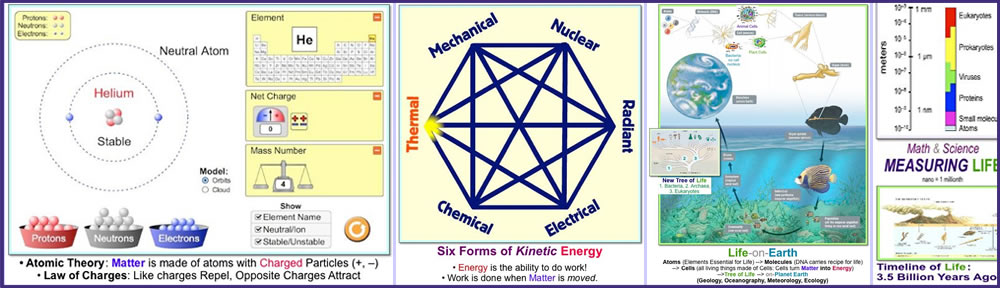
Matter • Energy • Life-on-Earth… Measurement & Math… Technology… Experimental Design
The “Star Trek Game”: While “boldly seeking out new worlds” as captain of the Enterprise… the Admiral allows you an exception to the Prime Directive (non-interference with alien civilization rule)…
a planet is dying and if the natives don’t have a scientific revolution soon they will perish: You may tell the young civilization one scientific secret before you move on. What would you tell them?
Others classes picked:
National Geographic World Atlases Show Warming • TED Talk on Oceans
Two new atlases provide clear visual evidence of the effect climate change and extreme weather can have on people and property.
LONDON, 12 July 2014 – For people who find it hard to believe the Earth really is warming, new visual evidence will soon be available – two atlases, one showing graphically the retreat of Arctic ice, the other the human and economic price exacted by extreme weather.
The 10th edition of the National Geographic Atlas of the World is to be published on 30 September. The publication’s geographer, Juan José Valdés, says the reduction in multi-year ice – ice that has survived for two summers – is so noticeable compared with previous editions that it is the biggest visible change since the breakup of the USSR.
via Striking Changes to World Atlases to be Released » The Daily CatchThe Daily Catch.
Quantum Mechanics: Animation explaining quantum physics. – Video Animation
Quantum Mechanics: Animation explaining quantum physics.
via Quantum Mechanics: Animation explaining quantum physics. – YouTube.
Matter and Energy TRANSFORMATIONS • Here’s What Happens When You Light a Fire in Space – Megan Garber – The Atlantic
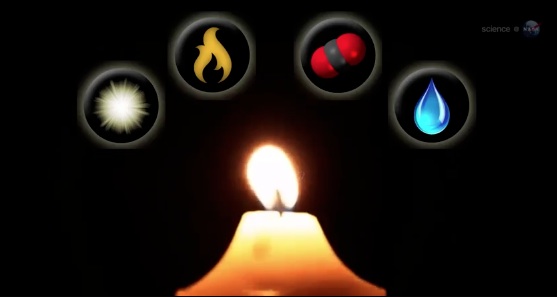
On Earth Fire Produces Light, Heat, CO2, Water, and Soot (Hydrocarbons)… and FLAME!
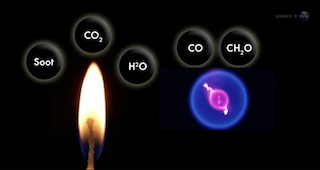
In Space things get weird… Fire Byproducts:
- On Earth (High Temp Flame: “Teardrop.” By-products: Soot, Carbon Dioxide, Water) vs
- In Space/in the MicroGravity of the Space Station (Lower Temp Flameless Fire: “Spherical.” By-products: Carbon Monoxide, Formaldehyde
“When it comes to fire,” says physics professor Forman A. Williams, “we’re just getting started.”
Take the flame of a candle, the kind you might find on a birthday cake. The flame takes the familiar shape — as, basically, a gaseous teardrop — because of gravity. The hot air rises and draws fresh, cool air behind it. The buoyancy makes the flame shoot up and flicker.
To watch video: Fire on the Space Station….