NASA Ponders Mars Farming for 2030s Manned Mission

Future astronauts may grow some of their meals inside greenhouses, such as this Martian growth chamber, where fruits and vegetables could be grown hydroponically, without soil.

WASHINGTON —The first humans to live on Mars might not identify as astronauts, but farmers. To establish a sustainable settlement on Earth’s solar system neighbor, space travelers will have to learn how to grow food on Mars — a job that could turn out to be one of the most vital, challenging and labor-intensive tasks at hand, experts say.

“One of the things that every gardener on the planet will know is producing food is hard — it is a non-trivial thing,” Penelope Boston, director of the Cave and Karst Studies program at New Mexico Institute of Mining and Technology, said yesterday (May 7) at the Humans 2 Mars Summit here at George Washington University. “Up until several hundred years ago it occupied most of us for most of the time.”

Early Mars colonists may have to revert to this mode of life to ensure their own survival, she suggested. [Cooking Lessons for Mock Mars Mission (Photos)]

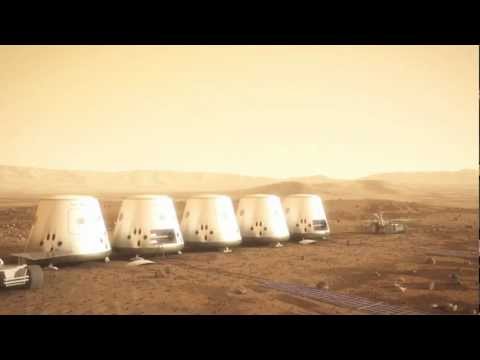
via NASA Ponders Mars Farming for 2030s Manned Mission.

Dangers Travelers to Mars will face during their 300-500 day journey

Round Trip to Mars? The Dangers any Couple will Have to Brave on Their Journey

  • Even with radiation shielding in place, the round trip to Mars is likely to involve massive exposure levels from charged particles.
  • Out in deep space, the crew of a 500-day trip would be exposed to total radiation roughly equal to the dose an astronaut that flew five or six times to the ISS would expect to receive over their career.
  • Long-term weightlessness, including bone loss and muscle loss. The couple who fly past Mars will surpass Soviet cosmonaut Valery Polyakov’s 437-day record for continuous time in microgravity, set in 1994-1995 aboard the Russian space station Mir.
  • The sleeping quarters will be shielded against the danger of a solar storm erupting from the sun – sending radiation to unbearable levels.
  • The mental stresses on the human mind are also untested in the reality of deep space – to date extreme isolation has only been experienced by overwinter crews in Antarctica
  • There will be no backup plan to rescue the astronauts if something goes wrong – they will be alone in the night 75 million miles away from Earth
  • The couple will have to ration about 3,000 pounds of dehydrated food they’ll have to rehydrate with the same water they drank and turned to waste two days ago


Read more: http://www.dailymail.co.uk/sciencetech/article-2287777/Mars-mission-couple-coat-spacecraft-walls-POO-protect-cosmic-rays.html#ixzz3DcrdXg8h
Follow us: @MailOnline on Twitter | DailyMail on Facebook

A one-way trip to Mars – CBS News

It sounds like a tale from pulp science fiction: volunteers signing up to take a one-way trip to another planet. But that’s just what’s in the works in the Mars One program.

The Netherlands-based non-profit organization plans to send four people to the Red Planet in 2024, with the hopes of establishing the first human settlement there.

While some are skeptical that the program will ever get off the ground, the team at Mars One stands by the mission.

“We’re going to be a new and complete society on Mars,” explained Dr. Norbert Kraft, Mars One Chief Medical Officer. “Independence from Earth is the goal in the end.”

via A one-way trip to Mars – CBS News.

Terraforming Mars • Human’s Future in Space? • Moon Base, La Grange Stations, Mars

Terraforming_Mars_transition_horizontal

The Future

  •  How will our progression occur?
  • Sooner rather than later, the United States, China, Russia or the European Union
  • (most likely some combination of these) will retrace the first steps into space.

*****

By the late 2020s, astronauts will be orbiting Mars, landing on its two moons, Phobos and Deimos, and finally will descend to the surface of the planet.

Unlike the moon, our friendly red neighbor has an atmosphere, which can be adjusted in its elements, and thereby terraformed into an eventual Earth-like world. So with Mars in the longterm, we will be engineering a new home.

In this view, we see Mars over the horizon of Phobos, one of its two tiny moons.

*****

Terraforming Mars into an Earth like planet is a step-by-step process, this is a middle stage where we heat up the atmosphere by unlocking the polar ice caps with plants, our best friends in the terraforming process. Interestingly, Mars has a pink sky and blue sunsets, exactly the opposite of what we have on Earth, with blue sky and reddish sunsets.

 mars terraforming greenhouse gardening

The Red Planet had had oceans and rivers once, indicating a good environmental temperature between 32 and 212 degrees …and with our intervention, it can again…mars terraforming-the final product

via The Future.