How Caffeine Evolved to Help Plants Survive and Help People Wake Up

Cocoa BeansScientists had already determined that caffeine was also made in other plants, like tea and cacao, by N-methyltransferases. But by sequencing the coffee genome, Dr. Albert and his colleagues were able to make a more detailed comparison of the genes in different species. They discovered that in cacao, the enzymes manufacturing caffeine did not evolve from the same ancestors as those in coffee.

In other words, the coffee plant and cacao plant took different evolutionary paths to reach the same destination. Evolutionary biologists call this sort of process convergent evolution.

Continue reading →

8th Grade Science Reading Projects 4-7 • Project 4: Article: Ebola and the Vast Viral Universe • Projects 5, 6, 7: Finish First Chapters 2, 3, 4 of Life on Earth

  • Classification of Life (Do Viruses meet six characteristics of living things? Reread Chapter 1.3, Life on Earth)

http://nyti.ms/1wvsCka

By all evidence, researchers say, viruses like Ebola have been parasitizing living cells since the first cells arose on earth nearly four billion years ago. Some say that viruses actually invented cells.

Aids Virus Electron Microscope

Continue with your Life on Earth Reading- Goal is to finish the four Unit 1 Chapters (Passing all Open-Book Quizzes with 100%) by Nov 7

Table of Contents
Unit 1: Unity and Diversity of Life on Earth
1. What Is Life?
2. The Chemistry of Life
3. Evolutionary Mechanisms
4. History of Life on Earth


(Read through the Dale-chall difficult word list definitions- see links to videos when necessary)


Q2 Plant Science: Project 2b: Grower’s Calendar • Wisconsin Fast Plants® Program

GROWER’S CALENDAR

Follow the grower’s calendar for Fast Plants® to help get your plan underway. Use the links to find more detailed instructions about each task.Fill in the dates as you plan for planting and growing your Fast Plants®.

Task Day of Cycle (time required) Activities
Preparation Start (1 1/2 hrs)Date:____________
  1. Assemble light bank and rack or light box.
  2. Set up reservoirs.
  3. Saturate water mat according to growing instructions.
  4. Arrange all planting materials.
Planting Day 1 (1 hr)Date:____________
  1. Plan to start life cycle on a Monday or Tuesday.
  2. Plant, water from above, label, set planters (quads, deli containers, or bottle tops) on water source (watermat or water reservoir bottom) with soil surface 5–10 cm (~2 inches) from the lights.
Germination Days 2– 3Date:____________
  1. Water from top with pipet.
  2. Cotyledons emerge.
Tending Days 4–5 (30 min)Date:____________
  1. Thin to 1 plant per cell.
  2. Transplant if necessary to obtain 1 plant in every cell.
  3. Check the water level in the reservoir!
Growth Days 6–11 (15 min/day)Date:____________
  1. Check plants and reservoir level daily throughout the rest of the life cycle.
  2. Observe growth and development.
Flowering Day 12 (30 min)Date:____________
  1. Flower buds beginning to open.
  2. Make bee sticks.
Pollination Days 13–18 (15 min/day)Date:____________
  1. Pollinate for 2–3 consecutive days.
  2. On the last day of pollination, pinch off any remaining unopened buds.
Seed Development Days 17–35 (10 min/day)Date:____________
  1. Observe seed pod development.
  2. Embryos mature in 20 days.
Seed Maturation Day 36 (30 min)Date:____________
  1. Twenty days after the last pollination, remove plants from water reservoir.
  2. Allow plants to dry for 5 days
Harvesting Day 40 (30 min)Date:____________
  1. Harvest seeds from dry pods.
  2. Clean up all equipment.
  3. Plant your own seeds or store them appropriately.

GROWER’S CALENDAR

Continue reading →

Links to Classification of Life / Taxonomy Websites

“The incredible diversity of life on this planet, most of which is microbial, can only be understood in an evolutionary framework” — Carl Woese, 2000

Slideshow: Classification Wars • How do we keep track of 30,000,000 Species of Life?

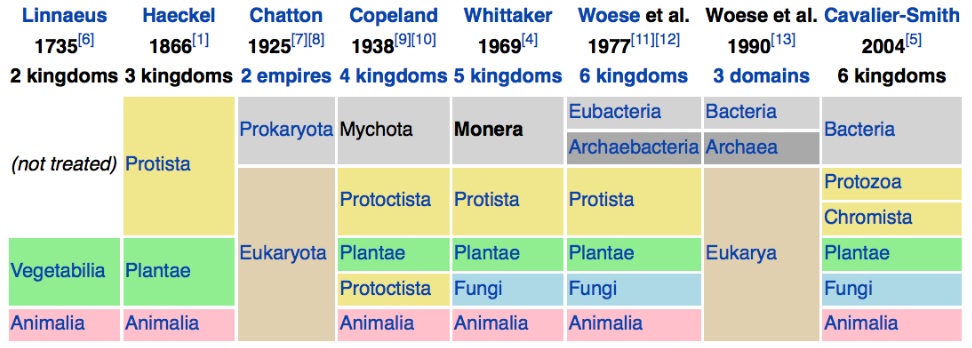
  • Before 1969: Life was classified into 2 KINGDOMS: Plant Kindgom – Animal Kingdom
  • From 1969 – 1990: Life was classified into 5 KINGDOMS: Monera, Protista, Plantae, Fungi, Animalia, by R.H. Whittaker [Science 163, 150 (1969)] using classification according to Linnaeus – based on anatomy, morphology, embryology, and cell structure.  (PS. Viruses are not in ANY of these KINGDOMS…remember that scientists do not classify them as ‘alive’).

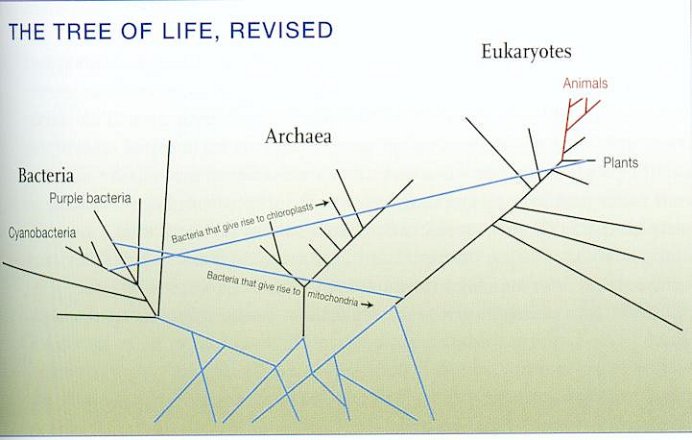
BUT – the traditional 5 Kingdom system says nothing about how organisms within Kingdoms or between kingdoms may be related to each other via evolutionary relationships among the kingdoms.

So since 1990 many biologists have added 3 DOMAINS above the KINGDOM Level: Bacteria, Archaea, Eukarya


((We won’t have time to go here…but what evidence do scientists have for how life began on planet Earth? Click lhere for last year’s notes on “The Origin of Life” if you are interested!))


Aristotle’s Classification of Living Things:

Linnaeus’s Classification of Living Things:

History of Classification of Life

How to Make and Use a Cladogram – Classification of Life -Wikipedia

Cladogram

From Wikipedia, the free encyclopedia
For help on how to use cladograms in Wikipedia, see Help:Cladograms

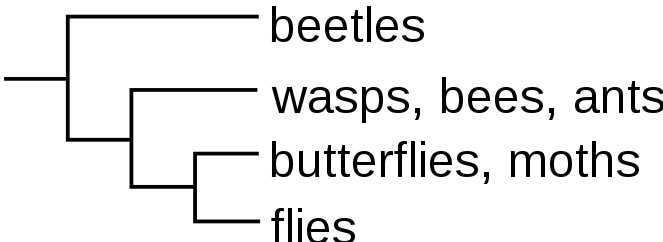
A horizontal cladogram, with the ancestor (not named) to the left

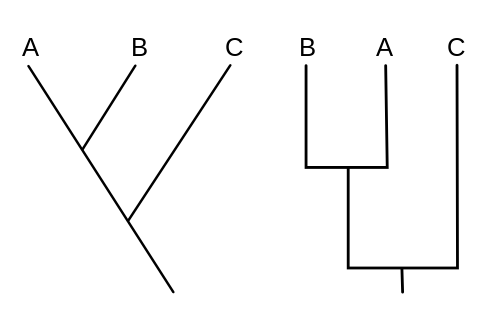
Two vertical cladograms, the ancestor at the bottom

A cladogram is a diagram used in cladistics which shows relations among organisms. A cladogram is not, however, an evolutionary tree because it does not show how ancestors are related to descendants or how much they have changed; many evolutionary trees can be inferred from a single cladogram.[1][2][3][4][5] A cladogram uses lines that branch off in different directions ending at groups of organisms. There are many shapes of cladograms but they all have lines that branch off from other lines. The lines can be traced back to where they branch off. These branching off points represent a hypothetical ancestor (not an actual entity) which would have the combined traits of the lines above it.[4][6] This hypothetical ancestor might then provide clues about what to look for in an actual evolutionary ancestor. Although traditionally such cladograms were generated largely on the basis of morphological characters, DNA and RNA sequencing data and computational phylogenetics are now very commonly used in the generation of cladograms.

via Cladogram – Wikipedia, the free encyclopedia.