Q2 Plant Science: Project 2b: Grower’s Calendar • Wisconsin Fast Plants® Program

GROWER’S CALENDAR

Follow the grower’s calendar for Fast Plants® to help get your plan underway. Use the links to find more detailed instructions about each task.Fill in the dates as you plan for planting and growing your Fast Plants®.

Task Day of Cycle (time required) Activities
Preparation Start (1 1/2 hrs)Date:____________
  1. Assemble light bank and rack or light box.
  2. Set up reservoirs.
  3. Saturate water mat according to growing instructions.
  4. Arrange all planting materials.
Planting Day 1 (1 hr)Date:____________
  1. Plan to start life cycle on a Monday or Tuesday.
  2. Plant, water from above, label, set planters (quads, deli containers, or bottle tops) on water source (watermat or water reservoir bottom) with soil surface 5–10 cm (~2 inches) from the lights.
Germination Days 2– 3Date:____________
  1. Water from top with pipet.
  2. Cotyledons emerge.
Tending Days 4–5 (30 min)Date:____________
  1. Thin to 1 plant per cell.
  2. Transplant if necessary to obtain 1 plant in every cell.
  3. Check the water level in the reservoir!
Growth Days 6–11 (15 min/day)Date:____________
  1. Check plants and reservoir level daily throughout the rest of the life cycle.
  2. Observe growth and development.
Flowering Day 12 (30 min)Date:____________
  1. Flower buds beginning to open.
  2. Make bee sticks.
Pollination Days 13–18 (15 min/day)Date:____________
  1. Pollinate for 2–3 consecutive days.
  2. On the last day of pollination, pinch off any remaining unopened buds.
Seed Development Days 17–35 (10 min/day)Date:____________
  1. Observe seed pod development.
  2. Embryos mature in 20 days.
Seed Maturation Day 36 (30 min)Date:____________
  1. Twenty days after the last pollination, remove plants from water reservoir.
  2. Allow plants to dry for 5 days
Harvesting Day 40 (30 min)Date:____________
  1. Harvest seeds from dry pods.
  2. Clean up all equipment.
  3. Plant your own seeds or store them appropriately.

GROWER’S CALENDAR

Continue reading →

8th Grade Level: Science, Optics, and You: Light and Color – Primary Colors

color mixing-primary colors of light

Primary Colors

The human eye is sensitive to a narrow band of electromagnetic radiation that lies in the wavelength range between 400 and 700 nanometers, commonly known as the visible light spectrum. This small span of electromagnetic radiation is the sole source of color. All of the wavelengths present in visible light form colorless white light when they are combined, but can be refracted and dispersed into their individual colors by means of a prism.

The colors red, green, and blue are classically considered the primary colors because they are fundamental to human vision. All other colors of the visible light spectrum can be produced by properly adding different combinations of these three colors. Moreover, adding equal amounts of red, green, and blue light produces white light and, therefore, these colors are also often described as the primary additive colors.

Interactive Java Tutorial

Primary Additive Colors

Explore how the primary additive colors interact with one another to form new colors.

As illustrated by means of the overlapping color circles in Figure 1, if equal portions of green and blue light are added together, the resultant color is cyan. Similarly, equal portions of green and red light produce the color yellow, and equal portions of red and blue light yield the color magenta. The colors cyan, magenta, and yellow are commonly termed the complementary colors because each complements one of the primary colors, meaning that the two colors can combine to create white light. For instance, yellow (red plus green) is the complement of blue because when the two colors are added together white light is produced. In the same way cyan (green plus blue) is the complement of red, and magenta (red plus blue) is the complement of green light.

via Molecular Expressions: Science, Optics, and You: Light and Color – Primary Colors.

What are Plankton? • Three Types of Plankton

WHAT ARE  PLANKTON?

The Greek work – plankton – means wandering or roaming – and by definition plankton are those living things which drift about at the mercy of ocean currents.

Many types of Plankton can swim but they are not big or strong enough to move against the current.

Most of the plankton is so small you need a microscope to see it but some plankton – such as jellyfish are much larger.

Continue reading →

Phytoplankton (Plant- Wanderers) – Wikipedia

Phytoplankton

Diatoms are one of the most common types of phytoplankton.

Phytoplankton are the autotrophic components of the plankton community and a key factor of oceans, seas and freshwater basins ecosystems. The name comes from the Greek words φυτόν (phyton), meaning “plant“, and πλαγκτός (planktos), meaning “wanderer” or “drifter”.[1] Most phytoplankton are too small to be individually seen with the unaided eye. However, when present in high enough numbers, they may appear as a green discoloration of the water due to the presence of chlorophyll within their cells (although the actual color may vary with the species of phytoplankton present due to varying levels of chlorophyll or the presence of accessory pigments such asphycobiliproteins, xanthophylls, etc.).

via Phytoplankton – Wikipedia, the free encyclopedia.

Richard Feynman: Carbon and Oxygen, Fire, Carbon Dioxide… and Trees

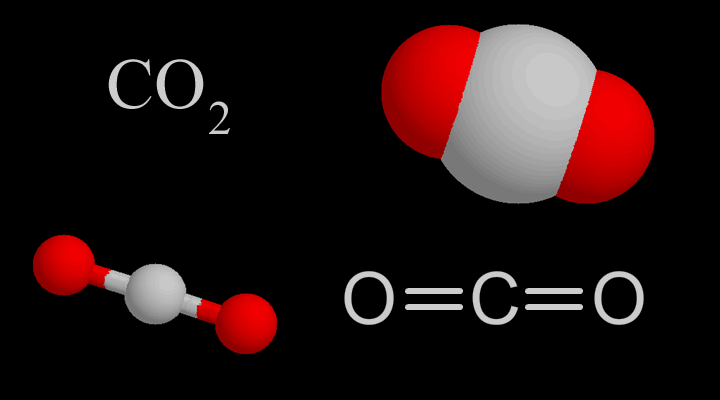
  • Matter: Atoms: Carbon, Oxygen; Molecules: Carbon Dioxide;
  • Energy: Fire: Thermal Energy (Heat); Light Energy
  • Life: Carbon-based: Trees

co2 molecule_720x400
*** *** *** The Carbon Dioxide Molecule *** *** ***

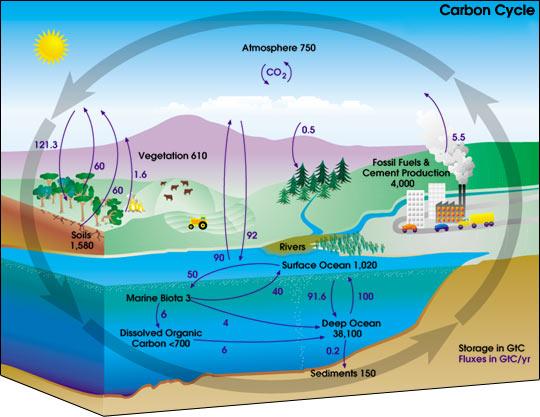
Carbon Cycle (With Ocean) Diagram

The Carbon Cycle: Ocean, Air, Trees…

To see more Richard Feynmann on Jiggling Atoms; Thermal Energy (Heat); Solid, Liquid, Gas, etc.

* Continue reading →