
Science Clarified » Real-Life Chemistry Vol 1
Category Archives: 1. MATTER
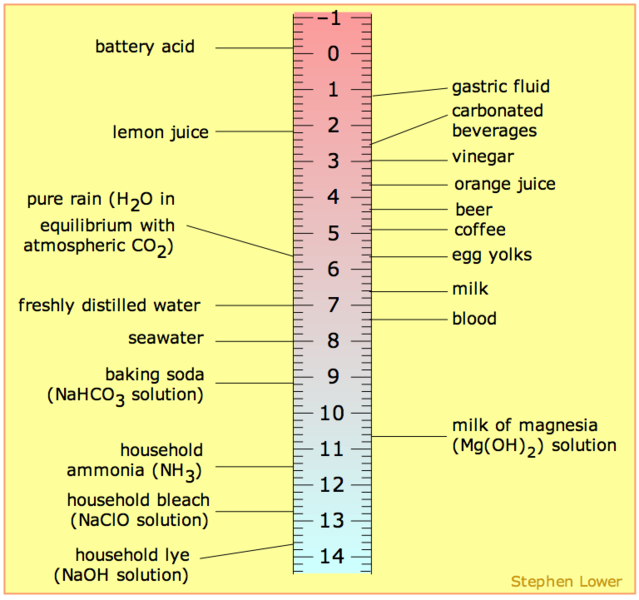
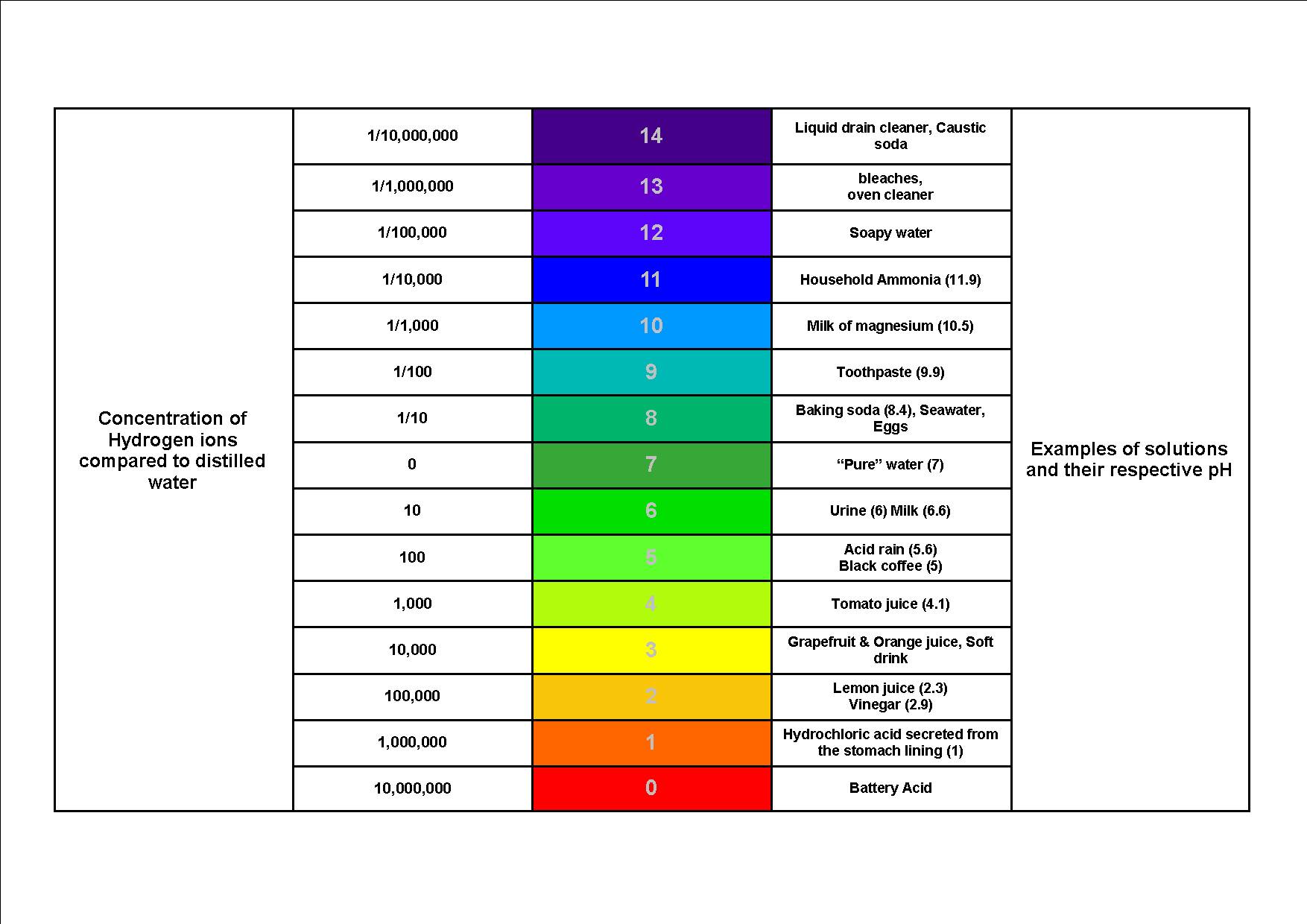
Characteristic pH (parts of Hydrogen) of various liquids (pH Scales)
****** ****** ******
The World of Mars – NYTimes.com
…our science team is composed not of nine men but of 472 men and women representing 13 different countries. In the 16 months since Curiosity’s arrival, we have already achieved our main goals. Just eight months into the mission, the rover discovered that beneath its six flight-grade aluminum wheels was the dried-out husk of an ancient streambed and lake of fresh water. The kind of water that could have supported simple microorganisms — low in salt, free of strong acid and full of nutrients. A human might even have been able to drink the stuff, though you may not have wanted to bottle it for resale.
The S.U.V.-size rover — with its laboratory of spectrometers, lasers, X-ray diffractometer, radiation detector, neutron generator, 17 cameras, and its own weather station — has pushed deep into the environmental records of early Martian history. Data from Curiosity show that sulfur, nitrogen, hydrogen, oxygen, phosphorus and carbon — some of the key chemical ingredients for life — were available to microbes, had they ever originated on Mars. These primitive organisms could have fed on the chemical energy stored in rocks and minerals, just like a flashlight bulb lights up by using the chemicals stored in a dry cell battery. It all depends on the state of mineral oxidation, the flow of electrons through rocks and microbes, and chemolithoautotrophy (if you want to get into it). Some microbes on Earth survive by consuming exactly this type of energy source. They eat rocks. Might the same have occurred on ancient Mars? It is pretty cool, and it brings us closer to finding out if life ever originated somewhere other than Earth.
As you read this, Curiosity is driving across a flat plain and closing the distance on the base of Mount Sharp, a massive mountain formed from a stack of layered rocks three times higher than the Grand Canyon is deep. Of course, moving forward at about half a football field per day, we are still many months away. That’s O.K. The roads are unpaved and the nearest mechanic is millions of miles distant.
Richard Feynman: Carbon and Oxygen, Fire, Carbon Dioxide… and Trees
- Matter: Atoms: Carbon, Oxygen; Molecules: Carbon Dioxide;
- Energy: Fire: Thermal Energy (Heat); Light Energy
- Life: Carbon-based: Trees
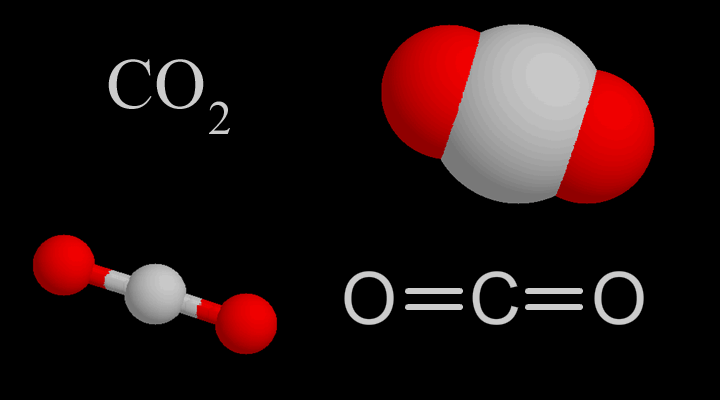
*** *** *** The Carbon Dioxide Molecule *** *** ***
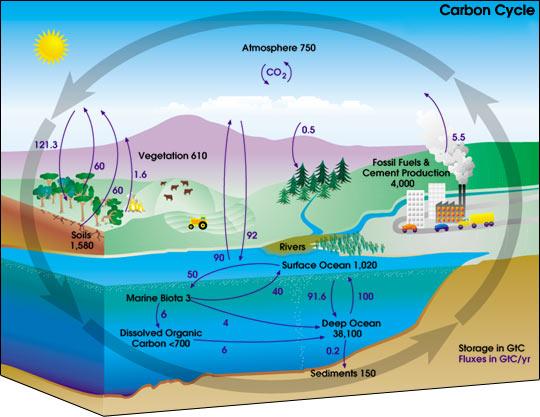
The Carbon Cycle: Ocean, Air, Trees…
To see more Richard Feynmann on Jiggling Atoms; Thermal Energy (Heat); Solid, Liquid, Gas, etc.
Energy Explained, in Two Pages! • Energy: the Ability to Move Matter (Do Work) …


Four Fundamental Forces – Wikipedia
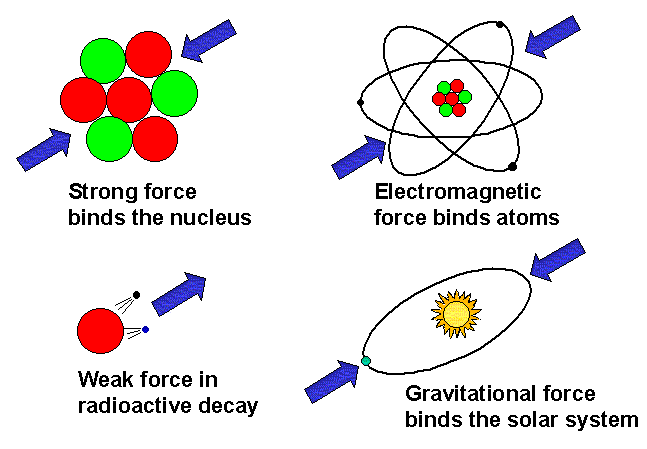
Fundamental interactions, also called fundamental forces
A force is defined as a push or pull* that changes an object or a particle’s state of motion or causes the object to deform. Newton defined a force as anything that caused an object to accelerate — F = ma, where F is force, m is mass and a is acceleration.
Four fundamental interactions are conventionally recognized:
- gravitational,
- electromagnetic,
- strong nuclear, and
- weak nuclear.
Everyday phenomena of human experience are mediated via 1. gravitation and 2. electromagnetism.
Matter and Energy TRANSFORMATIONS • Here’s What Happens When You Light a Fire in Space – Megan Garber – The Atlantic
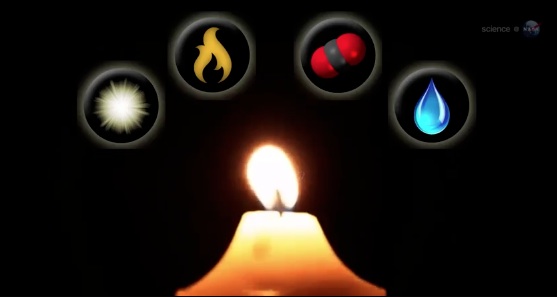
On Earth Fire Produces Light, Heat, CO2, Water, and Soot (Hydrocarbons)… and FLAME!
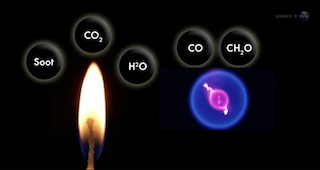
In Space things get weird… Fire Byproducts:
- On Earth (High Temp Flame: “Teardrop.” By-products: Soot, Carbon Dioxide, Water) vs
- In Space/in the MicroGravity of the Space Station (Lower Temp Flameless Fire: “Spherical.” By-products: Carbon Monoxide, Formaldehyde
“When it comes to fire,” says physics professor Forman A. Williams, “we’re just getting started.”
Take the flame of a candle, the kind you might find on a birthday cake. The flame takes the familiar shape — as, basically, a gaseous teardrop — because of gravity. The hot air rises and draws fresh, cool air behind it. The buoyancy makes the flame shoot up and flicker.
To watch video: Fire on the Space Station….
OTA STEM: Industrial Arts with 6th Grade
6th Graders Investigate Paper Airplane Designs
6th graders are busy investigating paper airplane designs in order to better understand how their changes affect their designs. Particular care is being given to observing changes in distance flown, height flown, and/or how many twists, loops or stunts the plane performs.
OTA Home Link (all 6th graders should be able to answer the following questions):
- What are some important characteristics of paper airplanes that make them fly farther?
- How does surface area affect how high or far a plane flies?
- What is center of mass and how does it affect the flight of paper airplanes?


7th – 8th Grade Rocket Launch!
OTA students study rocket science and aerodynamics in the STEM program.